Paving a Road for a Square-Wheeled Bicycle
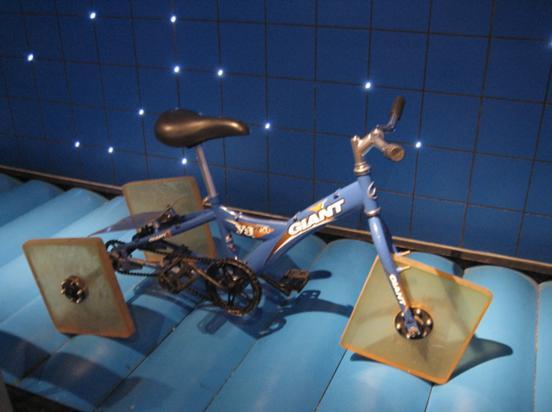 Square-wheeled bicycle
Have you ever seen a bicycle with square wheels? It's generally assumed that only round wheels can move a vehicle smoothly forward — but that's only true for flat, straight roads. Who says a road has to be flat? As long as you lay down the right kind of road, a bicycle with square wheels can roll forward just as smoothly! In this post, let's pave a road for a square-wheeled bicycle.
Actually, the square-wheeled bicycle is nothing new — it has long appeared in various science museums. As you can see from the pictures, its special track is made up of many arcs, each with a length equal to the side length of the square. As the wheel rolls forward, the square stays tangent to the arc (ensuring it doesn't slip). What curve is the shape of such a road? Fortunately, it isn't very complicated, and — surprisingly — it turns out to be a curve we've already studied before: the catenary! It turns out that designing such a track doesn't require a master designer at all — all you need is to hold a chain in your hand and let it hang freely...more
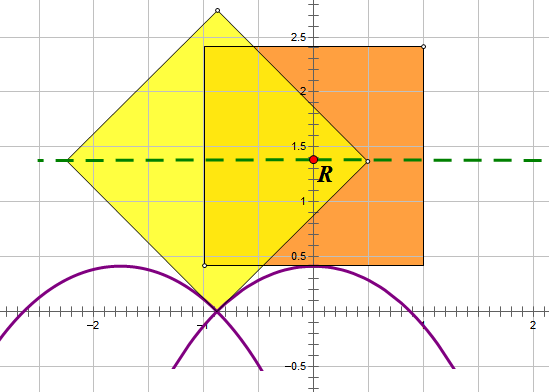 Square-wheel bicycle analysis 1
As shown in the figure, these are two special positions of the square wheel. Let the side length of the square be 2. From the figure, it's not hard to see that, taking the x-axis as the ground, the distance from the axle (R) to the ground is $\sqrt{2}$, and the distance from the midpoint of the top edge to the ground is $\sqrt{2}-1$.
Label each point as shown below:
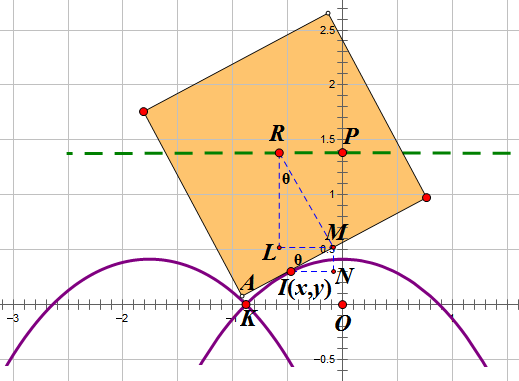 Square-wheel bicycle analysis 2
Let $y=y(x)$ be the equation of the track, where $I(x,y)$ is a point of tangency between the square wheel and the "road." According to the relationship between the road and the wheel, the length of segment AI must equal the length of arc KI. Denote this length by s; in the language of calculus, this is written as
$$s=\int_{x_0}^x \sqrt{dx^2+dy^2}=\int_{x_0}^x \sqrt{1+\dot{y}^2}dx$$
($x_0$ is a zero point at the left end)
At the same time, we have the following relation:
$$\begin{aligned}AI=s,MI=1-s,RM=1 \\ RM \cos\theta+MI \sin\theta+y=OP\end{aligned}$$
that is, $cos\theta+(1-s)sin\theta+y=\sqrt{2}$
Solving for s from this, and substituting $tan\theta=\dot{y}$, we get
$$s=1+\dot{y}^{-1}+y\sqrt{1+\dot{y}^{-2}}-\sqrt{2}\cdot \sqrt{1+\dot{y}^{-2}}$$
Equating the two expressions for s, we obtain an integral equation:
$$\int_{x_0}^x \sqrt{1+\dot{y}^2}dx=1+\dot{y}^{-1}+y\sqrt{1+\dot{y}^{-2}}-\sqrt{2}\cdot \sqrt{1+\dot{y}^{-2}}$$
To turn this into a more familiar differential equation, we differentiate both sides.
Differentiating the left-hand side gives
$$\sqrt{1+\dot{y}^2}$$
Differentiating the right-hand side gives
$$-\dot{y}^{-2}\ddot{y}+(y-\sqrt{2})\cdot \frac{-\dot{y}^{-2}\ddot{y}}{\sqrt{1+\dot{y}^2}}+\sqrt{1+\dot{y}^2}$$
After cancellation, this becomes:
$$\sqrt{2}-y=\sqrt{1+\dot{y}^2}$$
which can be rewritten as: $\frac{dx}{dy}=\frac{1}{\sqrt{(\sqrt{2}-y)^2-1}}$
that is
$$\begin{aligned}-x=\int \frac{1}{\sqrt{(\sqrt{2}-y)^2-1}} d(\sqrt{2}-y) \\ =arccosh(\sqrt{2}-y)+C\end{aligned}$$
which we rewrite as
$$y=-\cos h(-C-x)+\sqrt{2}=-\cos h(C+x)+\sqrt{2}$$
($cosh x$ is the hyperbolic cosine function, $cosh x=\frac{e^x+e^{-x}}{2}$)
From the initial conditions, we can deduce that C = 0, so the final equation of the track is
$$y=-\cos hx+\sqrt{2}$$
(taking only the part above the x-axis)
This is a catenary. What a marvelous curve!
Having solved this problem, readers will naturally wonder about a follow-up question: for a wheel shaped like an arbitrary regular n-gon, what shape must the road take for smooth forward motion?
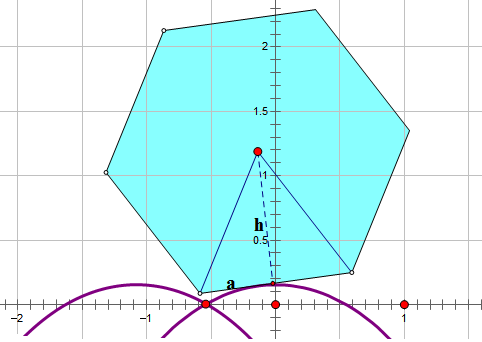 Regular hexagon wheel
The answer is delightfully simple — it doesn't get much more complicated at all; it's still just a catenary! As shown in the figure, let the side length of the regular n-gon be 2a and its height be h. Then the final answer is:
$$y=-h \cos h(\frac{x}{h})+\sqrt{a^2+h^2}$$
Taking h = 1 as the unit length, and using $a=h*tan(\frac{\pi}{n})$, we get:
$$y=-\cos h x+\sqrt{1+\tan^2(\frac{\pi}{n})}$$
This is nothing more than the track for the square wheel, shifted downward a little!
As n tends to infinity, the regular n-gon becomes a circle, and common sense tells us that the road should then be a straight line. But at this point, the road equation becomes $y=-cosh x+1$, and readers might wonder why this isn't a straight line. Anyone puzzled by this shouldn't forget that we've already specified that the track equation only takes the portion above the x-axis (y ≥ 0), and the full track is formed by joining these pieces horizontally. For this equation, only the single point (0,0) satisfies y ≥ 0 — and joining infinitely many copies of that single point together is precisely what forms a straight line!
And with that, our journey of paving a road for the square-wheeled bicycle comes to an end! This result leaves me marveling once again at the mysteries of nature. That a chain, hanging freely under gravity, should end up paving the very road for a square-wheeled bicycle — it feels as though some mysterious force is forever weaving together things that seem to have nothing to do with one another. Perhaps this is exactly what makes mathematics so thrilling.
Translated automatically with claude-sonnet-5; all equations are reproduced verbatim from the source. Copyright remains with the original author.