*Natural Extremes* Series — 7. The Catenary Problem
Johann corresponded with 110 scholars of his time, exchanging roughly 2,500 letters of academic discussion, many of which have become precious documents in the history of science — for instance, his correspondence with his brother Jacob, as well as with Leibniz, Huygens, and others, concerning the catenary, the brachistochrone (i.e. the cycloid), and the isoperimetric problem. Although these exchanges were full of disputes — Johann and Jacob in particular accused each other of being overly harsh, which often caused friction between the brothers — such arguments undoubtedly drove science forward, and the brachistochrone problem in particular gave birth to the calculus of variations.
Interestingly, in 1690 Johann Bernoulli's older brother Jacob Bernoulli posed the catenary problem as a challenge to the mathematical community, namely:
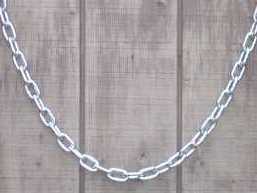
Fix both ends of a chain (necklace) and let it hang naturally under gravity. Find the equation of the curve it forms.
The drooping steel cable of a suspension bridge, a dew-laden spider's web, the wires strung between telephone poles — all of these trace out catenaries. Galileo was the first to notice the catenary curve and guessed that it was a parabola. In 1691, Leibniz, Huygens, and Johann Bernoulli each independently arrived at the correct answer, using the newly born methods of calculus. more
With the knowledge we've already gathered in the Natural Extremes series, let us try to solve this problem ourselves. There is no doubt that once the "chain" has reached equilibrium, we can regard its gravitational potential energy as having reached a minimum. Although this may feel a bit like "taking things for granted," everyday experience tells us it must be so: the equilibrium-state axiom tells us that minimal potential energy implies equilibrium, and a hanging chain can only settle into one equilibrium state.
Given that its gravitational potential energy has reached a minimum, the problem becomes one of finding, among curves of fixed length, the one whose gravitational potential energy is smallest — exactly the same type of problem as the earlier "brachistochrone," which falls under the calculus of variations. In other words, the brachistochrone and catenary problems are essentially the same in nature.
Let the shape of the curve be $y=y(x)$, with the x-axis representing the ground. Suppose the chain is uniform with linear density 1; then each small segment $ds=\sqrt{dy^2+dx^2}$ has mass $dm=ds=\sqrt{dy^2+dx^2}$, and its height is y, so the gravitational potential energy of this small piece is $dE_p=gy dm=gy\sqrt{dy^2+dx^2}=gy\sqrt{\dot{y}^2+1}dx$. Again, since we are only interested in the shape of the curve, let us set g = 1. The problem then becomes one of finding the function y(x) that minimizes
$$\int_{x_1}^{x_2} y\sqrt{\dot{y}^2+1}dx$$
In the sixth article of this series, we derived formula (1):
$v^2(1+\dot{y}^2)=Const$————(1)
and pointed out that when the expression for v depends only on y, the function that minimizes
$$t=\int_{x_1}^{x_2} \frac{\sqrt{\dot{y}^2+1}dx}{v}$$
can be computed from equation (1).
For the present problem, we can set $v=\frac{1}{y}$; substituting into (1) gives $\frac{1+\dot{y}^2}{y^2}=C$,
which can be rearranged into $dx=\frac{1}{\sqrt{C}}\frac{d(\sqrt{C}y)}{\sqrt{(\sqrt{C}y)^2-1}}$. Integrating (using this integral formula, and placing the curve in the first quadrant so that both x and y are positive) gives
$$x=\frac{1}{\sqrt{C}}ln|\sqrt{C}y+\sqrt{Cy^2-1}|+C_2=\frac{1}{\sqrt{C}}arcosh(\sqrt{C}y)+C_2$$
Mathematicians tend to prefer the rightmost form (in terms of hyperbolic functions) to describe this shape. By making a suitable choice (that is, translating the curve, i.e. shifting the position of the starting point) so that $C_2=0$, this can be simplified to
$$y=\frac{1}{\sqrt{C}}\cos h(\sqrt{C}x)$$
This is the final equation of the catenary. All that remains is to fit it to the actual length of the chain — a task we leave to the reader to think through on their own. ^_^
Readers might also like to ponder a somewhat more complex question:
Suppose we had a chain large enough that its span reached the length of Earth's radius. What shape would such a chain take? In other words, the gravitational field is no longer uniform, and only Earth's gravity is considered.
Discussion thread: http://bbs.spaces.ac.cn/topic.php?id=4
We are now nearing the end of the Natural Extremes series. Next, we need to do some purely analytical work. Although this may be somewhat dry, it is unavoidable — analytical work of this kind lets us see more clearly into the essence of a problem and guides us toward the right direction, rather than letting us become so intoxicated by superficial beauty that we lose our way. Through the analysis that follows, we will come to understand the general idea behind finding extrema, and from it we will derive one of the fundamental equations of the calculus of variations — the Euler–Lagrange equation.
Translated automatically with claude-sonnet-5; all equations are reproduced verbatim from the source. Copyright remains with the original author.