The Nature of Extremes Series — 6. Solving the Brachistochrone
Through the little story in the previous section, we now have a basic grasp of what the brachistochrone problem is about: we need to find an unknown function that satisfies some extremal condition. Since the function itself is unknown, this kind of problem is called "functional analysis" (calculus of variations). We also mentioned that Bernoulli cleverly arrived at the answer using Fermat's principle. Now let's revisit that history, retrace Bernoulli's reasoning, and look for further applications.
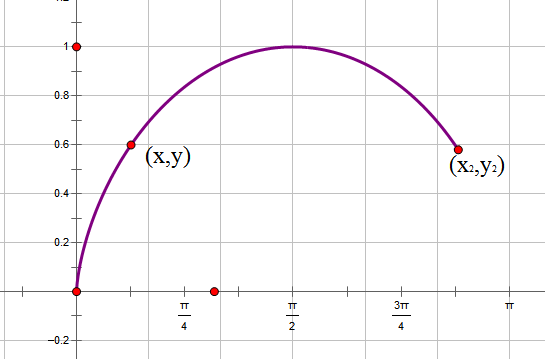 Brachistochrone-1
For computational convenience, we flip the brachistochrone upside down and place the starting point at the origin. During the fall, gravitational potential energy converts into kinetic energy, so at point (x,y) we have $\frac{1}{2} mv^2=mgy\Rightarrow v=\sqrt{2gy}$. Since we're purely interested in the shape of the curve, we set g=0.5, giving $v=\sqrt{y}$. The distance traveled up to point (x,y) is $ds=\sqrt{dy^2+dx^2}=\sqrt{\dot{y}^2+1}dx$, so the time is $dt=\frac{ds}{v}=\frac{\sqrt{\dot{y}^2+1}dx}{\sqrt{y}}$. Thus the brachistochrone problem becomes finding the function that minimizes $t=\int_0^{x_2} \frac{\sqrt{\dot{y}^2+1}dx}{\sqrt{y}}$. more
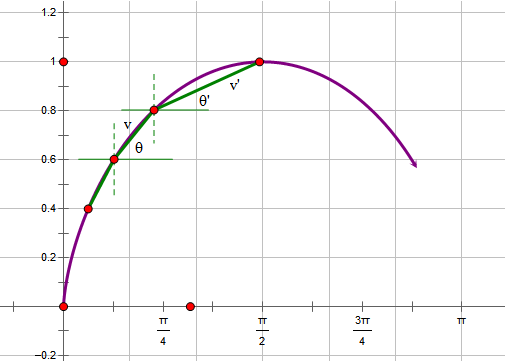 Brachistochrone-2
Following Bernoulli's approach, we treat the brachistochrone as a light path, dividing it into infinitely many equal horizontal segments. Each segment must then satisfy the law of refraction of light, as shown in the figure, which gives us
$$\frac{v}{\cos\theta}=\frac{v'}{\cos\theta'}=...=Const$$
where Const denotes a constant. Since
$$\cos\theta=\frac{1}{\sqrt{1+\tan^2 \theta}}=\frac{1}{\sqrt{1+\dot{y}^2}}$$
we obtain
$$v^2(1+\dot{y}^2)=Const\tag{1}$$
Note that we haven't yet used the condition $v=\sqrt{y}$ — in other words, equation (1) is not specific to this particular problem. So what kind of problems can equation (1) be applied to? The answer is: problems where "the expression for the speed v depends explicitly only on y." In other words, whenever v depends explicitly only on y, the function that minimizes
$$t=\int_{x_1}^{x_2} \frac{\sqrt{\dot{y}^2+1}dx}{v}$$
can be computed from equation (1).
Why is this the case? We need to recall a bit of optics. Applying the law of refraction first requires constructing the "normal," and how is the normal constructed? Well, it is perpendicular to the tangent plane of the interface between the two different media. The different behavior of light in the two media is precisely a difference in propagation speed; therefore, in mathematical terms, "the interface between two different media" is an equal-speed surface.
If $v=v(x,y)$, then clearly, the equal-speed surface for each value of speed (which, in two dimensions, degenerates into an equal-speed curve) can be written as $v_c=v(x,y)$, where $v_c$ is a constant representing the speed. Given this, differentiating both sides yields (this is getting a bit deep — the following expression involves partial derivatives, so readers unfamiliar with them can skip it)
$$0=\frac{\partial v}{\partial x}+\frac{\partial v}{\partial y}\dot{y}=0\tag{2}$$
This lets us find the slope of the speed-level surface (curve) at the point (x,y). For the case where v depends explicitly only on y, $\dot{y}$ is identically zero, so every normal is perpendicular to the x-axis. That's precisely why we can follow Bernoulli's approach of "dividing it into infinitely many equal horizontal segments" — otherwise this step wouldn't even hold. For the case where v is not purely a function of y, we can still use equation (2) to find the slope and then work out the angle — cumbersome, but it works; however, if v also contains derivative terms such as $\dot{y}$, then this approach breaks down.
Returning to the brachistochrone problem, substituting $v=\sqrt{y}$ into (1) gives
$$y(1+\dot{y}^2)=C_1$$
$\dot{y}=\sqrt{\frac{C_1}{y}-1}$, that is, $x=\int \sqrt{\frac{y}{C_1-y}}dy$
Setting $y=C_1(\frac{1}{2}-\frac{1}{2} cos 2t)=C_1 sin^2 t$ and substituting gives $x=\int 2C_1 sin^2 t dt=C_1(t-\frac{1}{2} sin 2t +C_2)$; from the initial condition that the curve passes through (0,0), we get $C_2=0$; the other constant can be determined from another point. Thus the brachistochrone is
$$\begin{aligned}x=C_1(t-\frac{1}{2} \sin 2t) \\ y=C_1(\frac{1}{2}-\frac{1}{2} \cos 2t)\end{aligned}$$
As we can see, this is a cycloid, also known as a roulette curve or a tautochrone (isochrone) curve.
[Definition of the Cycloid]
 Cycloid (Roulette)
The cycloid is one of the many fascinating curves in mathematics. It is defined as follows: as a circle rolls slowly along a straight line, the path traced out by a fixed point on the circle is called a cycloid.
Its parametric equations are
$$x=r(t- \sin t),y=r(1- \cos t)$$
By the 17th century, people had discovered that the cycloid has the following properties:
- Its arc length equals four times the diameter of the rolling circle. What's especially interesting is that this length is a rational number that does not depend on π.
- The area under the arc is three times the area of the rolling circle.
- The point on the circle that traces out the cycloid moves at varying speeds — in fact, at certain positions it is even momentarily at rest.
- When marbles are released from different points inside a container shaped like a cycloid, they all reach the bottom at the same time.
Translated automatically with claude-sonnet-5; all equations are reproduced verbatim from the source. Copyright remains with the original author.