The Natural Extremes Series — 5. The Story of the Brachistochrone
If the earlier installments of this series haven't quite scratched your itch yet, then the brachistochrone and catenary problems coming up may well be what you're looking for. But before we dive into the theoretical treatment of the brachistochrone problem, let's first tell the story of a thrilling mathematical contest that took place in the 17th century. I believe that every friend who loves mathematics and physics will be stirred and moved by it. What it embodies is not merely an academic rivalry, but the tireless spirit of generation after generation of people pursuing truth and blazing new trails.
(The following content is compiled by Kexue.fm from material found online.)
In 1630 the Italian scientist Galileo posed a fundamental problem of analysis: "A point mass, under the action of gravity and moving without friction, slides from a given point A to another point B that does not lie directly below it — along what curve should it slide so that the time taken is the shortest?" This can be regarded as the origin of this famous problem (why hadn't anyone else thought of it? This just shows that the mark of a great scientist is the ability to think, to innovate, to have ideas — a person without ideas is little different from a walking corpse). Unfortunately, Galileo claimed the curve was a circle, which turned out to be the wrong answer.
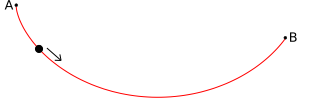 Brachistochrone more
In 1696 the Swiss mathematician Johann Bernoulli raised this brachistochrone problem again, soliciting solutions from mathematicians across Europe. Bernoulli called it the "Brachistochrone," a term formed from the Greek words for "shortest" (brachistos) and "time" (chronos).
Naturally, people first thought of the straight line connecting A and B. But Bernoulli said: "Although the segment AB is the shortest distance, it is not the path along which the ball descends in the shortest time. If by the end of the year (1696) no one has found this curve, I will announce it myself." A straight line might not be the path of shortest time, because since the ball starts from rest, the path should initially be steeper, so as to accelerate the ball more quickly and give it speed.
This was a bit like a challenge thrown down in a wuxia novel — clearly Bernoulli himself had already worked out the answer before daring to issue such a challenge. The difficulty of the problem lay in the fact that one had to find a curve — which really amounted to finding an unknown function satisfying certain given conditions — something that had never been done before, and which stood to open up an entirely new field of mathematics. Mathematicians were thus tremendously excited, and research flourished.
Bernoulli's original deadline was the end of 1696, but he received only one solution — from his own teacher, Leibniz (one of the independent inventors of calculus, and himself a great mathematician). Leibniz asked Bernoulli to extend the deadline to the following Easter (roughly late March to late April), to give European mathematicians more time to fully work out this difficult problem.
Interestingly, in his "letter of challenge" Bernoulli specifically hinted at the identity of his intended target, writing: "…few can solve our unique problem, even among those who boast that, through their special methods… they have not only penetrated deeply into the secrets of geometry, but have extended its domain in extraordinary ways — such people believe that their great theorems are known to no one, when in fact they have already been published by others."
This was nothing less than a barely veiled shot at the great Isaac Newton! The "theorems" Bernoulli referred to were clearly the method of fluxions (Newton's own name for calculus), and Newton had claimed that he had discovered this theory well before Leibniz published his 1684 paper on calculus. As mentioned earlier, Leibniz was Bernoulli's teacher, and since his master was locked in a priority dispute with Newton over the invention of calculus, the disciple was not about to let the matter rest and would defend his school's honor. Johann Bernoulli personally copied out the brachistochrone problem and sent it in a sealed envelope to England — to Newton.
By this time, however, Newton was no longer the Newton of old. He himself admitted that his mind was no longer as sharp as it had been twenty years earlier, and moreover he was busy all day with the mundane affairs of the Royal Mint. On this episode, we may look at the account left by Newton's niece Catherine: "One day in 1697, when the problem sent by Bernoulli arrived, Sir Isaac Newton was busy at the Mint with the recoinage, and did not return home, utterly exhausted, until very late. But he did not go to bed until he had solved the problem — and by then it was four o'clock in the morning."
Even in his later years, and after a full day's work at his official post, Newton still managed to solve in a few hours a problem that had defeated many European mathematicians! This gives us a glimpse of the sheer power of this great genius. Newton felt that his honor and reputation as the leading authority of his generation were being challenged, and that his rivals were waiting to see him fail — so he rose to the occasion and solved the problem in just a few hours. Newton, it is said, was infuriated, reportedly declaring: "I do not love to be… teased by foreigners about mathematical things." (Of course, if you don't have the ability, all you can do is be teased.)
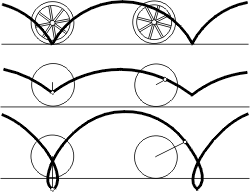 Cycloid
By the Easter 1697 deadline, Bernoulli had received five solutions in total: his own, one from his teacher Leibniz, a third from his brother Jakob Bernoulli — which surely irritated Johann no end, since the two brothers never conceded to one another and were forever locked in rivalry — a fourth from l'Hôpital, and finally one whose envelope bore an English postmark. Interestingly, this last one was submitted anonymously, yet its answer was entirely correct! Clearly this letter came from a supreme genius, and could only be from Isaac Newton. As the story goes, Bernoulli, half annoyed and half in awe, set down this anonymous solution and remarked knowingly: "I recognize the lion by his claw."
Apart from l'Hôpital's solution, all the others were published in the May 1697 issue of the Acta Eruditorum. The answer was a segment of a cycloid — a curve that Pascal and Huygens had studied before, though neither of them had realized it was also the curve of quickest descent. Because a pendulum bob takes the same time to complete a full swing regardless of amplitude along this curve, the cycloid is also known as the isochrone.
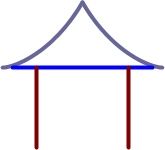 Large roof
The brachistochrone also finds a beautiful application in architecture. In traditional Chinese architecture, the "large roof" (大屋顶) — when viewed from the side, the two slanted sides of what looks like an "isosceles triangle" are not straight line segments, but rather two segments of brachistochrone curves. Designed this way, during a sudden summer downpour, the rainwater falling on the roof can drain away as quickly as possible, helping to protect the building.
Challenges in the history of mathematics are nothing new, but this particular brachistochrone challenge may well be the most thrilling in the history of mathematics, for several reasons:
First, a great many people took part. Second, everyone who arrived at the correct answer was a towering figure in mathematics. Newton and Leibniz had each independently founded calculus; the Bernoulli family, represented here by the two brothers, was a dynasty of mathematicians, a bit like the Bach family was to music. L'Hôpital had shown mathematical talent from a young age, solving Pascal's cycloid problem at the age of fifteen (a feat that today's whiz kids preparing for middle-school entrance exams still have a few years to go before matching). The famous l'Hôpital's rule, which everyone becomes familiar with in calculus courses, bears his name to this day.
Third, each participant's solution had its own distinct flavor. Johann Bernoulli's solution was the most elegant: drawing an analogy with Fermat's principle, he fused physics and geometry together, arriving at the answer through an optical line of reasoning (a bit like a flashy trick in a math olympiad, if you will). Jakob's method was the most general, embodying the spirit of the calculus of variations. Newton, Leibniz, and l'Hôpital all used methods of calculus (as opposed to variational methods, calculus was by then considered the "traditional" approach), though their specific steps differed.
Animated demonstration:
Finally, this problem directly paved the way for the entrance of another peerless genius — the great mathematician Leonhard Euler (a student of Johann Bernoulli), who from 1726 onward began publishing related works, and in 1728, with his characteristic thoroughness, revisited the brachistochrone and related problems, ultimately establishing a general method for solving problems of extremizing integrals. Euler's methods were later developed further by Lagrange, who was the first to place the calculus of variations on a rigorous analytical footing, and who made full use of it in building his system of analytical mechanics — reducing the whole of mechanics to a single unifying variational principle, the principle of virtual work.
These new branches, together with calculus itself, formed the vast domain known as "analysis," which stood alongside algebra and geometry as the third great branch of mathematics — and in the eighteenth century, it flourished far beyond either algebra or geometry.
Eighteenth-century mathematicians not only vastly expanded the territory of analysis, but also gave it a meaning set in contrast to geometry: they strove to use purely analytical methods to free themselves from dependence on geometric argument. This tendency became another defining feature of eighteenth-century mathematics, and it found its most typical expression in the work of Euler and Lagrange.
In the preface to his Analytical Mechanics, Lagrange declared: "One will not find any diagrams in this work. The methods I present require neither constructions nor geometrical or mechanical reasoning, but only algebraic (analytical) operations, subject to a uniform and regular procedure."
Translated automatically with claude-sonnet-5; all equations are reproduced verbatim from the source. Copyright remains with the original author.