Quaternions and Their Deep Connection to Vectors
When we use vectors for geometry and physics, have we ever stopped to think that vectors actually originated from "numbers"?
Before vectors were developed (although the idea of a "quantity with both magnitude and direction" had long been recognized), complex numbers had already been accepted and put to preliminary use. When we associate complex numbers with vectors, we might assume that it was because the operations on complex numbers represented on the complex plane resemble vector operations that complex numbers came to be linked with geometry. In fact, the reverse is true: vectors gradually split off from research into complex numbers and even something called "quaternions." In other words, there was a period in history when "quaternions" and vectors developed as separate approaches to geometry. Maxwell separated the scalar part and the vector part of quaternions, treating them as distinct entities, and carried out a great deal of vector analysis. The formal establishment of three-dimensional vector analysis, and its formal split from quaternions, was accomplished independently by Gibbs and Heaviside in the 1880s. Vector algebra was then extended to vector-valued functions and vector calculus, which set off a debate between quaternions and vector analysis—one that vector analysis ultimately won. As a result, "quaternions" gradually disappeared from textbooks. Nevertheless, some particularly clever and specialized applications of quaternions still keep them from being forgotten. more
What exactly is a quaternion? Let's first look at how complex numbers came about. As we all know, once $i^2=-1$ is introduced, the extra "imaginary number" combines with the real numbers to form the set of complex numbers. But we can set aside that story and instead treat complex numbers abstractly, as a purely formal "symbol": a complex number is a number of the form $a+bi$, where a and b are real numbers, and arithmetic follows the usual rules for real numbers, except that whenever two i's are multiplied together, the result is recorded as -1; in all other cases the symbol i is simply retained (that is, we don't need to worry about what i "actually is"). The benefit of "inventing" such a number is that it turns out to be convenient for studying geometry and physics. In other words, we don't need to worry about what this kind of number really represents—we only need to know that it makes things easier for us, letting us reach results relatively conveniently. That's enough.
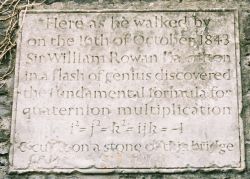 Commemorative stone carving on Broom Bridge
Once the theory of complex numbers had developed, people came to realize that real numbers are a kind of "one-dimensional number"—that is, the points on a single number line correspond one-to-one with all real numbers—while complex numbers are a kind of "two-dimensional number," requiring a plane (the complex plane) to establish a one-to-one correspondence with points. At this point, the Irish mathematician William Rowan Hamilton set out to construct a "three-dimensional number." It was supposed to have properties similar to those of complex numbers, requiring a three-dimensional space for its one-to-one correspondence, taking the form $a+bi+cj$, where a, b, c are real numbers, i is exactly the imaginary unit from complex numbers, and j is a unit similar to but independent of 1 and i. This is equivalent to saying that complex numbers form a subset of his envisioned "three-dimensional numbers." Such "invention" is easy enough—we can readily follow the same pattern to write down "four-dimensional numbers," "five-dimensional numbers," and so on. The key question is whether such numbers can actually be made to work. Hamilton required that $j^2=-1$ (but note that $i != j$), leaving the remaining question of considering $ij=?$.
Hamilton proposed several requirements for "n-dimensional numbers":
An "n-dimensional number" takes the form $a_0+a_1 i_1+a_2 i_2+...+a_{n-1} i_{n-1}$, where $i_1^2=i_2^2=...=i_{n-1}^2=-1$, analogous to the imaginary unit in complex numbers; its "modulus" is defined as $r=\sqrt{a_0^2+a_1^2+...+a_{n-1}^2}$;
By setting a universal result for $i_p \cdot i_q (p != q)$, the modulus of the product of two "n-dimensional numbers" should equal the product of their moduli (this is called the "modulus law").
The distributive law of multiplication must hold.
It's not hard to see that complex numbers satisfy these rules. Hamilton used these requirements to work out his envisioned "three-dimensional numbers"—in other words, to compute $ij=?$. First, a reminder for the reader: once we introduce "three-dimensional numbers" and other such "hypercomplex numbers," arithmetic no longer necessarily follows the rules we're used to. For example, before we've pinned down the specific properties of three-dimensional numbers, we can't assume that the square root of 1 is only $+-1$.
Let's start with the simplest case and consider $ij=A$. By the "modulus law," we should have |A|=1, so let's set $A=x+yi+(+-\sqrt{1-x^2-y^2})j$.
Next consider $i(i+j)$. We have $i(i+j)=-1+ij=(-1+x)+yi+(+-\sqrt{1-x^2-y^2})j$, and by the modulus law, $(-1+x)^2+y^2+(1-x^2-y^2)=(-1+x)^2+1-x^2=2$, from which we compute x=0.
Building on this calculation, we've already found some clues and can push the derivation further. Applying the modulus law again to $(1+i)(i+j)=-1+i+j+ij=(-1+x)+(y+1)i+(1+-\sqrt{1-x^2-y^2})j$, and having already found x=0, substituting gives $-1+(y+1)i+(1+-\sqrt{1-y^2})j$, $|(1+i)(i+j)|^2=4=(-1)^2+(y+1)^2+(1+-\sqrt{1-y^2})^2$, and hence $y = +-1/sqrt{2}$. It looks like we should be celebrating already?
To be careful, let's check one more case, $(1+i)j=j+ij=x+yi+(1+-\sqrt{1-x^2-y^2})j$. Substituting x=0 gives $(1+i)j=yi+(1+-\sqrt{1-y^2})j$, $2=y^2+(1+-\sqrt{1-y^2})^2$, and hence $y=+-1$—which contradicts the result above!
We find that this contradiction simply cannot be resolved. In the end, we're forced to conclude: "three-dimensional numbers" do not exist!
After going through this derivation, you might feel a bit disheartened: if three-dimensional numbers don't even exist, then surely there's no point considering four-dimensional numbers either. But that's not how it turned out. On October 16, 1843, the mathematician Hamilton mentioned at the beginning of this article discovered what we now call "quaternions"—a four-dimensional number. It takes the form $a+bi+cj+dk$. You might think: why not just set d=0 and get back to three-dimensional numbers? Not so fast—first let's look at the rules of arithmetic for these four-dimensional numbers:
i2=j2=k2=-1
ij=k, jk=i, ki=j
ji=-k, kj=-i, ik=-j
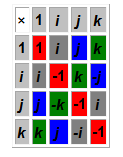 Quaternion multiplication table
Even though setting d=0 makes k disappear, multiplying i and j together still brings k back into existence, so we're forced to consider "quaternions" after all. All these rules can be derived one by one using the same method we just used to work out three-dimensional numbers. It's also easy to see that quaternion multiplication does not satisfy commutativity (AB is not necessarily equal to BA), which can be shown by computing squares. Interested readers are welcome to work through the details themselves.
The day after discovering "quaternions," Hamilton wrote a letter to a friend, John T. Graves, reporting his discovery. Based on Hamilton's work, Graves went on to generalize it into what he called "octaves" (or octonions)—a new kind of number containing Hamilton's quaternions. Like quaternions, these octonions support addition, subtraction, multiplication, and division. Hamilton was delighted by Graves's generalization and studied these octonions in detail, discovering that their multiplication does not satisfy associativity—in general, for three octonions A, B, C, one finds A×(B×C)≠(A×B)×C. The British mathematician Cayley also independently discovered octonions. (Because Cayley was more famous, later generations came to refer to octonions as "Cayley numbers.")
On January 4, 1844, John Graves wrote to Hamilton reporting the basic multiplication rules he had discovered for octonions:
i2=j2=k2=l2=m2=n2=o2=-1
i= jk = lm = on =-kj =-ml =-no
j= ki= ln= mo= -ik= -nl= -om
k= ij =lo= nm= -ij= -ol= -mn
l=mi=nj=ok=-im=-jn=-ko
m=il=oj=kn=-li=-jo=-nk
n=jl=jo=mk=-lj=-oi=-km
o=ni=jm=kl=-in=-mj=-lk
One of the key practical applications of quaternions concerns the rotation of solid bodies. To learn more, you may also refer to the attachment to this article. This article is meant simply to give a brief account of the development of quaternions and the broader expansion of the concept of "number." If the opportunity arises in the future, I will certainly discuss the applications of quaternions with readers in more detail.
For more on quaternions, see: http://zh.wikipedia.org/zh-cn/%E5%9B%9B%E5%85%83%E6%95%B8
For more on Hamilton, see: http://www.math123.cn/sxxs/588.htm
Attachment: Quaternions.pdf
Translated automatically with claude-sonnet-5; all equations are reproduced verbatim from the source. Copyright remains with the original author.