The "Vectors" Series — 4. Turning the World Upside Down (Vectors, Complex Numbers, Polar Coordinates)
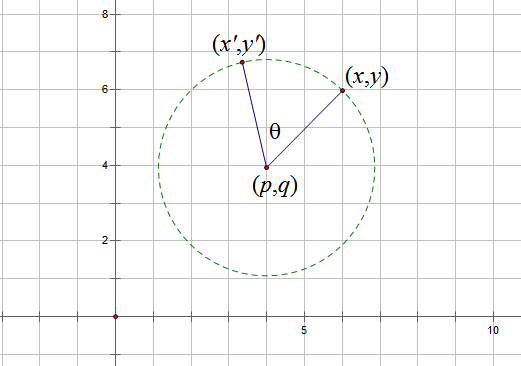 Coordinate rotation
As shown in the figure, the coordinate (x, y) is rotated counterclockwise by angle θ about the point (p, q) to obtain the coordinate (x', y'). Find the expressions for x', y' in terms of x, y. more
We've discussed this problem before, in the post "Formula for Rotating Function Graphs"], where it was analyzed using methods from analytic geometry. That post was written back in February, before I had systematically studied vectors and complex numbers. Now, from the perspectives of vectors and complex numbers respectively, BoJone will give two proofs of the rotation formula, for reference only — please point out any errors.
To simplify the problem, let's first perform the following translation:
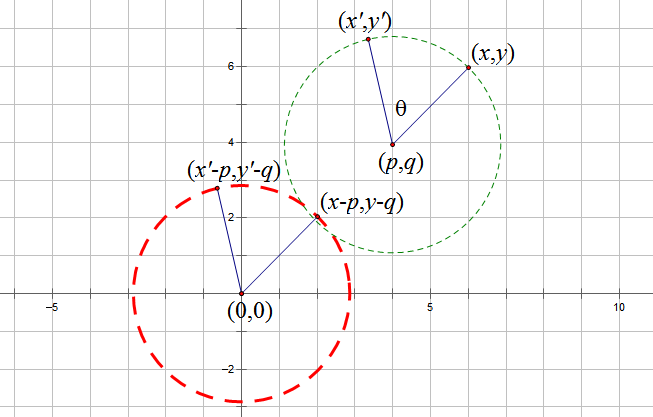 Coordinate rotation - translation
This way we only need to discuss the case where the center of rotation is at the origin. First, let's solve it using vectors. The two points, before and after rotation, are represented as vectors $\vec{A}=(x-p,y-q,0),\vec{B}=(x'-p,y'-q,0),|\vec{A}|=|\vec{B}|=R$, so we have $\vec{A}\times\vec{B}=(0,0,(x-p)(y'-q)-(x'-p)(y-q))$, and
$$\vec{A}\cdot \vec{B}=R^2 \cos\theta=(x-p)(x'-p)+(y-q)(y'-q)\tag{1}$$$$|\vec{A}\times\vec{B}|=|R^2 \sin\theta|=|(x-p)(y'-q)-(x'-p)(y-q)|\tag{2}$$
Consider the case of $0 < \theta <\pi$:
From $(1)\times (y-q)+(2)\times (x-p)$ we get
$$\begin{aligned}(y'-q)[(y-q)^2+(x-p)^2]=R^2[(y-q)\cos\theta+(x-p)\sin\theta] \\ y'-q=(y-q)\cos\theta+(x-p)\sin\theta\end{aligned}\tag{3}$$$(1)\times (x-p)+(2)\times (y-q)$gives
$$\begin{aligned}(x'-p)[(y-q)^2+(x-p)^2]=R^2[(x-p)\cos\theta-(y-q)\sin\theta] \\ x'-p=(x-p)\cos\theta-(y-q)\sin\theta\end{aligned}\tag{4}$$
(3) and (4) are the coordinate rotation formulas. The form is the same when $\pi < \theta <2\pi$.
Next, let's solve it using complex numbers. As we know, complex numbers can be represented on the complex plane, and when two complex numbers are multiplied, the result is also a complex number whose modulus equals the product of the moduli of the factors, and whose argument equals the sum of their arguments. So let's use $z_1=(x-p)+(y-q)i$ to represent the point before rotation, and $z_2=(x'-p)+(y'-q)i$ to represent the point after rotation. It's clear that z2 is obtained by multiplying z1 by a complex number with modulus 1 and argument θ; it's not hard to see that this complex number is $cos\theta+i*sin\theta$. That is,
$$\begin{aligned}[(x-p)+(y-q)i]\cdot [\cos\theta+(\sin\theta)i]=(x'-p)+(y'-q)i \\ [(x-p)\cos\theta-(y-q)\sin\theta]+[(y-q)\cos\theta+(x-p)\sin\theta]i \\ =(x'-p)+(y'-q)i\end{aligned}$$
By the condition for equality of complex numbers, we then have
$$\begin{aligned}y'-q=(y-q)\cos\theta+(x-p)\sin\theta \\ x'-p=(x-p)\cos\theta-(y-q)\sin\theta\end{aligned}$$
A key point when using complex numbers to solve geometry problems is applying the condition for the equality of complex numbers: "real part = real part, imaginary part = imaginary part." This sometimes lets us bring the problem back into the realm of real numbers, where we can then apply known techniques to solve it. To make better use of complex numbers in geometry, one also needs to be familiar with how they're used on the complex plane — the key is understanding the geometric meaning of operations on complex numbers.
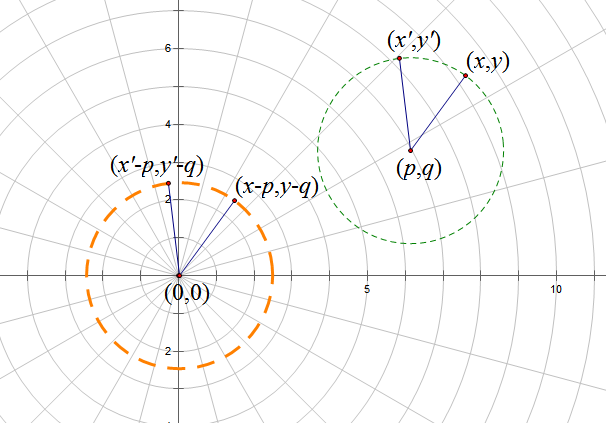 Coordinate rotation - polar coordinates
Finally, let's look at a derivation using polar coordinates. From the figure above, we can see that
$$x-p=r \cos f,y-q=r \sin f,r=\sqrt{(x-p)^2+(y-q)^2}$$
and also that
$$\begin{aligned}x'-p= r \cos (f+\theta)=r \cos f \cos\theta-r \sin f \sin\theta=(x-p)\cos\theta-(y-q)\sin\theta \\ y'-q= r \sin (f+\theta)=r \sin f \cos\theta + r \cos f \sin\theta=(y-q)\cos\theta+(x-p)\sin\theta\end{aligned}$$
This completes the proof.
Translated automatically with claude-sonnet-5; all equations are reproduced verbatim from the source. Copyright remains with the original author.