The Trigonometric Solution of Cubic Equations
When it comes to solving equations, algebraists want to theoretically prove the existence of solutions as well as how to find them—which is how we ended up with important theories such as the root-finding formulas for degree 1 through 4 equations, and the fact that general algebraic equations of degree 5 or higher cannot be solved by radicals. However, ordinary practitioners (physicists, astronomers, and the like) usually don't need any of this. They only care about finding the roots of a given equation as quickly as possible (especially the real roots), so what they're typically after are numerical algorithms for the equation. Of course, if there happens to be a reasonably simple root-finding formula available, that's welcome too. What follows is a root-finding formula for cubic equations that meets exactly this need, and a good deal of the theory involved is related to trigonometric functions.
Preliminaries
\begin{equation}\frac{2}{\tan 2A}=\frac{1}{\tan A}-\tan A\end{equation}
\begin{equation}\frac{2}{\sin 2A}=\frac{1}{\tan A}+\tan A\end{equation}
\begin{equation}\cos(3A)=4\cos^3 A-3\cos A\end{equation}
Approach
Here we only discuss how to solve the cubic equation $x^3+ax^2+bx=c$, since this form of cubic is more representative in practical applications. Any such cubic equation can, through a transformation, be turned into the form $y^3+mx=n$, and then further transformed into $z^3\pm 3z=p$. The form $z^3\pm 3z=p$ admits a relatively simple solution method, so this lets us solve for the roots of the cubic in a comparatively simple way (bear in mind, the emphasis here is always on "comparatively," since no matter how simple the solution to a cubic is, it can never be as simple as the quadratic formula...).
Transformation
I. $x^3+ax^2+bx=c \to y^3+mx=n$
This is actually quite simple: just set $x=y-a/3$, substitute into the original equation, and we get:
$$y^3+(b-\frac{a^2}{3})y=c+\frac{ab}{3}-\frac{2a^3}{27}$$
Comparing with $y^3+mx=n$, it's easy to see that:
$$m=b-\frac{a^2}{3},n=c+\frac{ab}{3}-\frac{2a^3}{27}$$
The transformation is complete.
II. $y^3+mx=n \to z^3\pm 3z=p$
Here "$\pm $" has the same sign as m. Let $y=\lambda z$; substituting and simplifying gives $z^3+\frac{m}{\lambda^2}=\frac{n}{\lambda^3}$. Comparing with $z^3\pm 3z=p$, we get:
$$\begin{aligned}\frac{m}{\lambda^2}=\pm 3&,\frac{n}{\lambda^3}=p\\ \lambda=|m/3|^{(1/2)}&,p=n|\frac{3}{m}|^{(3/2)}\end{aligned}$$
The transformation is complete.
Solution
Now the problem reduces to solving equations of the form $z^3\pm 3z=p$, and we need to discuss this case by case.
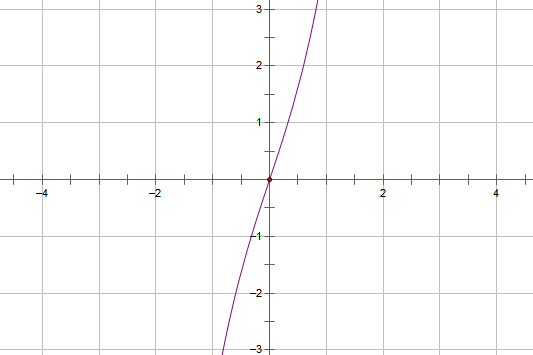 Graph of x^3+3x
First consider $z^3+3z=p$. Let $z=A^{-1}-A$; substituting into the equation and simplifying gives $A^{-3}-A^3=p$, which could be turned into a quadratic equation by a further substitution. But instead, let's set $A^3=\tan B$, and using formula (1) from the "Preliminaries" section, this becomes $\frac{2}{\tan 2B}=\frac{1}{\tan B}-\tan B=p$, i.e. $\tan 2B=\frac{2}{p}$, from which we can back out $A=(\tan \frac{\arctan \frac{2}{p}}{2})^{(1/3)}$. This completes the solution. As the graph shows, for every value of p, this equation has exactly one real root.
Next consider $z^3-3z=p$. Let $z=A^{-1}+A$; substituting into the equation and simplifying gives $A^{-3}+A^3=p$, which likewise could be turned into a quadratic equation via substitution. Mimicking the approach above, let $A^3=\tan B$, and using formula (2) from the "Preliminaries" section, this becomes $\frac{2}{\sin 2B}=\frac{1}{\tan B}+\tan B=p$, i.e. $\sin 2B=\frac{2}{p}$, from which we back out $A=(\tan \frac{\arcsin\frac{2}{p}}{2})^{(1/3)}$.
 Graph of x^3-3x
At this point some readers might think the problem is fully solved. However, notice that in the expression for A in the last step, one term is $\arcsin\frac{2}{p}$, which is only valid for $|p|> 2$. But the graph shows that when $|p|\leq 2$, the equation does not lack real roots—rather, it has 2 to 3 real roots. This means we need another method to handle this special case. This time we turn to formula (3) from the preliminaries. The equation $z^3-3z=p$ can be rewritten as $4(z/2)^2-3(z/2)=p/2$, so that every coefficient matches formula (3) term by term. This gives us $\cos 3A=p/2,2\cos A=z$, from which we back out $z=2\cos(\frac{\arccos (p/2)+2k\pi}{3}),(k=0,1,2)$, yielding three real roots. With this, the solution of the cubic equation is essentially complete.
Summary
Let's organize the process above:
For the general cubic equation $x^3+ax^2+bx=c$, first compute
$$m=b-\frac{a^2}{3},n=c+\frac{ab}{3}-\frac{2a^3}{27},p=n|\frac{3}{m}|^{(3/2)}$$
If m is positive or zero, the equation has only 1 real root—proceed to step (I). If m is negative, and p > 2, the equation has 1 real root; if p = 2, it has 2 real roots; if p < 2, it has 3 real roots—proceed to step (II). If m = 0, the equation has 1 real root—proceed to step (III).
(I). (m > 0)
$$\begin{aligned}A=(\tan \frac{\arctan \frac{2}{p}}{2})^{(1/3)},z=A^{-1}-A \\ x=|m/3|^{(1/2)}z-a/3\end{aligned}$$
(II).1. (m < 0, |p| > 2)
$$\begin{aligned}A=(\tan \frac{\arcsin\frac{2}{p}}{2})^{(1/3)},z=A^{-1}+A \\ x=|m/3|^{(1/2)}z-a/3\end{aligned}$$
(II).2. (m < 0, |p| < 2)
$$\begin{aligned}z=2\cos(\frac{\arccos (p/2)+2k\pi}{3}),(k=0,1,2) \\ x=|m/3|^{(1/2)}z-a/3\end{aligned}$$
(III). (m = 0)
$$x=\sqrt[3]{n}-\frac{a}{3}$$
Conclusion
Through the transformations and solutions above, we can see that any cubic equation with real coefficients can be transformed into the form $z^3\pm 3z=p$ (where p is real), and $z^3\pm 3z=p$ always has at least one real root. This means we've thereby also proven that any cubic equation has no fewer than one real root.
Someone might ask: what if I want to find the non-real roots? This can actually be done using Vieta's formulas. For the three roots of the cubic equation $x^3+ax^2+bx=c$, the following relations hold:
$$x_1 x_2 x_3=c;x_1+x_2+x_3=-a$$
If one real root is already known, the equations above reduce to a system of two equations in two unknowns (quadratic), which can be solved with ease. We won't elaborate further here.
The idea of combining trigonometric functions with root-finding for cubic equations has been around for a long time, but it had never been fully generalized. Studying Introduction to Celestial Mechanics gave me the inspiration, and through searching online I found the relevant formulas; by piecing together this material, I arrived at the method for solving cubic equations presented here. Since none of the formulas used are my own "original" invention, I don't dare arrogantly claim to have created a "new" method. The inspiration came only from a persistent interest in solving equations, plus help from books and the internet, so it's really nothing worth boasting about. Still, I do hope that readers, when reading or reposting this, will link back to Scientific Spaces, so that more people can come to know it. ^_^
Translated automatically with claude-sonnet-5; all equations are reproduced verbatim from the source. Copyright remains with the original author.