So How Much Do We Really Know About Centroids (Centers of Mass)?
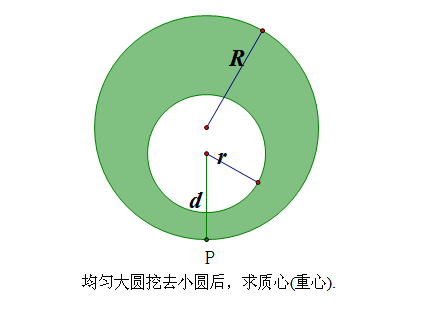 Finding the centroid (center of mass) of a large disk with a small disk removed
Whether in math problems or physics applications, we constantly encounter problems of this type: find the centroid (center of mass) of what remains after a regular-shaped object has had another regular-shaped object removed from (or added to) it. more
The so-called "center of gravity" refers to the fact that every part of an object experiences the force of gravity; in terms of overall effect, we can regard the gravitational forces acting on all the parts as being concentrated at a single point (the point of application of gravity on the object) — this point is called the object's center of gravity. "Center of mass," meanwhile, refers to an imaginary point on a system of matter at which the mass is considered to be concentrated. The center of mass makes sense even without a gravitational field, whereas the center of gravity does not. If the gravitational field is uniform, the center of mass and the center of gravity of the same system of matter coincide at the same imaginary point; in a non-uniform gravitational field, they generally do not.
The most direct way to find a centroid is, of course, to use multiple integrals. But this approach is, needless to say, complicated, and for an arbitrarily given plane region or solid, it is often difficult to even write down the relevant function. So below I've organized three methods that can handle the kinds of problems mentioned above. These three methods approach the problem from different angles, each with its own elegance. Finally, I'll give a fourth method for finding the center of gravity of an irregular thin plate.
I. Pappus's Theorem
When a bounded plane region moves in a direction that is everywhere perpendicular to it, the area it sweeps out equals the distance traveled by its centroid multiplied by the length of the curve; or, when a plane region sweeps out a volume by moving with a velocity perpendicular to itself, that volume equals the distance traveled by the centroid multiplied by the area of the surface.
This statement can feel hard to parse on a first read, but if you focus on the second half, the key point is that the direction of motion is perpendicular to the plane region. In this sense, the "motion" referred to above is not necessarily a simple translation — in other words, the path of motion doesn't have to be a straight line; it can also be rotation about some fixed axis. Let's briefly go over the proof of this theorem:
Let the area of the plane region be S and its mass be M. Divide the region into infinitely many small pieces, each with area $s_i$. The definition of the centroid is $\vec{R}_{c}=\frac{\sum \vec{R}_{i}m_i}{M}$; for a uniform plane, $m_i \prop s_i$, so the definition of the centroid can be rewritten as:
$$\vec{R}_{c}=\frac{\sum \vec{R}_{i}s_i}{S}$$
Differentiating both sides gives
$$\begin{aligned}d\vec{R}_{c}=d(\frac{\sum \vec{R}_{i}s_i}{S})=\frac{\sum d(\vec{R}_{i})s_i}{S} \\ S|d\vec{R}_{c}|=\sum |d(\vec{R}_{i})|s_i\end{aligned}$$
If the direction of motion is perpendicular to the plane, i.e., perpendicular to $d(\vec{R}_{i})$, then the area swept out in an instant is $s_i$, and the length swept out in an instant is $|d(\vec{R}_{i})|$, so the volume swept out in an instant is $|d(\vec{R}_{i})|s_i$, and the volume swept out over a period of time is: $\int [\sum |d(\vec{R}_{i})|ds]=\int (S|d\vec{R}_{c}|)=S\int |d\vec{R}_{c}|$
The rightmost expression is exactly the distance traveled by the centroid multiplied by the area. This completes the proof of Pappus's theorem.
The material above is just meant to give you a sense of Pappus's theorem — if you're only interested in applying it, you don't really need to worry about the proof. Now let's put the theorem to use: we can use it to find volumes or centroids, such as in the problem we posed at the beginning. Since this figure is symmetric, the centroid must lie on the axis of symmetry. Let's rotate the "disk with a hole" once around the axis shown by the red line in the figure below, and use "volume divided by area" to locate the centroid.
By Pappus's theorem, the volume generated by rotating the large disk once is $\pi R^2*2\pi R$, and the volume generated by rotating the small disk once is $\pi r^2*2\pi d$, so the volume of the resulting solid of revolution is $2\pi^2(R^3-r^2 d)$; while the area of the original figure is $S=\pi(R^2-r^2)$. Therefore, the distance traveled by the centroid is $\frac{2\pi^2(R^3-r^2 d)}{\pi(R^2-r^2)}=\frac{2\pi(R^3-r^2 d)}{R^2-r^2}$.
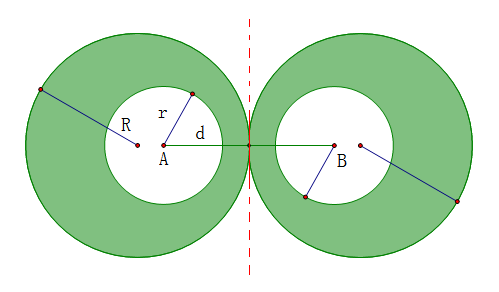 Rotating the "disk with a hole"
The centroid lies on AB, so the path it traces out must also be a circle, giving us $2\pi R_c=\frac{2\pi(R^3-r^2 d)}{R^2-r^2}$, so the centroid is located at a distance $R_c=\frac{R^3-r^2 d}{R^2-r^2}$ from point P.
Pappus's theorem is very useful for handling problems of this kind, and it also makes it easy to compute the volumes of certain solids. However, it does have drawbacks — for instance, it can only be applied to planar figures, and the calculations can sometimes get cumbersome.
II. The Common Centroid of Centroids (the Step-by-Step / Incremental Method)
The common centroid of n point masses is equal to
the common centroid of some a of those point masses
and
the common centroid of the remaining (n−a) point masses,
combined via their
common centroid.
We already know the mass and centroid of both the large disk before removal and the small disk that gets removed, so we can apply the method above. For combinations of several solids, this lets us handle things very conveniently; for cases where something is "removed," we just need to record the mass of the removed part as negative. I call this the step-by-step method or incremental method.
Continuing with the problem above: the distance between the centroids of the large and small disks is (R−d), and the ratio of the masses of the large and small disks is $R^2:(-r^2)$. By the definition of the centroid (analogous to lever balance), we can find that the centroid is located at a distance $\frac{-r^2}{R^2+(-r^2)}(R-d)$ from the center of the large disk (this is a negative value, meaning it lies outside the segment connecting the two centers), so the centroid is located at $R-\frac{-r^2}{R^2+(-r^2)}(R-d)=\frac{R^3-r^2 d}{R^2-r^2}$ from point P.
III. The Gravitational Potential Energy Method
Dear reader, you read that correctly, and I didn't make a typo — it really is "gravitational potential energy." This is a method BoJone came up with on a whim while reading about gravitational potential energy in a mechanics textbook, and then used to find centroids. Here we apply a physical law:
The gravitational potential energy of an object equals the distance between the object's centroid and the zero-potential surface, multiplied by the gravitational force acting on the object.
With this law in hand, and using the additivity of energy, we can conveniently find the location of an object's centroid.
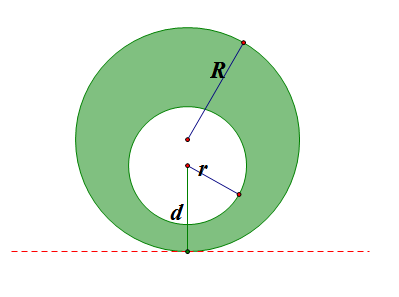 Finding the centroid via the "gravitational potential energy method"
In the original problem, we choose the red line in the figure above as the zero-potential surface. Let the density of the disk be 1. Then the gravitational potential energy of the large disk is $\pi R^2 *g*R$, and the gravitational potential energy of the small disk is $\pi r^2 *g*d$, so the gravitational potential energy of the resulting object is $E_p=\pi R^2 *g*R-\pi r^2 *g*d$; and the mass of the object is $M=\pi R^2-\pi r^2$, so the distance from the object to the zero-potential surface is $\frac{E_p}{Mg}=\frac{R^3-r^2 d}{R^2-r^2}$.
At this point, I've basically covered all three methods (whew...). These three methods approach the problem from different angles — some mathematical, some physical — yet they all arrive at the same result. Actually, BoJone is quite fond of calculus but not particularly skilled at it, so rather than finding the centroid via multiple integrals, I went looking for the "shortcuts" above. In the process of searching for shortcuts, the first thing I considered was a physical approach — my initial idea was to use the law of gravitation, but I gave that up once I remembered that forces aren't simply additive in the way I needed. Then, by chance, I came across "the gravitational potential energy of a rigid body," and it immediately clicked! Pappus's theorem, meanwhile, I discovered while searching through reference material. The second method is one that BoJone had come up with earlier for finding centroids, and now it finally gets to be put to use — heh!
Finally, let me introduce a "plumb-line method" for finding the center of gravity of an irregular thin plate. In practice, no matter how good your computational skills are, using mathematical analysis to find a center of gravity in the real world is often impractical. What we need is a way to quickly locate the center of gravity in practice (even if not with perfect precision). For a thin plate (which doesn't even need to be uniform), pick a fixed point on it (such as A or B), tie a thin string to it, hold the other end of the string, and let the plate and the string hang naturally under gravity, then mark on the plate the position of the string. Repeat this procedure from a different fixed point, and the intersection of the two lines drawn on the plate is the location of the plate's center of gravity.
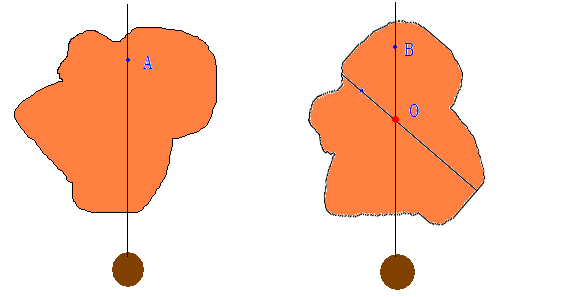 Finding the centroid via the "plumb-line method"
Translated automatically with claude-sonnet-5; all equations are reproduced verbatim from the source. Copyright remains with the original author.