The Mysterious Circle — the "Six-Point Circle" of a Triangle (with an added method)
A user named watt5151 on the Shulian Tiandi Forum posed the following problem:
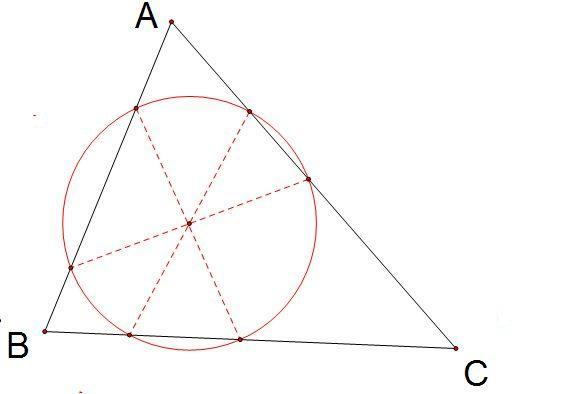 Triangle's "six-point circle"
As shown in the figure, given triangle ABC, how can we construct a circle that intersects all three sides of the triangle, such that the six intersection points can be connected to form three diameters?more
We've all seen plenty of circumscribed circles and inscribed circles, so seeing such a fresh problem, BoJone found it quite interesting, and took the liberty of calling this circle the triangle's "six-point circle," spending an afternoon looking into it. The conclusion reached is this: for a non-obtuse triangle, this behaves just like the circumcircle and incircle — such a circle always exists, and exists uniquely. For an obtuse triangle, in some cases it does not exist (although you can still construct such a circle, it no longer has six intersection points with the triangle — in other words, the circle "overflows").
After being on holiday for a while, it feels like I haven't done math problems in ages — my brain's gotten a bit rusty. Below is an account of BoJone's thought process. First, let's draw the following figure:
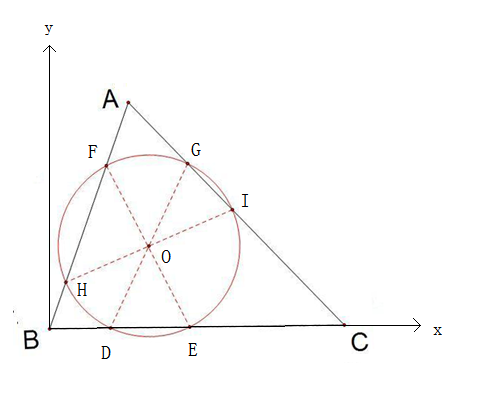 Triangle's "six-point circle" - coordinate diagram
Let the coordinates of point A be (a,b), and the coordinates of point C be (c,0), and let the equation of the desired circle be $(x-m)^2+(y-n)^2=R^2$. That is, the coordinates of point O are (m,n). It's not hard to find that the coordinates of points E and D are respectively $(m+-\sqrt{R^2-n^2},0)$. Since E, O, F are collinear, the coordinates of F are $(m-\sqrt{R^2-n^2},2n)$, and similarly the coordinates of G are $(m+\sqrt{R^2-n^2},2n)$.
Since A, F, B are collinear and AF=BF, we can write: $$\frac{m-\sqrt{R^2-n^2}}{2n}=\frac{a}{b}\tag{1}$$
Since A, G, C are collinear and AG=GC, we can write: $\frac{m+\sqrt{R^2-n^2}-c}{2n}=\frac{a-c}{b}$——(2)
We now have two equations above, but three unknowns m, n, R. The remaining condition lies in the diameter HI — we could find the equation of this line, and combine it with the two equations above to pin down m, n, R, which would show that this circle exists and is unique. But this approach is too cumbersome, and isn't convenient for straightedge-and-compass construction. BoJone instead proceeds as follows:
Adding (1)+(2) gives: $\frac{2m-c}{2n}=\frac{2a-c}{b}\Rightarrow 2m-c=\frac{2a-c}{b}(2n)$, which is a linear function passing through the two points (c/2, 0) and (a, b/2), so we can easily plot this line's graph. Point O lies on this line.
Although we still can't pin down exactly where O is, remember — we've only chosen side BC as the x-axis so far. We can perform the same operation choosing AB or AC as the axis instead, which produces another line intersecting the one we already have. Since O is unique, the intersection point must be O. Once we know where O is, that's equivalent to knowing the lengths m and n (even though we don't know their exact numerical values, we don't actually need to — we only want to be able to construct this circle in the figure). From equation (1), we have $R^2=n^2+(m-\frac{2na}{b})^2$, which is a quantity constructible with straightedge and compass.
Now that we've worked out the general method, the next task is to "translate" the above analysis into concrete steps for a compass-and-straightedge construction. Below is a diagram BoJone sketched on paper to illustrate this:
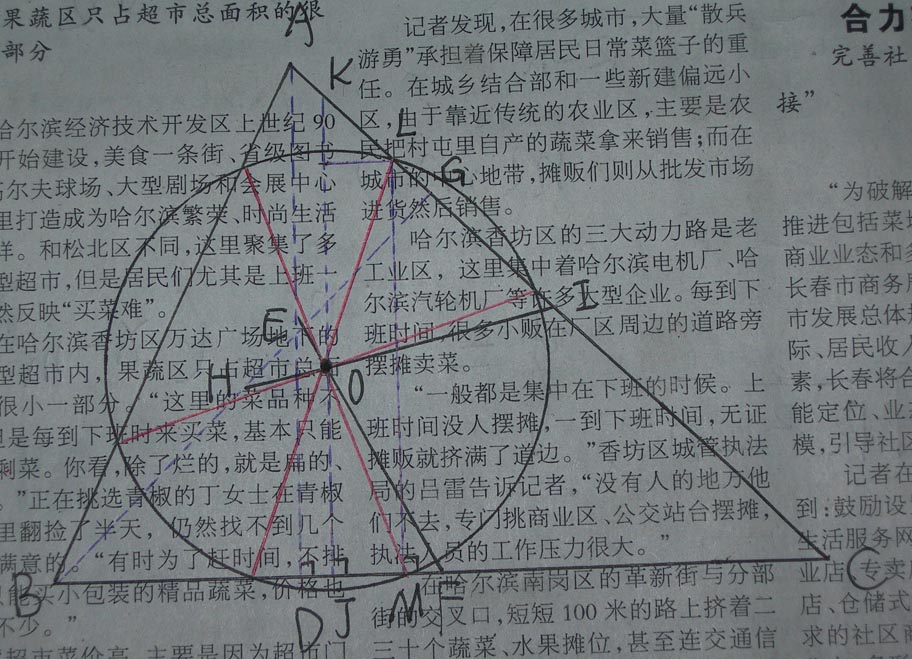 Triangle's "six-point circle" - straightedge-and-compass construction
Steps:
1. Choose one side of the triangle and construct its midpoint; also draw the altitude to this side, and construct the midpoint of that altitude.
2. Construct the line through these two midpoints (EF).
3. Choose another side of the triangle and repeat steps 1 and 2 (to construct HI).
4. Find the intersection point of the two lines constructed in steps 1, 2, and 3 — this intersection point is the center of the circle.
5. Choose one side of the triangle, and construct a segment LM = 2n, with LM ⊥ BC, intersecting AC at point L and BC at point M.
(Note: step 5 can also be replaced with "construct segment LM = 2n, with LM ⊥ BC, intersecting AB at point L and BC at point M".)
6. With O as the center and OM as the radius, draw the circle — this is the desired circle.
Below is a construction method given by moderator hujunhua from the "Mathematics Research and Development Forum":
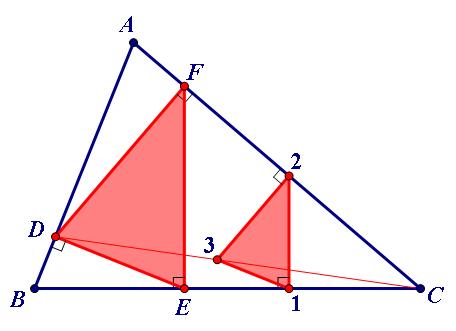 Triangle's "six-point circle" - straightedge-and-compass construction 2
Construction:
First construct a small triangle △123, similar to △ABC and rotated 90 degrees relative to it, which is almost inscribed in △ABC (two of its vertices land on two sides of △ABC). Then, through a homothety (a scaling transformation about a center point), bring it to be fully inscribed. The specific steps are as follows:
1. Take any point 1 on side BC, and construct the perpendicular to BC through it, intersecting AC at point 2.
2. Through point 2, construct the perpendicular to AC; through point 1, construct the perpendicular to AB; let these two perpendiculars meet at point 3.
3. Draw line C3, intersecting AB at point D.
4. Through D, construct the perpendicular to AB, intersecting BC at point E.
5. Through D, construct the perpendicular segment DF to AC.
6. The circumscribed circle of D, E, F is the desired circle.
Translated automatically with claude-sonnet-5; all equations are reproduced verbatim from the source. Copyright remains with the original author.