The *Vector* Series — 2. Radius of Curvature
The circle is so harmonious and perfect that mathematicians and physicists alike hold it dear. Geometrically, one can regard a small local piece of a curve as a circular arc and use the properties of circles to study it (in mathematics, the reciprocal of the radius of curvature is precisely the curvature — the larger the curvature, the more sharply the curve bends). Physicists, likewise, like to treat a small local segment of a particle's curved trajectory as circular motion, and use the methods of circular motion to describe that motion. Both approaches tell us the same thing: two different kinds of "curves" become equivalent over an infinitesimally small range. This also offers a bit of guidance for scientific inquiry in general: turn the unknown into the known, and use the known to understand the unknown. In both the physics and mathematics approaches, there is one point on which they converge, no matter the path taken: once we regard the trajectory as a circle, what is the radius of that circle? This is the first thing we need to work out.
In mathematical analysis, one can derive the formula for the radius of curvature using calculus. BoJone, however, prefers the physical approach — combining physics with vector methods to derive the radius-of-curvature formula, which BoJone finds has "a flavor all its own." more
Derivation 1:
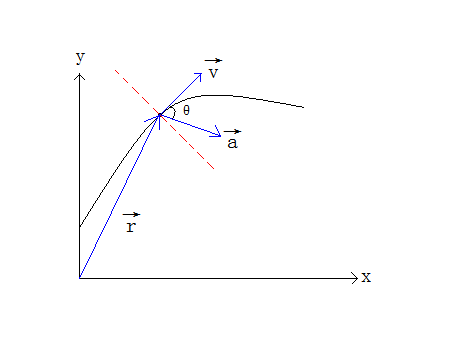 Diagram illustrating the derivation of the radius of curvature
Let's first consider the two-dimensional case. We know that the formula for centripetal acceleration is $a_c=\frac{v^2}{R}$. If we can find the centripetal acceleration and the velocity, we can determine R (the radius of curvature). For any given equation of motion $\vec{r}=\vec{r}(t)$, we already know the velocity, $\vec{v}=\dot{\vec{r}}$. What remains unknown is the centripetal acceleration.
What exactly is "centripetal"? It is simply the projection of the acceleration onto the direction of the radius of the circle at that point. We know that in circular motion, the velocity direction is always perpendicular to the radius direction, so the "centripetal" direction is in fact the direction perpendicular to the velocity (this is also called the "normal direction," which is why centripetal acceleration is also called "normal acceleration").
$$\vec{a}=\ddot{\vec{r}},|a_c|=|\vec{a}|\cdot \sin\theta=|\dot{\vec{r}}\times \ddot{\vec{r}}|\div |\dot{\vec{r}}|$$
Hence $R=\frac{v^2}{a_c}=\frac{|\dot{\vec{r}}|^3}{|\dot{\vec{r}}\times \ddot{\vec{r}}|}$
Setting $\vec{r}=(x,y,0)$, we obtain
$$\begin{aligned}\dot{\vec{r}}=(\dot{x},\dot{y},0),\ddot{\vec{r}}=(\ddot{x},\ddot{y},0) \\ \dot{\vec{r}}\times \ddot{\vec{r}}=(0,0,\dot{x}\ddot{y}-\dot{y}\ddot{x})\end{aligned}$$
Substituting gives: $R=\frac{(\dot{x}^2+\dot{y}^2)^(3//2)}{|\dot{x}\ddot{y}-\dot{y}\ddot{x}|}$
If we instead work in three-dimensional coordinates, we can obtain the radius of curvature for a space curve in three dimensions:
$$R=\frac{(x'^2+y'^2+z'^2)^{3//2}}{\sqrt{(z''y'-y''z')^2+(x''z'-z''x')^2+(y''x'-x''y')^2}}$$
Derivation 2:
Here we obtained two equations concerning circular motion
$$\vec{R}\cdot \dot{\vec{r}}=0\tag{1}$$$$\dot{\vec{r}}^2+\vec{R}\cdot \ddot{\vec{r}}=0\tag{2}$$
Again setting $\vec{r}=(x,y),\vec{R}=(a,b)$, and substituting, we get
$$\dot{x}^2+\dot{y}^2+a\ddot{x}+b\ddot{y}=0;a\dot{x}+b\dot{y}=0$$
which can be solved to give
$$\begin{aligned}a=-\frac{\dot{x}^2\dot{y}+\dot{y}^3}{\ddot{x}\dot{y}-\dot{x}\ddot{y}} \\ b=\frac{\dot{y}^2\dot{x}+\dot{x}^3}{\ddot{x}\dot{y}-\dot{x}\ddot{y}}\end{aligned}$$
$R=\sqrt{a^2+b^2}=\frac{(\dot{x}^2+\dot{y}^2)^(3//2)}{|\dot{x}\ddot{y}-\dot{y}\ddot{x}|}$
Translated automatically with claude-sonnet-5; all equations are reproduced verbatim from the source. Copyright remains with the original author.