Proof that "an n-th degree equation has n roots"
Fundamental theorem of algebra: every polynomial with complex coefficients in one variable has at least one complex root. In other words, the field of complex numbers is algebraically closed.
Although it bears this name, it doesn't quite live up to it — it isn't really the most fundamental theorem of algebra. It was given this name because, at the time it was formulated, algebra was essentially about solving polynomial equations with real or complex coefficients, and so it came to be called the Fundamental Theorem of Algebra(Fundamental theorem of algebra).
Building on this premise, we can deduce:
An n-th degree algebraic equation in one variable with complex coefficients has n roots within the complex numbers (some of which may be pairs of complex conjugate roots).
The proof uses mathematical induction together with polynomial "division," as follows:
We know that a first-degree equation in one variable has 1 root, and that an n-th degree equation in one variable has at least 1 root. Assume that an (n-1)-th degree equation has (n-1) roots; we want to show that an n-th degree equation has n roots.
Let the function be $f(x)=a_0+a_1 x^1+...+a_n x^n$
Let's compute $\frac{f(x)}{x-x_1}$, where $x_1$ is a given constant. This calculation can proceed much like ordinary long division:
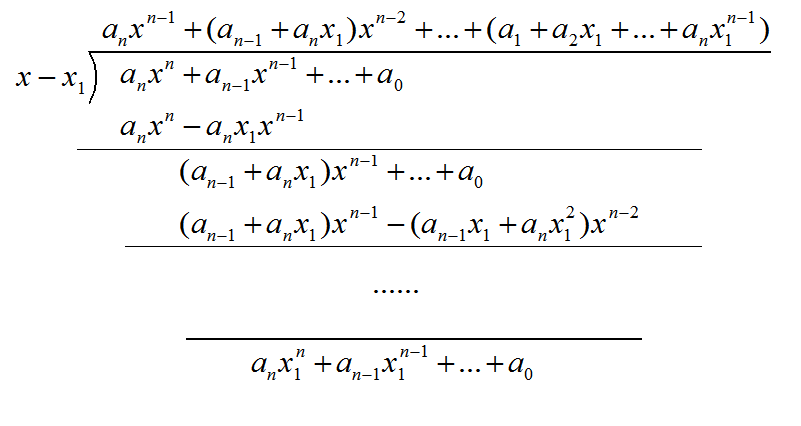 polynomial division computation process
Eventually, we arrive at the result:
$$\begin{aligned}f(x)=&\,a_0+a_1 x^1+...+a_n x^n \\ =&\,(x-x_1)[a_n x^{n-1}+(a_{n-1}+a_n x_1)x^{n-2}+...+(a_1+a_2 x_1+...+a_n x_1^{n-1})]+a_0+a_1 x_1^1+...+a_n x_1^n\end{aligned}$$
Let $x_1$ be a root of the equation $a_0+a_1 x^1+...+a_n x^n=0$, so that
$$\begin{aligned}&\,a_0+a_1 x^1+...+a_n x^n \\ =&\,(x-x_1)[a_n x^{n-1}+(a_{n-1}+a_n x_1)x^{n-2}+...+(a_1+a_2 x_1+...+a_n x_1^{n-1})]\end{aligned}$$
Then the solutions satisfying $a_n x^{n-1}+(a_{n-1}+a_n x_1)x^{n-2}+...+(a_1+a_2 x_1+...+a_n x_1^{n-1})=0$ are also roots of the equation $f(x)=0$, and this equation has (n-1) roots. Adding $x=x_1$, we find that $f(x)=0$ has a total of n roots.
Q.E.D.
Translated automatically with claude-sonnet-5; all equations are reproduced verbatim from the source. Copyright remains with the original author.