Generic Crawler Exploration (Part 3): Results and Code
Sample Results
Here are the crawling results on several sites. Figure 1 shows the results on this very blog, demonstrating that the approach works on general-purpose websites; Figures 2 and 3 show results on forums built with two different open-source forum programs, demonstrating that it works well on open-source software; Figure 4 shows results on the well-known Tianya forum, demonstrating that even forums developed in-house by a company can be crawled with decent results.
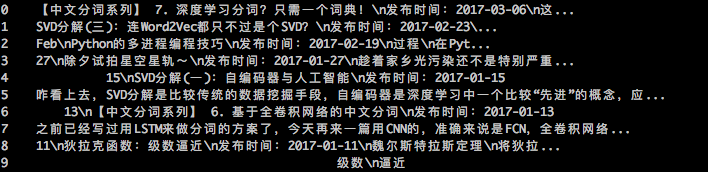 6-blogmore
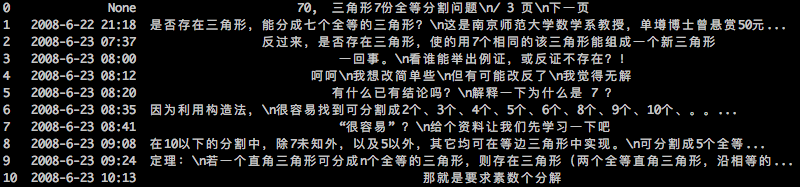 6-Discuz
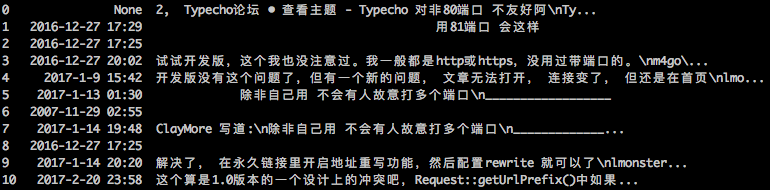 6-phpbb
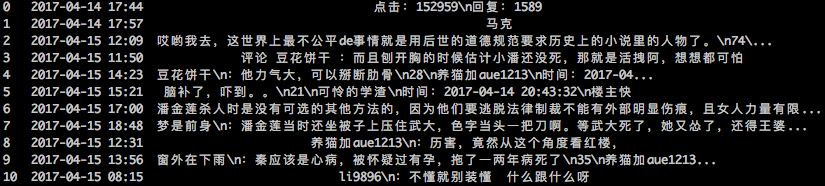 6-tianya
Room for Improvement
All in all, this is a fairly efficient, unsupervised, general-purpose website crawling scheme that can adapt to different websites (not limited to forums), and is well suited for large-scale deployment within a company.
That said, there are still a few places where this approach could be improved:
1. To guarantee efficiency and stability, we sacrificed some generality — for instance, when deciding what content to keep, we simply judge based on the proportion of Chinese characters, rather than using a more precise language-model-based approach.
2. There isn't much room left for further improvement, because the scheme based on comparing against a standard template essentially extracts valid text in a mixed, undifferentiated way, losing positional and hierarchical information. Although clustering can partially address this, there are still websites where it fails, and there isn't much headroom left for improvement on top of the current method.
3. It doesn't make use of visual information — for example, it can't accurately locate usernames, because we have no way of knowing which part of the page counts as the username. But if you look at the page with your own eyes, it's actually fairly easy to tell. In other words, visual information is a fairly important signal, and if higher accuracy is required, we would need to make use of it.
I look forward to seeing better solutions.
Code
Python 2.7 code~
Generic crawling framework:
#! -*- coding:utf-8 -*-

import requests as rq
import numpy as np
import re
from lxml.html import html5parser

class crawler:
    def __init__(self, standard_urls):
        self.title = ''
        self.emphase_mark = set(['p', 'br', 'em', 'strong', 'b', 'font', 'u', 'a', 'img', 'h1', 'h2', 'h3', 'h4', 'h5', 'sup', 'sub', 'blockquote', 'cite', 'code', 'pre'])
        self.standard_urls = standard_urls
        self.sess = rq.Session()
        self.standard_contents = []
        self.find_title = re.compile('<title>([\s\S]*?)</title>').findall
        if isinstance(standard_urls, list):
            self.standard_dom = self.create_dom(self.standard_urls[0])
            self.standard_contents = set([c[1:] for c in self.traverse_dom(self.standard_dom)[1]])
            for url in self.standard_urls[1:]:
                self.standard_dom = self.create_dom(url)
                self.standard_contents = self.standard_contents & set([c[1:] for c in self.traverse_dom(self.standard_dom)[1]])
        else:
            self.standard_dom = self.create_dom(self.standard_urls)
            self.standard_contents = set([c[1:] for c in self.traverse_dom(self.standard_dom)[1]])
        self.find_zh = re.compile(u'[\u4e00-\u9fa5]').findall
        self.find_zh_en = re.compile(u'[a-zA-Z\d_\u4e00-\u9fa5]').findall
        self.find_date = re.compile(u'.*?年.*?月.*?日|发布时间|\d{4}\-\d{1,2}\-\d{1,2}|昨天|前天|今天|小时前|\d{1,2}:\d{2}').findall
    def create_dom(self, url):
        r = self.sess.get(url)
        return html5parser.fromstring(r.content)
    def traverse_dom(self, dom, idx=0, tag=''):
        content = []
        if len(dom) > 0:
            tag += (str(dom.tag)+'_')
            if dom.tag not in self.emphase_mark:
                idx += 1
            idx_ = idx
            if dom.text and dom.text.strip():
                content.append((idx_, tag, dom.text.strip()))
            for d in dom:
                idx, content_ = self.traverse_dom(d, idx, tag)
                content.extend(content_)
            if dom.tail and dom.tail.strip():
                content.append((idx_, tag, dom.tail.strip()))
        elif dom.tag != 'head':
            if dom.text and dom.text.strip():
                content.append((idx, tag, dom.text.strip()))
            if dom.tail and dom.tail.strip():
                content.append((idx, tag, dom.tail.strip()))
        if (isinstance(dom.tag, str) or isinstance(dom.tag, unicode)) and 'title' in dom.tag and not self.title:
            self.title = dom.text.strip() + dom.tail.strip()
        return idx, content
    def peak(self, d):
        r = []
        if d[0] > d[1]:
            r.append(0)
        for i in range(1, len(d)-1):
            if d[i] > max(d[i-1], d[i+1]):
                r.append(i)
        if len(d) >= 3 and d[-1] > d[-2]:
            r.append(len(d)-1)
        return r
    def keep_proba(self, s):
        if len(self.find_zh_en(s)) == len(s):
            return 1
        else:
            c0 = len(''.join(self.find_date(s)))
            return 1.*(len(self.find_zh(s))+c0)/(len(s))
    def crawl_url(self, url, cluster_times=2):
        self.title = ''
        dom = self.create_dom(url)
        content = self.traverse_dom(dom)[1]
        content_ = []
        for c in content:
            if c[1:] not in self.standard_contents:
                content_.append(list(c))
        content = [content_[0]]
        for c in content_:
            if c[0] == content[-1][0]:
                content[-1] = [c[0], c[1], content[-1][2]+'\n'+c[2]]
            else:
                content.append(c)
        content = [c for c in content if self.keep_proba(c[2]) >= 0.25]
        for _ in range(cluster_times):
            content_ = content[:]
            if len(content_) >= 3:
                idxs = [c[0] for c in content_]
                idxs = set([idxs[i+1] for i in self.peak(np.diff(idxs))])
                content = [content_[0]]
                cc = 1
                for i in range(1, len(content_)):
                    if content_[i][0] in idxs:
                        content[-1][0] = int(content[-1][0]/cc)
                        content.append(content_[i])
                        cc = 1
                    else:
                        content[-1] = [content[-1][0]+content_[i][0], content[-1][1], content[-1][2]+'\n'+content_[i][2]]
                        cc += 1
        return [c[2] for c in content]
Applied specifically to forums:
def find_datetime(s):
    r = []
    for t in s.split('\n'):
        l = len(t)*1.
        d = re.findall('\d+\-\d+\-\d+ +\d+:\d+', t)
        if d and len(d[0])/l > 0.5:
            r.append(d[0])
        else:
            d = re.findall(u'\d+年 *\d+月 *\d+日 +\d+:\d+', t)
            if d and len(d[0])/l > 0.5:
                d = re.findall(u'(\d+)年 *(\d+)月 *(\d+)日 +(\d+):(\d+)', t)
                r.append('%s-%s-%s %s:%s'%d[0])
            else:
                r.append(None)
    return r

def extract_info(b,c):
    r = []
    for t in b:
        dts = find_datetime(t)
        t = t.split('\n')
        dt = max(dts)
        if dt:
            idx = dts.index(dt)
            r.append((dt, '\n'.join(t[:idx]), '\n'.join(t[idx+1:])))
        else:
            r.append((None, '\n'.join(t), '\n'.join(t)))

    idx = 1 + (sum([c.keep_proba(i[1]) for i in r]) < sum([c.keep_proba(i[2]) for i in r]))
    r = [(i[0], i[idx]) for i in r if i[idx]]
    if not r[0][0]:
        r = r[1:]
    rr = [r[0]]
    for a,b in r[1:]:
        if not a:
            rr[-1] = rr[-1][0], rr[-1][1]+'\n'+b
        else:
            rr.append((a,b))
    return rr

if __name__ == '__main__':

    c = crawler(['http://bbs.emath.ac.cn/thread-9531-1-1.html', 'http://bbs.emath.ac.cn/thread-2749-1-1.html'])
    b = c.crawl_url('http://bbs.emath.ac.cn/thread-9538-1-1.html')

    title = c.title
    r = extract_info(b,c)
    keys = ('publish_date', 'content', 'title', 'author')
    final = {}
    final['post'] = dict(zip(keys, (r[0][0], r[0][1], title, '')))
    final['replys'] = [dict(zip(keys, (i[0], i[1], title, ''))) for i in r[1:]]

    import pandas as pd
    pd.DataFrame(r)
Translated automatically with claude-sonnet-5; all equations are reproduced verbatim from the source. Copyright remains with the original author.