The Fun Side of Everyday Math: How Likely Is a Shared Birthday?
Sina Technology, Beijing time, July 28 — According to foreign media reports, mathematics often makes smart people feel not-so-smart, and sometimes even downright annoyed.
In fact, mathematics itself is great fun — it's part of our everyday life, and everyone can enjoy it. It's just that in the classroom, math gets taught in a dry, rigid way by dry, rigid teachers. Below is a roundup of everyday fun math recently published by the UK's Daily Mail.
The Calculator on Your Body
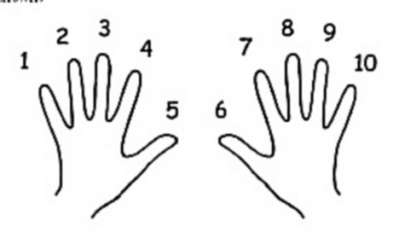 Number your fingers from left to right] more
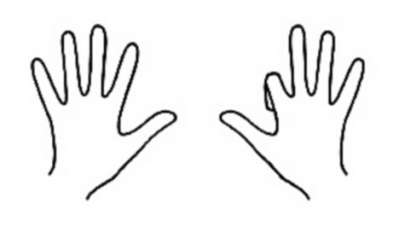 Bend the finger labeled 7 to compute 7×9]
When it comes to calculating with your hands, one of the simplest tricks is for multiplying by 9 — a trick many kids know well, but which grown-ups often forget. To calculate multiples of 9, rest your hands on your knees and, as shown in the table below, number your fingers from left to right. Now pick the multiple of 9 you want to compute; say the equation is 7×9. Just bend the finger labeled 7, as shown in the image above. Then count the fingers remaining to the left of the bent finger — that's 6 — and the fingers remaining to its right — that's 3. Put them together, and you get the answer to 7×9: 63.
The Probability of Sharing a Birthday
Suppose you're at a wedding with 50 guests. Someone might ask: "I wonder what the probability is that two people here share a birthday? By 'share a birthday' I mean the same calendar date, like May 5th — not that they were born at the exact same moment."
Most people probably assume this probability is quite small; if they tried to work it out, they might guess something like one in seven. But the correct answer is that, on average, about two guests at this wedding will share a birthday. If the birthdays of this group are spread evenly across the calendar, the probability that two people share a birthday is 97%. In other words, you'd need to attend 30 gatherings of this size before finding even one where no two guests share a birthday.
One reason people find this surprising is that they confuse the probability of two specific people sharing a birthday with the probability that any two people in the group share one. The probability that two specific people share a birthday is 1 in 365. The key to this problem is the size of the group. As the number of people increases, the probability that some two of them share a birthday rises sharply. So in a group of 10, the probability of a shared birthday is about 12%. In a party of 50, it's about 97%. However, it's only once the group reaches 366 people (accounting for someone possibly being born on February 29th) that you can be certain two people in the group share a birthday.
How Many Socks Do You Need to Guarantee a Matching Pair?
The answer to how many socks you need to guarantee a matching pair isn't two. And this isn't just a problem unique to my house. Why is that? Well, I can guarantee that on a dark winter morning, if I pull two socks out of a drawer containing black and blue socks, they might well not match. Bad luck as I may be, if I pull out 3 socks, I can guarantee that at least two of them will be the same color. Whether the matching pair turns out to be black or blue, there will always be a matching pair among three. So it turns out that with just one extra sock, mathematical certainty triumphs over Murphy's Law. From this we can conclude: the answer to "how many socks make a matching pair" is 3.
Of course, this only holds when there are two colors of socks. If the drawer contains three colors — say blue, black, and white — you'd need to pull out at least 4 socks to guarantee a matching pair. If there are 10 different colors in the drawer, you'd need to pull out 11. The general mathematical rule here: if you have N types of socks, you must draw N+1 to guarantee a matching pair.
Timing with a Burning Rope
Suppose you have a rope that takes exactly one hour to burn from one end to the other. Without looking at a clock, using only this rope and a box of matches, you need to measure out exactly half an hour. You might think this is easy — just mark the midpoint of the rope and time how long it takes to burn to that mark. Unfortunately, though, the rope doesn't burn evenly: some parts are thicker, some thinner, so the burn rate varies along its length. Maybe one half burns in just 5 minutes, while the other half takes 55 minutes. Given this, it seems impossible to measure exactly 30 minutes using this rope — but that's not actually true. There's a clever trick: light the rope from both ends at the same time. The time it takes to burn completely will be exactly 30 minutes.
The Trains-Approaching-Each-Other Problem
Two trains travel toward each other on the same track, each moving at 50 miles per hour. When they are 100 miles apart, a fly starts flying from train A toward train B at a speed of 60 miles per hour. Upon reaching train B, it immediately turns around and flies back toward train A, and keeps doing this back and forth until the two trains collide, crushing the fly. How far did the fly travel before being crushed?
We know the trains start 100 miles apart, each traveling at 50 miles per hour. That means each train covers 50 miles, so they collide after exactly one hour. During that one hour, from departure to collision, the fly is flying continuously at 60 miles per hour, so by the time the trains collide, the fly has traveled 60 miles. It doesn't matter whether the fly flies in a straight line, a zigzag path, or tumbles around in the air — the result is the same.
Coin Flips Aren't as Fair as You Think
Flipping a coin is a common way of making decisions, and people believe it's fair to both parties, assuming the coin is equally likely to land heads or tails — a 50/50 chance. Interestingly, though, this widely held belief isn't quite correct.
First, although the odds of a coin landing on its edge are extremely small, that possibility does exist. Second, even setting aside that tiny possibility, tests show that with the conventional method of flipping a coin — flicking it with your thumb — the side that starts facing up is slightly more likely, about 51% of the time, to still be facing up when it lands.
This happens because when you flick a coin with your thumb, sometimes it doesn't actually flip over in the air; instead it wobbles like a shaky flying saucer, rising and falling without truly turning over. So next time you need to guess which side of a coin will be facing up after it's flipped, take a look at which side is facing up before the flip — your odds of guessing correctly will be a bit better. But if the person flipping the coin catches it in their fist and then turns their fist over before revealing it, you should guess the opposite of the side that was originally facing up. (Xiaowen)
Translated automatically with claude-sonnet-5; all equations are reproduced verbatim from the source. Copyright remains with the original author.