Understanding Riemannian Geometry, Part 1: A Geometric Path
It's been a month since my last update; this month I've spent quite a bit of time trying to understand Riemannian geometry, and I have some thoughts to share. I recall that Meng Yan's Understanding Matrices and my own New Understanding of Matrices were both well received by readers, so this time I'll follow that same naming convention and call this series Understanding Riemannian Geometry.
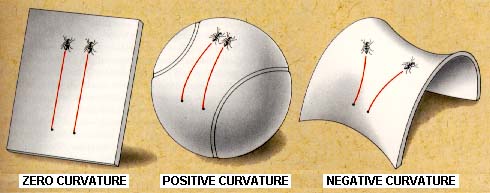 An ant living in two-dimensional space
Riemannian geometry is the branch of geometry that studies intrinsic geometry. Put simply, we might be living in a curved space—like an ant living on a two-dimensional sphere. As beings living in a curved space, we don't necessarily have enough insight to embed our curved space into a higher-dimensional one in order to study it, just as the ant only knows how to crawl around on the surface and cannot conceive of the sphere from the viewpoint of "a surface embedded in three-dimensional space," because the sphere is its entire world. This is precisely why we have intrinsic geometry: it tells us that even while trapped inside a curved space, we can still measure lengths, areas, volumes, and so on; we can still do differentiation and integration; and we can even discover that our space is curved! In other words, given enough intelligence, an ant living on a sphere could discover that its surface is curved—much like Columbus's circumnavigation of the globe—by walking in a fixed direction and eventually returning to its starting point, which would prove that the space it inhabits must be curved. This discovery requires no knowledge whatsoever of three-dimensional space. more
That's the idea, in principle—but you'd be hard pressed to find this viewpoint stated explicitly in a standard textbook on Riemannian geometry (the one I use is do Carmo's Riemannian Geometry, English edition). At best it might get a passing mention in the preface, and that's it. What you actually encounter is a pile of concepts like "manifold," "homeomorphism," "tangent bundle," "metric," "connection," "exterior derivative," and so on—each of which sounds baffling on first contact. After burying your head in this for a semester, it starts to feel like you're studying abstract functional analysis (Riemannian functional analysis?), with no trace of geometric flavor left, and nobody even stops to ask: are we really studying geometry here? Beyond the lack of geometric flavor, many concepts are introduced by skipping over their actual geometric background and simply handing you an abstract definition. Take the metric, for instance: you're told that it comes from introducing an inner product on the tangent space, and then the inner product of tangent vectors can be expressed in terms of the metric—which sounds clear enough, except that at this point many students still haven't really grasped what a tangent space is, and even once they do, they're left wondering: what even is this thing, and why are we doing it this way?
To be fair, abstraction has its virtues—once you've mastered an abstract framework, it often lets you solve a whole class of problems at once. But after all, this is supposed to be a geometry course, and it ought to contain some intuitive content; we shouldn't let painstaking, rigorous mathematical formalism get in the way of actual thinking. Intuition may not be the ultimate goal that mathematics is after, but intuition is very often the wellspring of insight.
 Georg_Friedrich_Bernhard_Riemann
In this article, I'll attempt a geometric route to expound some of the more important concepts in Riemannian geometry. This is not a path well suited to beginners—for example, we'll very quickly derive the geodesic equation using the calculus of variations, which may set the bar too high for someone just starting out. But all things considered, I think readers will find this a path with a strong "geometric flavor"—one where there are no manifolds, no exterior derivatives, and no tensors. In search of ideas and inspiration, I made a point of reading Riemann's original paper on geometry in the Collected Works of Riemann—after all, if we're doing Riemannian geometry, how could we not read Riemann's own paper? Having read it, I found that the way Riemann originally presented the material bears some resemblance to what I do here: he too moves quickly from the metric, derives the geodesic equation via the calculus of variations, and then goes on to other discussions. This confirms that the calculus of variations is a clean, efficient tool well worth learning.
For readers who care about rigor, I should point out that what we discuss here is actually only the torsion-free case (i.e., we assume the torsion vanishes). The Riemannian geometry used in general relativity is likewise torsion-free. Being torsion-free essentially means that the space is everywhere locally equivalent to flat space, and this form of geometry is the one that's practically useful; even if you want to go on to study geometry with torsion, you first need a solid grasp of the torsion-free case.
This series draws on every book I own on Riemannian geometry and general relativity, including:
Differential Geometry (by Peng Jiagui and Chen Qing)
Collected Works of Riemann, Vol. 1 (Higher Education Press)
Gravitation (MTW's "gravity bible," which contains a wealth of worked examples)
Field Theory (Landau)
Gravitation and Spacetime
The Feynman Lectures on Physics (the beloved physics textbook)
Feynman Lectures on Gravitation (Feynman's course on general relativity)
Modern Geometry: Methods and Applications, Volume 1: The Geometry of Surfaces, Transformation Groups, and Fields
Readers are welcome to consult these works as well to aid their understanding. Let me repeat once more: this series cannot stand on its own as a complete course in Riemannian geometry. At best, it serves as a supplement offering geometric intuition to existing textbooks on the subject; there is a great deal of more advanced material that still requires a standard textbook. I am merely attempting to elucidate the geometric meaning of some basic concepts, and to offer a thread that ties them together.
Translated automatically with claude-sonnet-5; all equations are reproduced verbatim from the source. Copyright remains with the original author.