Life is short, I use Python!
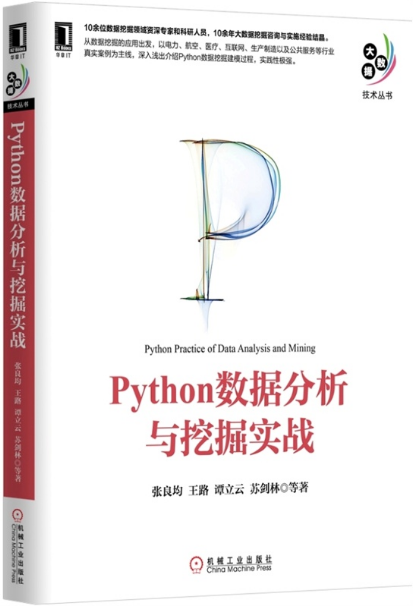 Python Data Analysis and Mining in Practice
Over the summer, at the invitation of Tipdm, I wrote a companion volume to their book MATLAB Data Mining in Practice: Python Data Mining in Practice (there's also an R-language companion). The main work involved writing an introduction to Python and translating the MATLAB code in the book into Python. I happily accepted—partly for the side income, partly to systematically train my own Python programming skills, and also to experience a head-to-head comparison of MATLAB, R, and Python. The book has now officially been published and can be found on Amazon, Dangdang, JD, and Taobao. I'm honored to be listed as one of the authors, so I suppose this counts as my first published book.more
This post admittedly has a whiff of advertising—and it is, indeed, an advertisement—but it's not really here to sell this book; it's here to "sell" Python. As far as the book goes, I'm confident that the Python scripts in it, whether in terms of code simplicity or execution efficiency, hold their own against the MATLAB and R versions. And while the case studies in the book typically involve only a few hundred data points, when I designed the code I kept in mind that it might be used for analyses involving tens or even hundreds of thousands of data points. As for real-world application, in my part-time work at a company I use Python to run data analysis on tens of millions of articles, which shows that Python performs admirably everywhere. It's no wonder people sigh: life is short, I use Python!
Indeed. Life is short, I use Python! Even if you don't end up working as a programmer or data analyst, it's still worth learning Python—it will bring great convenience to whatever work you currently do, whether you're a student, a teacher, a researcher, or an ordinary office worker.
Coming back to MATLAB Data Mining in Practice, let me add a few more words of promotion so this post doesn't feel too short. Most of the case studies in this book actually come from three data mining competitions organized by Tipdm, and since the competition problems themselves have clear real-world backgrounds, the case studies in the book are quite practical and cover a broad range of topics. In terms of tasks, it includes the basics: data processing, classification, clustering, association analysis, natural language processing, and so on. In terms of models, it touches on common ones like logistic regression, SVM, decision trees, and neural networks. This book may not necessarily be a great book, but it is certainly a book written with care. (At the very least, my code translations were done with a lot of care, ha—and Chapter 2's introduction to Python was written entirely by me from scratch; I'll share it with everyone later. ^_^)
Translated automatically with claude-sonnet-5; all equations are reproduced verbatim from the source. Copyright remains with the original author.