On the Exact Law of Free-Fall Motion (Part 2)
Earlier in this article, we made use of a free-fall formula from Newtonian gravitation:
\begin{equation}t=\sqrt{\frac{r_0}{2GM}}\left(r_0 \cdot \arctan \sqrt{\frac{r_0 -r}{r}}+\sqrt{r(r_0 -r)}\right)\label{eq:1}\end{equation}
Let's try to derive this formula.
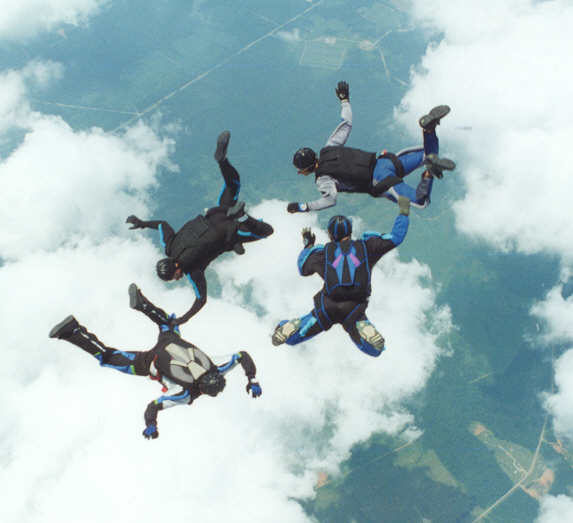 The free-fall stage of skydiving
Meanwhile, as I've gone deeper into my studies, I've come to realize just how important differential equations are. Many problems I once thought were unsolvable have gradually been resolved using differential equations. In future articles, we'll continue to experience the tremendous power of differential equations! So, for anyone with ambitions to study physics seriously, I strongly recommend mastering differential equations — and for going even deeper, partial differential equations as well!
To begin, suppose an object of mass $m$ is located at a distance $r$ from the center of the Earth. The gravitational force it experiences is $\frac{GMm}{r^2}$, and by Newton's second law $F=ma$, the acceleration acquired by the freely falling object is $\frac{GM}{r^2}$. Suppose the object starts falling freely toward the center of the Earth from a distance $r$. We want to find the displacement $s$ as a function $s=s(t)$ of $t$. more
By the definition of acceleration, we have $\frac{d^2 s}{dx^2}=a=\frac{GM}{(r-s)^2}$, so the problem essentially reduces to solving the ordinary differential equation
\begin{equation}s''=\frac{GM}{(r-s)^2}\end{equation}
Next, let $s'=v$, so that $s''=v(\frac{dv}{ds})$. Substituting into the equation above gives $GM(r-s)^{-2} ds=vdv$. Integrating both sides:
\begin{equation}\begin{gathered}\int vdv = \int GM(r - s)^{ - 2} ds = - \int GM( r - s)^{ - 2}d(r - s) \\ \Downarrow\\ \frac{1}{2} v^2 = GM[(r - s)^{ - 1} + C_1]\end{gathered}\end{equation}
Given the physical setup, when $t=0$, we have $v=s=0$, which implies $C_1=-r^{-1}$, i.e.
\begin{equation}\frac{1}{2}v^2 = GM[(r - s)^{ - 1} - r^{ - 1}] \quad\Rightarrow\quad \frac{ds}{dt} = v = \sqrt {\frac{2GM}{r}} \sqrt {\frac{s}{r - s}}\end{equation}
Integrating both sides:
\begin{equation}\int dt = \sqrt {\frac{r}{2GM}} \int (\sqrt {\frac{r - s}{s}} )ds =2\sqrt {\frac{r}{2GM}} \int (\sqrt {r - s} )d(s^{0.5}) \end{equation}
Letting $s^{0.5}=P$, we get
\begin{equation}2\int (\sqrt {r - s} )d(s^{0.5}) =2\int (\sqrt {r - p^2} )dp\end{equation}
By the integration formula:
\begin{equation}\int \sqrt{a^2-x^2} dx =\frac{a^2}{2} \arcsin \frac{x}{a} +x/2 \sqrt{a^2-x^2}+C\end{equation}
we obtain
\begin{equation}2\int (\sqrt {r - p^2} )dp=r\cdot \arcsin \frac{p}{\sqrt{r}}+p \sqrt{r-p^2}+C\end{equation}
Substituting back $s$, we have:
\begin{equation}2\int (\sqrt {r - s} )d(s^{0.5}) =r\cdot \arcsin \sqrt{\frac{s}{r}}+\sqrt{s(r-s)}+C\end{equation}
which gives:
\begin{equation}t=\sqrt{\frac{r}{2GM}}\left(r\cdot \arcsin\sqrt{\frac{s}{r}}+\sqrt{s(r-s)}+C\right)\end{equation}
When $s=0$, $t=0$, so $C=-\pi r / 2$, from which we get:
\begin{equation}t=\sqrt{\frac{r}{2GM}}\left(r\cdot \arcsin\sqrt{\frac{s}{r}}+\sqrt{s(r-s)}\right)\end{equation}
And by the inverse trigonometric identity $\arcsin \frac{a}{b} = \arctan\sqrt{\frac{a^2}{b^2-a^2}}$, this immediately gives
\begin{equation}t=\sqrt{\frac{r}{2GM}}\left(r\cdot\arctan\sqrt{\frac{s}{r-s}}+\sqrt{s(r-s)}\right)\label{eq:2}\end{equation}
It's not hard to see that equations $\eqref{eq:1}$ and $\eqref{eq:2}$ are equivalent: the $r$ in $\eqref{eq:2}$ is in fact the $r_0$ of $\eqref{eq:1}$, while $s$ corresponds to $r_0 - r$.
Translated automatically with claude-sonnet-5; all equations are reproduced verbatim from the source. Copyright remains with the original author.