The Parallel-Lines Problem You've Never Really Thought About
 Euclid
The subject of this post is parallel lines. Friends who know their mathematics might guess I'm about to write about non-Euclidean geometry. But no—this time it's purely the Euclidean geometry we've all been learning since childhood, based on "Euclid's fifth postulate" (also known as the parallel postulate). Yet even within this Euclidean geometry we've studied since our school days, there are probably plenty of questions about parallel lines that we've never actually thought through clearly. Parallelism is such a fundamental concept in geometry that, when discussing propositions this basic, it's remarkably easy to fall into circular reasoning, or even to get the logical order backwards.
Since middle school we've been fed rules for judging parallel lines such as "if corresponding angles are equal, the two lines are parallel" and "if alternate interior angles are equal, the two lines are parallel," and of course we can't forget "through a point not on a given line, only one line can be drawn parallel to that line." But how much of this is basic axiom, how much of it is provable, and how exactly would one prove it? I suspect many people don't have a clear understanding of this, and I myself didn't have a good answer either. The middle-school teachers who taught us about parallel lines probably couldn't articulate it clearly either. At some point I realized that I actually couldn't prove "if corresponding angles are equal, the two lines are parallel"—Euclid's fifth postulate doesn't seem to hand us this criterion directly. So I went back and flipped through a middle-school math textbook, and discovered that this criterion—"if corresponding angles are equal, the two lines are parallel"—was in fact simply handed to us without proof. No wonder I could never come up with a simple proof of it myself...
So I wanted to write this post, to offer a bit of a reference for understanding the full logical structure behind parallel lines. more
Finding the Parallel Line
Right from the start, let's state that we're only discussing Euclidean geometry, and so we accept the following axiom:
Through a point not on a given line, only one line can be drawn parallel to that line.
Of course, in Euclid's Elements, the more fundamental starting point is the following four postulates:
1. A straight line segment can be drawn joining any two points.
2. Any straight line segment can be extended indefinitely in a straight line.
3. Given any straight line segment, a circle can be drawn having the segment as radius and one endpoint as center.
4. All right angles are equal to one another.
In fact, hidden inside the first postulate is also the assumption that only one straight line can be drawn through two given points, and hidden inside the second is the assumption that every straight line has infinite length. Without these "hidden" assumptions, the postulates above would not be sufficient to serve as the foundation of Euclidean geometry. It's also not hard to show that "only one line can be drawn through two points" is equivalent to saying "two distinct lines in a plane intersect at most at one point."
The above is the foundation for this post—and, of course, for Euclidean geometry itself. Now, the fifth postulate tells us there is only one parallel line, so let's first go find it. Here's how:
The green line is the given line, the purple point is the given point; draw the perpendicular from the purple point to the given line.
Notice that at every step we take, we need to justify why we're allowed to take it, so as to avoid getting the logical order backwards. So why can we draw a perpendicular to the given line? First, draw an arbitrary line through the purple point that intersects the green line, producing two angles ∠A and ∠B, with ∠A − ∠B > 0. As we rotate this line about the purple point toward the right, at some point we'll necessarily reach ∠A − ∠B < 0, so there must be some position where ∠A = ∠B. Since ∠A + ∠B = 180°, this means ∠A = ∠B = 90°. This is, at its core, an application of the intermediate value theorem for continuous functions—a result from mathematical analysis! You read that right, mathematical analysis is needed even for a question this simple. If we really want to make geometry rigorous, we have to lean on the tools of algebra!
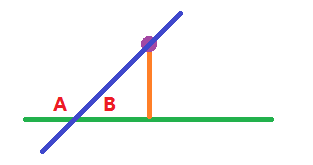 Why we can draw the perpendicular
Next, through the purple point, draw a line (the blue line below) perpendicular to the orange line we just constructed.
 Finding the parallel line
Now we can show that the blue line is parallel to the green line. The idea behind the proof is simple: the whole figure is symmetric about the orange line. If the blue line and the green line met on one side, then by symmetry they would also have to meet on the other side, giving two points of intersection—which contradicts the axiom we already accepted, that "two distinct lines in a plane intersect at most at one point." Hence the two lines can only be parallel.
We've now found a parallel line, and by the fifth postulate there is only one such line, so this must be the one.
"If Alternate Interior Angles Are Equal, the Two Lines Are Parallel"
Now let's prove "if alternate interior angles are equal, the two lines are parallel." Personally, I don't think this is simple at all...
Suppose we have two parallel lines: the blue line and the green line. The yellow line crosses both parallel lines, creating a pair of alternate interior angles C and D. Next, through the intersection point at angle C, draw a pink line perpendicular to the blue line; we can then show that this pink line is also perpendicular to the green line. This seems obvious, but it still needs proof: if the pink line were not perpendicular to the green line, then by the same construction as before we could draw yet another line through that same point which is also parallel to the blue line—giving two distinct lines through the same point both parallel to the blue line, a contradiction. As a bonus, it's also easy to show that the red line is parallel to the pink line.
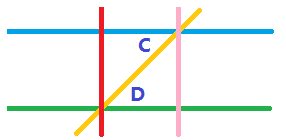 Alternate interior angles equal
Now we've obtained a rectangle—a figure whose four interior angles are all 90°. We can then use the symmetry of the rectangle to show that the two triangles are congruent, i.e., that two triangles with three pairs of equal corresponding sides are congruent, which in turn gives us the equality of the alternate interior angles. This congruence criterion itself stems from the rigidity of triangles—which is likewise a geometric axiom.
But let's not forget: we still haven't proven that opposite sides of the rectangle are equal!! Here the rectangle is defined as a quadrilateral whose four interior angles are all 90°, which does not by itself include the condition that opposite sides are equal—that has to be proved. Fortunately, it's not hard: using symmetry, fold the rectangle in half. By the way we constructed our parallel line (two successive perpendiculars), the parallel line through the midpoint is exactly the axis of symmetry, so after folding, the two halves coincide exactly. (I've described this somewhat informally here; it can certainly be written out in precise mathematical language—I encourage readers to try it themselves. Symmetry is the key idea.)
A Brief Summary
We've spent this much space just to pin down the notion of parallelism, and I'm still not entirely sure whether I've made everything clear. This shows that when dealing with such basic questions, one needs to interrogate every step and proceed cautiously, or else risk falling into logical contradictions. Whether it's actually worth going to this much trouble is, of course, a matter of personal taste.
There may well be places where my reasoning is not fully rigorous, or where logical contradictions have crept in—if readers spot any, I'd welcome the criticism.
Translated automatically with claude-sonnet-5; all equations are reproduced verbatim from the source. Copyright remains with the original author.