From Fermat's Last Theorem, Continued (11): Rational Points and the Chord-Tangent Method
 Rational points on a circle
In this series of posts we have explored some basic facts about rings and fields, and used integral domains together with the theorem on unique factorization to prove Fermat's Last Theorem for the cases n=3 and n=4. Using facts about the Gaussian integers or the Eisenstein integers is, relatively speaking, a fairly "high-level" piece of modern algebra (Gauss was born in 1777, and Eisenstein in 1823 — though Eisenstein died young, in 1852, while Gauss lived on until 1855). If things go "smoothly," these high-level tools let us prove non-existence of solutions, or find the general solution (if one exists).
However, for elementary number theory, the barrier of entry for knowledge of rings and fields over the complex numbers is a bit too high. Moreover, rings and fields are a rather "powerful" tool — and by "powerful" I mean something almost "domineering": if it succeeds, it takes the whole city in one stroke, giving us the complete general solution (or proving no solution exists); but if it fails, we often can't even extract a single nontrivial solution. Yet for some problems, even finding part of the solution set is already hard enough, let alone finding the general solution (we will feel this deeply later on when we study the integer solutions of $x^4+y^4 = z^4 + w^4 $). So for these problems, relying purely on ring/field thinking often fails to give us even a partial answer. (Of course, what exactly counts as "purely" is itself hard to pin down — this remark is admittedly a bit rough.)
more
What this post introduces instead is a geometric method that can effectively help us find rational points on certain Diophantine curves. Remarkably, this method is not new at all — in fact it's quite "ancient," since according to historical study, it was already used by Diophantus, the "father of Diophantine equations" himself. It is a geometric technique for finding rational points on a curve. As we will see, many problems about integer solutions of Diophantine equations can be reduced to the corresponding question about rational solutions, and that is exactly where this method comes into its own. Without further ado, let's take a look. (The ideas in this post are drawn from Mathematics and Its History.)
Rational points on a circle
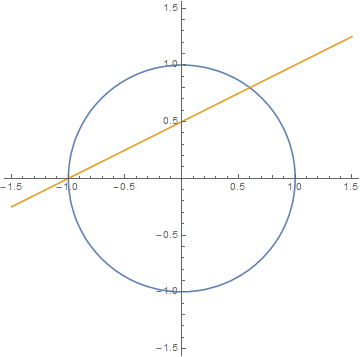
Let's start with the secant-line (chord) method. I think the best example for introducing it is the problem of Pythagorean triples. Finding the integer solutions of the Diophantine equation $a^2+b^2=c^2$ is equivalent to finding the rational points on the unit circle $x^2+y^2=1$. An obvious rational point is $(\pm 1,0)$, and the goal of the chord method is to use this obvious rational point to generate a whole family of nontrivial rational points. The underlying idea is not hard at all — it mainly exploits the relationship between the roots and coefficients of an algebraic equation, i.e., Vieta's formulas!
Rational points on a circle
Through the point $(-1,0)$ we draw a line of slope $k$, with equation
$$y=k(x+1)$$
This line already meets the circle $x^2+y^2=1$ at $(-1)$, so it must have another intersection point with the unit circle. The question now is: is this other intersection point also rational? By Vieta's formulas, it's easy to see that as long as $k$ is rational, the other intersection point must also be rational. This is because substituting the line's equation into the circle's equation gives a quadratic
$$1=x^2+k^2 (x+1)^2=(1+k^2)x^2 + 2k^2 x +k^2$$
As long as $k$ is rational, the coefficients of this equation are all rational, and by Vieta's formulas, $x_1 + x_2=-\frac{2k^2}{1+k^2}$: since one root is $x_1=-1$, the other root must also be rational, namely $x_2=\frac{1-k^2}{1+k^2}$, and hence the other point is the rational point $\left(\frac{1-k^2}{1+k^2},\frac{2k}{1+k^2}\right)$. A little rearranging then gives the general formula for Pythagorean triples.
Rational points on cubic curves
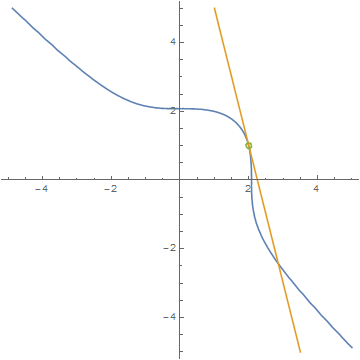
We previously considered the integer solutions of $x^3+y^3=z^3+w^3$, viewing it as an equation in $x,y$ — a cubic, with $z,w$ a rational parameter — which has the trivial rational point $(x,y) = (z,w)$.
By analogy with finding rational points on a circle: if we know two rational points on a cubic curve, we can draw the secant line through them, and it will meet the cubic curve at a third point, which must also be rational. However, in most cases we only know a single rational point on the curve. So is there a way to find other rational points starting from just one? There is indeed a way — we let the two known rational points coincide in the limit, so that the secant line becomes a tangent line. In other words: given one rational point, we draw the tangent line to the curve at that point, then substitute this tangent line's equation into the original cubic equation, obtaining a cubic equation with rational coefficients. Now, the known rational point is a double root of this cubic! Hence the remaining third root must also be rational. Let's illustrate this tangent-line technique concretely by finding a family of solutions to $x^3+y^3=z^3+w^3$.
 Rational points on a cubic curve
Differentiating both sides gives
$$3 x^2+ 3 y^2 \frac{dy}{dx}=0$$
from which we find that at the point $(z,w)$ we have $\frac{dy}{dx}=-\frac{z^2}{w^2}$, and so the tangent line at that point has equation
$$y=-\frac{z^2}{w^2}(x-z)+w$$
Substituting this back into the original equation gives
$$x^3+\left[-\frac{z^2}{w^2}(x-z)+w\right]^3=z^3+w^3$$
which yields the third root (the double root being $w=z$):
$$x=\frac{2 w^3 z+z^4}{z^3-w^3}$$
and correspondingly
$$y=\frac{w^4+2 w z^3}{w^3-z^3}$$
So we have found a two-parameter family of rational solutions
$$\left(\frac{2 w^3 z+z^4}{z^3-w^3}\right)^3+\left(\frac{w^4+2 w z^3}{w^3-z^3}\right)^3=z^3+w^3$$
Of course, this parametrized family does not generate all rational solutions — as we can tell from the fact that it only has two parameters, whereas the complete set of rational solutions should require at least three parameters. This is a characteristic feature of the tangent-line method: it is usually effective, but incomplete. Many problems about cubic curves can be handled similarly to produce a family of rational solutions (provided, of course, that rational solutions exist — or at least that one particular rational solution is already known). A more general equation of this type is $y^2=ax^3+bx^2+cx+d$, where $a,b,c,d$ are all rational.
The tangent-line result for y²=ax³+bx²+cx+d
For convenience in later applications, let us state — without derivation — the result for $y^2=ax^3+bx^2+cx+d$. Readers who are interested can work out the derivation themselves; the method is the same as above, just with a few more steps and roughly the same level of complexity, or you may consult the reference book at the end of the post. Suppose this cubic curve passes through $(x_1,y_1)$ and $(x_2,y_2)$; then the secant-line method gives the third point as
$$x_3=-(x_1 + x_2)-\frac{b-[(y_2-y_1)/(x_2-x_1)]^2}{a}$$
Now consider the case where we only have a single point $(x_1,y_1)$, i.e., we replace $\frac{y_2-y_1}{x_2-x_1}$ by the derivative at that point, $\frac{dy}{dx}$, giving
$$\left\{\begin{aligned}&\frac{dy}{dx}=\frac{3ax_1^2+2bx_1+c}{2y_1}\\ &x_2=-2 x_1-\frac{b-[(3ax_1^2+2bx_1+c)/(2y_1)]^2}{a}\end{aligned}\right.$$
The Mordell theorem
Using the tangent-line method we've found a batch of rational points on the cubic curve. From here we can carry out two operations:
1. Take these new rational points as points of tangency, draw the tangent lines, and obtain yet another batch of solutions;
2. Pick any two rational points, draw the secant line through them, and likewise obtain new rational points.
These two steps can be repeated indefinitely. The question is: can this process ever produce all the rational points?
The answer is yes — this was conjectured by Poincaré and proved by Mordell: every rational point can be generated, starting from finitely many points, by repeatedly drawing tangent lines and chords. This once again confirms the value of the chord-tangent method. That said, we still don't have a general algorithm that, via tangent lines and secant lines alone, produces the entire set of rational points.
A word on Diophantus
 Diophantus
It's hard to imagine that the technique described above appeared nearly two thousand years ago — yet that does indeed seem to be the case!
Diophantus, an important scholar and mathematician of the late Alexandrian period of ancient Greece (roughly 246–330 CE, based on inference and calculation), discussed, in his book Arithmetica, many problems about rational points on quadratic and cubic curves — but his methods were not passed down to us. Over a thousand years later, Fermat too studied questions of rational and integer points on curves, and stated a number of claims (or perhaps conjectures), but Fermat's methods were likewise never widely transmitted. Newton, however — the founder of calculus and roughly a contemporary of Fermat — gave us the secant-line and tangent-line methods, and believed that these were in fact the very methods Diophantus and Fermat had used. Today we tend to believe this conjecture, because however you look at it, all the other methods we have for finding rational points on algebraic curves are more "high-level" than the chord-tangent method; by comparison, the chord-tangent method is a rather "down-to-earth", accessible tool. Moreover, given how devoted the ancient Greeks were to geometry, it's quite plausible that they arrived at the chord-tangent method precisely through geometric investigation of the problem of rational points.
Reference
Mathematics and Its History, by John Stillwell, published by Higher Education Press
Translated automatically with claude-sonnet-5; all equations are reproduced verbatim from the source. Copyright remains with the original author.