From Fermat's Last Theorem (Part 10): x^3+y^3=z^3+w^3
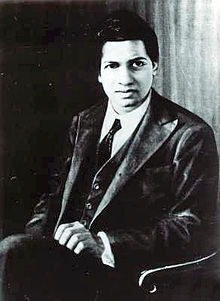 Ramanujan
Before diving into the mathematics, let's start with an anecdote about the great Indian mathematical genius Ramanujan. While Ramanujan was gravely ill, Hardy went to visit him. Hardy remarked, "I came here in taxi cab number 1729. It seemed to me rather a dull number, and I hope it isn't an unfavorable omen." Ramanujan replied, "No, it is a very interesting number. It is the smallest number expressible as the sum of two cubes in two different ways" (namely $1729 = 1^3+12^3 = 9^3+10^3$; such numbers later came to be called taxicab numbers). Littlewood, commenting on this anecdote, said, "Every positive integer is one of Ramanujan's personal friends." (From Wikipedia)
From this anecdote we see that certain integers can indeed be expressed as a sum of two cubes in two different ways. In other words, the Diophantine equation
$$x^3+y^3=z^3+w^3$$more
has pairwise distinct integer solutions $(x,y,z,w)$ (positive or negative). Using Eisenstein integers, we can derive an expression for the general solution. The general solution obtained here is more complicated than the ones found in textbooks, but it can generate all integer solutions from integer parameters. (There exists a simplified formula that can also produce all integer solutions, but to obtain certain integer solutions it requires a fractional parameter, which raises doubts about whether it truly generates all integer solutions.)
First, factor both sides within the Eisenstein integers:
$$(x+y)(x+y\omega)(x+y\omega^2)=(z+w)(z+w\omega)(z+w\omega^2)$$
Denote $x+y\omega$ as $\xi$, and $z+w\omega$ as $\eta$. We then obtain
$$\xi\bar{\xi}\left(\omega\xi+\omega^2\bar{\xi}\right)=\eta\bar{\eta}\left(\omega\eta+\omega^2\bar{\eta}\right)$$
A little analysis shows that $\xi$ must be a composite number in the ring of Eisenstein integers, so let us set
$$\xi=\alpha\beta$$
Then the left-hand side above becomes
$$\alpha\beta\bar{\alpha}\bar{\beta}\left(\omega\alpha\beta+\omega^2\bar{\alpha}\bar{\beta}\right)$$
Note that the quantity inside the parentheses must be a real number, so in general we may set (with $\lambda$ a real number)
$$\omega\alpha\beta+\omega^2\bar{\alpha}\bar{\beta}=\lambda\gamma\bar{\gamma}$$
Then the left-hand side of the equation becomes
$$\alpha\beta\bar{\alpha}\bar{\beta}\left(\lambda\gamma\bar{\gamma}\right)$$
Given the structure of the right-hand side, it should resemble the left-hand side, so the factors on the right can only be a rearrangement of the factors on the left. Without loss of generality, take one such rearrangement:
$$\alpha\gamma\bar{\alpha}\bar{\gamma}\left(\lambda\beta\bar{\beta}\right)$$
That is to say,
$$\left\{\begin{aligned}&\eta=\alpha\gamma\\ &\bar{\eta}=\bar{\alpha}\bar{\gamma}\\ &\omega\eta+\omega^2\bar{\eta}=\lambda\beta\bar{\beta}\end{aligned}\right.$$
Combining this with the already known relation
$$\left\{\begin{aligned}&\xi=\alpha\beta\\ &\bar{\xi}=\bar{\alpha}\bar{\beta}\\ &\omega\xi+\omega^2\bar{\xi}=\lambda\gamma\bar{\gamma}\end{aligned}\right.$$
we notice that
$$\left\{\begin{aligned}&\omega\alpha\gamma+\omega^2\bar{\alpha}\bar{\gamma}=\lambda\beta\bar{\beta}\\ &\omega\alpha\beta+\omega^2\bar{\alpha}\bar{\beta}=\lambda\gamma\bar{\gamma}\end{aligned}\right.$$
Now comes the crucial step: we flip our perspective and treat these as a system of equations in $\alpha,\bar{\alpha}$ — which turns out to be nothing more than a system of two linear equations in two unknowns! Solving it, we get
$$\alpha=\lambda\omega^2\frac{\beta\bar{\beta}^2-\gamma\bar{\gamma}^2}{\gamma\bar{\beta}-\beta\bar{\gamma}}$$
With this, we have completed the construction of the solution: given the parameters $\lambda,\beta,\gamma$, we can compute $\alpha$, and then, using
$$\xi=\alpha\beta,\quad\eta=\alpha\gamma$$
we can find $\xi,\eta$, and from there obtain $x,y,z,w$. Careful readers will notice that $\lambda$ is a real number while $\beta,\gamma$ is an Eisenstein integer; viewed as real numbers, each of them carries two free parameters, so altogether we get a solution with five free parameters! There are only four unknowns, yet five parameters — in principle there should be redundancy among the parameters. But in order to obtain all integer solutions from integer parameters, it turns out this is nonetheless necessary — quite a remarkable fact.
Setting $\beta=a+b\omega,\,\gamma=c+d\omega$, and with the help of Mathematica, we can derive (the case $\lambda$ is a trivial parameter choice and so is omitted)
$$\left\{\begin{aligned}x&=\frac{a^3 (c+d)-3 a^2 b c+3 a b^2 c+b^3 (d-2 c)-(c^2-c d+d^2)^2}{3 b c-3 a d}\\[2ex] y&=\frac{a^3 (c-2 d)+3 a^2 b d-3 a b^2 d+b^3 (c+d)-(c^2-c d+d^2)^2}{3 a d-3 b c}\\[2ex] z&=\frac{a^4-2 a^3 b+3 a^2 b^2-a (2 b^3+c^3+d^3)+b (b^3+2 c^3-3 c^2 d+3 c d^2-d^3)}{3 a d-3 b c}\\[2ex] w&=\frac{-a^4+2 a^3 b-3 a^2 b^2+a (2 b^3+c^3-3 c^2 d+3 c d^2-2 d^3)+b (-b^3+c^3+d^3)}{3 a d-3 b c} \end{aligned}\right.$$
— a rather complicated parametric solution indeed~~
Here, taking $a=-1,b=-2,c=3,d=3$ gives $x=9,y=-12,z=1,w=-10$, that is, $1^3+12^3=9^3+10^3$, which is the smallest integer solution.
Readers who are curious might want to try their hand at the case of $x^4+y^4=z^4+w^4$. Indeed, this equation also has pairwise distinct integer solutions; however, it is far more difficult than the cubic case, and to this day we don't even know a general solution of any form for it.
Translated automatically with claude-sonnet-5; all equations are reproduced verbatim from the source. Copyright remains with the original author.