Starting from Fermat's Last Theorem (III): Gaussian Integers
To extend the concept of integers, we need to understand two algebraic structures: rings and fields. This material is widely available online or in standard abstract algebra textbooks. The point of introducing these two structures abstractly is to be able to handle the properties of different number rings and number fields in a unified way. In the set of natural numbers $\mathbb{N}$, it's easy to define and compare the sizes of two numbers, and moreover every nonempty subset of natural numbers has a least element. Taken together, these two facts mean that $\mathbb{N}$ is "well-ordered" (this is also the foundation of mathematical induction). In a well-ordered structure, proofs of many properties become quite simple — the fundamental theorem of arithmetic, for instance. However, general number rings and number fields don't have this kind of "well-ordering"; for example, any two complex numbers cannot be compared in size. Because of this, ideas that don't rely on well-ordering become much more important.
Rings and Fields
For the definition of a ring, you can refer to the Wikipedia entry "Ring (mathematics)." Roughly speaking, a ring is a set whose elements can be added and multiplied, subject to certain necessary properties, such as closure under the operations, commutativity of addition, and so on. In number theory, what we study most of the time are number rings, meaning cases where the underlying set is a set of numbers, and usually the addition and multiplication of elements is just ordinary numerical addition and multiplication. For example, all the (real) integers form a number ring $\mathbb{Z}$, which is infinite; all the even integers also form a number ring $2\mathbb{Z}$; and for a prime $p$, modulo $p$ the set $\{0,1,2,\dots,p-1\}$ also forms a ring — and in fact, more specially, it is even a number field.
A field is a special case of a ring: the elements of a field can not only be added and multiplied (and since additive inverses are required, addition also entails subtraction), but can also be divided. See "Field (mathematics)" for details. Under the usual four arithmetic operations, the set of rational numbers $\mathbb{Q}$ is the smallest number field.
Gaussian Integers
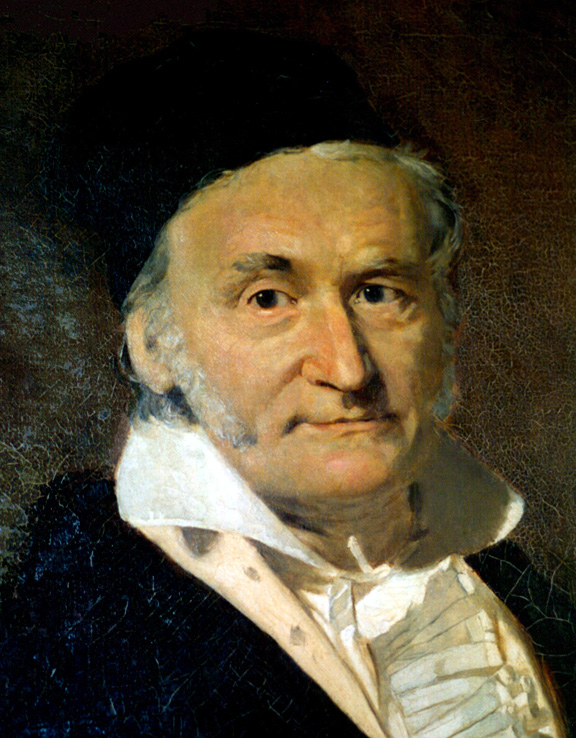 Carl_Friedrich_Gauss
What we usually call complex numbers, also known as Gaussian numbers, are defined abstractly as
$$\mathbb{C}=\{a+b i|a,b\in \mathbb{R},\ i^2=-1\}$$
and when $a,b$ are both (real) integers, we call these Gaussian integers:
$$\mathbb{Z}[i]=\{a+b i|a,b\in \mathbb{Z},\ i^2=-1\}$$
The addition and multiplication defined on $\mathbb{Z}[i]$ are just the ordinary addition and multiplication of complex numbers, and under these operations the Gaussian integers form an integer ring.
Next let's introduce the norm of Gaussian integers. The norm is a map from the elements of a number ring to $\mathbb{R}$. This is because, unlike $\mathbb{R}$, elements of a general number ring generally cannot be compared in size — that is, they cannot be ordered. But in order to impose some kind of ordering on a subset of elements of a number ring, we define the norm, denoted $N$ (the initial letter of "Normal"), which is required to satisfy: the norm of a product of two elements equals the product of their norms. For a Gaussian integer $\mathbb{Z}[i]$, the norm is defined as
$$N(a+bi)=(a+bi)(a-bi)=a^2+b^2$$
Of course, the norm isn't only defined for integers — it can equally well be defined for general complex numbers. And the norm of an integer isn't necessarily itself an integer; this depends on how the norm is defined. If we don't worry about other considerations, the norm of a complex number could also be defined as $N(a+bi)=\sqrt{a^2+b^2}$; it's just that, in number theory, we usually deal with integer or rational-number problems, and we'd like integers or rationals to have a norm that is itself an integer or rational, which makes our study more convenient.
With the norm in hand, we can define units. In $\mathbb{Z}[i]$, the units are the Gaussian integers whose norm is 1, namely $\pm 1,\pm i$. It's not hard to see that all four of these numbers are invertible, and moreover that these are the only invertible elements — hence units are also called invertible elements. "Invertible" means that both $a+bi$ and $\frac{1}{a+bi}$ belong to $\mathbb{Z}[i]$. If two Gaussian integers differ only by a unit factor, we say the two Gaussian integers are associates (they are associated with each other).
Next, the concept of divisibility: if $Z_1=Z_2 Z_3$, $Z_1,Z_2,Z_3\in \mathbb{Z}[i]$, then we say that $Z_2$ (or $Z_3$) divides $Z_1$, written $Z_2|Z_1$ (or $Z_3|Z_1$). It's easy to see that $Z_2|Z_1 \Rightarrow N(Z_2)|N(Z_1)$.
We can also define the common divisor and greatest common divisor of two Gaussian integers. If $Z_3|Z_1,Z_3|Z_2$, then $Z_3$ is a common divisor of $Z_1,Z_2$. If, for any common divisor $Z_1,Z_2$ of them, $Z_4$, we have $Z_4|Z_3$, then $Z_3$ is their greatest common divisor. The greatest common divisor can be thought of as the common divisor with the largest norm. If the greatest common divisor of two numbers is a unit, we say the two numbers are coprime.
Finally, we can define Gaussian primes. Let $Z_1$ be a Gaussian integer; if for any Gaussian integers $Z_2$ and $Z_3$, neither of which is a unit, such that $Z_1 \neq Z_2 Z_3$, [no such factorization exists] — then $Z_1$ is a Gaussian prime. This generalizes the notion of prime numbers among the ordinary integers, and Gaussian primes are usually denoted by the letter $\pi$. Note that in the Gaussian integers, 2 is no longer prime, since $2=(1+i)(1-i)$, where $(\pm 1 \pm i)$ are the four Gaussian primes of smallest norm. For a more detailed treatment of Gaussian integers and Gaussian primes, see Chapter 9 of Lectures on Number Theory (Part II) by Sun Qi and Ke Zhao.
Analysis Modulo 1+i
Among the ordinary integers, we have parity analysis — it's easy to tell whether a number is odd or even, and this lets us make various basic feasibility judgments. But among the Gaussian integers, since 2 is no longer prime, parity analysis no longer makes sense. However, there is an analogous "analysis modulo $1+i$," which plays the same role among the Gaussian integers that parity analysis plays among the ordinary integers. These properties play a central role in the proof of Fermat's Last Theorem $n=4$.
1. First, regarding operations on $1+i$ itself, note that $(1+i)^2=2i,(1+i)^4=-4,(1-i)i=1+i$.
2. $1+i|a+bi$ if and only if $2|a+b$.
Here are two proofs. The first: let $(m+ni)(1+i)=a+bi$; expanding gives $(m-n)+(m+n)i=a+bi$, so $a+b=(m-n)+(m+n)=2m$, and hence $2|a+b$. This proof is simple and reversible, but not very illuminating. The second proof: suppose $1+i|a+bi$; then necessarily $1-i|a-bi$, since the squares of $\pm i$ are all 1 — they play symmetric roles. Multiplying through gives $(1+i)(1-i)|(a+bi)(a-bi)$, and since $(1+i)(1-i)=2$, $(a+bi)(a-bi)=a^2+b^2=(a+b)^2-2ab$, we get $2|a+b$. This reasoning is less obviously reversible, but it generalizes more readily to other number rings.
3. If $1+i \nmid a+bi$, then $(a+bi)^2 \equiv \pm 1(\bmod\,4)$.
Since $1+i \nmid a+bi$, we have $2\nmid a+b$, so $a,b$ are one odd and one even. And $(a+bi)^2=a^2-b^2+2abi$, where $4|2abi$; if $a$ is even and $b$ is odd, then $4|a^2,\ -b^2\equiv -1(\bmod\,4)$; if $b$ is even and $a$ is odd, then $4|b^2,\ a^2\equiv 1(\bmod\,4)$, so $(a+bi)^2 \equiv \pm 1(\bmod\,4)$. $-4=(1+i)^4$, and this in turn means $(a+bi)^2 \equiv \pm 1(\bmod\,(1+i)^4)$.
4. If $1+i \nmid a+bi$, then $(a+bi)^4 \equiv 1(\bmod\,8)$.
Since $1+i \nmid a+bi$, we have $2\nmid a+b$, so $a,b$ are one odd and one even. And $(a+bi)^4=(a^4+b^4-6a^2 b^2)+4ab(a^2-b^2)i$; without loss of generality, suppose $a$ is odd and $b$ is even. Then every term of $b^4-6a^2 b^2 +4ab(a^2-b^2)i$ is divisible by 8, while $a^4$ is the fourth power of an odd number, which leaves remainder 1 when divided by 8. $-8i=(1+i)^6$, and this in turn means $(a+bi)^4 \equiv 1(\bmod\,(1+i)^6)$.
We've spent quite a lot of space here extending the concept of integers, and much of the content has been purely conceptual, which can be tedious both to understand and to remember. However, once we later see the elegant proofs that this extended notion of integers makes possible, we'll deeply appreciate that the effort was worth it. That said, we can't yet enjoy that payoff, because there's still one more piece we're missing: the unique factorization ring.
Translated automatically with claude-sonnet-5; all equations are reproduced verbatim from the source. Copyright remains with the original author.