Solving Cubic Equations by Radicals (A Popular-Science Version)
(Note: since this article contains a lot of square/cube roots, it's recommended that you read it directly in IE, or in IE with MathPlayer. Firefox's rendering of radicals is rather poor.)
As we all know, algebraic equations of degree 1 through 4 all have formulas for their roots (though these may not always be the simplest way to solve them). Most people are quite familiar with solving linear and quadratic equations. But do you know how to solve a cubic equation?
$$ax^3+bx^2+cx+d=0\,(a\neq0)$$
There is plenty of material about this online, but it tends to suffer from two shortcomings: first, a lack of proper tools for rendering professional mathematical notation (this is true of many websites); and second, language that is too technical to be accessible to a general audience (as with Wikipedia). more
To understand the formula for solving a cubic equation, we first need to know that, in general, an algebraic equation of degree n has n roots. For the most basic cubic equation $x^3+p=0$, we have:
$$x_1=-\sqrt[3]{p}$$
At the same time, by Vieta's formulas, we have $x_1+x_2+x_3=0,x_1\cdot x_2\cdot x_3=-p$. Since we already know $x_1=-\sqrt[3]{p}$, this becomes a system of quadratic equations in $x_2,x_3$, which can be solved (with $i^2=-1$ the imaginary unit):
$$x_2=-\frac{1}{2}(-1+\sqrt{3}i)\sqrt[3]{p}, \quad x_3=-\frac{1}{2}(-1-\sqrt{3}i)\sqrt[3]{p}$$
In particular, $\frac{1}{2}(-1+\sqrt{3}i)$ is usually written as $\omega$, giving us
$$x_2=-\sqrt[3]{p} \omega,\quad x_3=-\sqrt[3]{p}\omega ^2$$
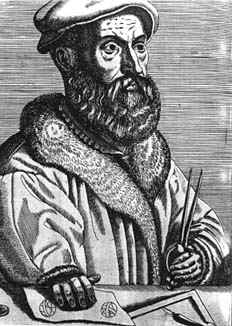 Image caption: Tartaglia
Now let's move on to solving the general cubic equation:
For a cubic equation $ax^3+bx^2+cx+d=0\,(a\neq 0)$, we can use a substitution: let $y=x+\frac{b}{3a}$, which transforms the original equation into a cubic equation in y:
$$y^3+py+q=0 \Leftrightarrow y^3+py=-q$$
where
$$\begin{aligned}&y=x+\frac{b}{3a}\\ &p=\frac{c}{a}-\frac{b^2}{3a^2}\\ &q=\frac{2{b^3}}{27a^3}-\frac{bc}{3a^2}+\frac{d}{a}\end{aligned}$$
(Cardano's proof) Since $(A-B)^3+3AB(A-B)=A^{3}-B^{3}$, we have $3AB=p,A^{3}-B^{3}=-q,y=A-B$, which turns into a system of sixth-degree equations in $A,B$. This system of sixth-degree equations is actually quite simple — through a substitution, it reduces to a system of quadratic equations, which can be solved. In the end we obtain:
$$\begin{aligned}&A=\sqrt[3]{-\frac{q}{2}+\sqrt{\left(\frac{q}{2}\right)^2+\left(\frac{p}{3}\right)^3}}, &B=\sqrt[3]{\frac{q}{2}+\sqrt{\left(\frac{q}{2}\right)^2+\left(\frac{p}{3}\right)^3}}\end{aligned}$$
From here it's straightforward to get the solution of the original equation.
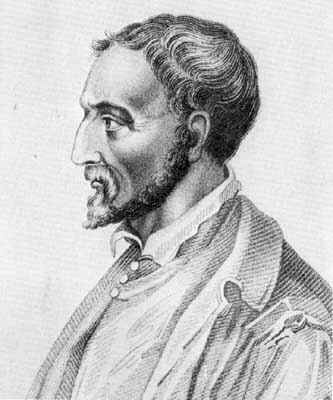 Image caption: Cardano, also transliterated as Cardan
Finally, we arrive at the root formula for the equation $y^3+px+q=0$:
$$\begin{aligned}&x_1=\sqrt[3]{-\frac{q}{2}+\sqrt{(\frac{q}{2})^2+(\frac{p}{3})^3}}+\sqrt[3]{-\frac{q}{2}-\sqrt{(\frac{q}{2})^2+(\frac{p}{3})^3}}\\ &x_2=\omega \sqrt[3]{-\frac{q}{2}+\sqrt{(\frac{q}{2})^2+(\frac{p}{3})^3}}+\omega^2\sqrt[3]{-\frac{q}{2}-\sqrt{(\frac{q}{2})^2+(\frac{p}{3})^3}}\\ &x_3=\omega^2\sqrt[3]{-\frac{q}{2}+\sqrt{(\frac{q}{2})^2+(\frac{p}{3})^3}}+\omega \sqrt[3]{-\frac{q}{2}-\sqrt{(\frac{q}{2})^2+(\frac{p}{3})^3}}\\ &\omega=\frac{1}{2}(-1+\sqrt{3}i)\end{aligned}$$
Having read this far, if you'd like to challenge yourself, why not try writing out the general root formula for $ax^3+bx^2+cx+d=0\,(a\neq 0)$? ^_^
As for the quartic equation, I'll write about that too when I have time.
References:
http://zh.wikipedia.org/w/index.php?title=%E4%B8%89%E6%AC%A1%E6%96%B9%E7%A8%8B&variant=zh-cn
http://baike.baidu.com/view/521598.htm
http://baike.baidu.com/view/1315076.htm
http://www.oursci.org/archive/magazine/200112/011208.htm
Translated automatically with claude-sonnet-5; all equations are reproduced verbatim from the source. Copyright remains with the original author.