The Common Tangent Circle of Three Mutually Tangent Circles
Back when I was learning to drive, my cousin once asked me about a circle-construction problem:
Circumscribed and inscribed circles of three circles (1)
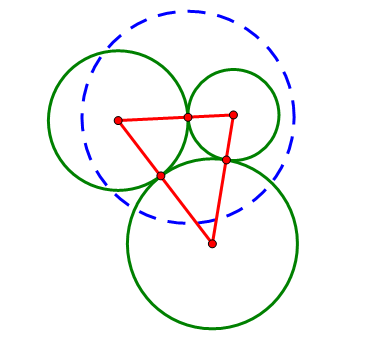
Given three pairwise tangent circles on a plane, along with their centers, construct (using only compass and straightedge) a circle that is tangent to all three of them.
If you try to tackle this purely with elementary geometry, it's hard even to tell whether such a circle exists. But I had a vague memory of having seen a similar problem before, and a term quickly came to mind: inversion. Inversion can turn a circle into a line (if the circle passes through the center of inversion), or into another circle (if it doesn't), while preserving other relations such as tangency and intersection. Applying the same inversion a second time to the transformed figure brings it back to the original one. The difficulty in this problem is that there are too many circles; using inversion, we can reduce it to a problem involving just two lines and one circle.
I'll assume the reader already has some basic knowledge of inversion. If not, please go to
http://zh.wikipedia.org/wiki/反演
and read up on it there. more
Here are the construction steps:
(1) Pick one of the points of tangency, and draw a circle centered at that point (with an arbitrary radius);
 Circumscribed and inscribed circles of three circles (2)
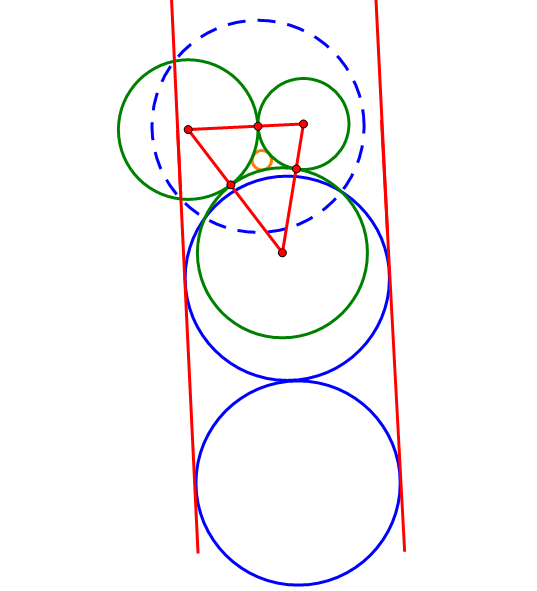
(2) Using the circle from (1) as the base circle of inversion, construct the inverse images of the three given circles. Two of them turn into two parallel lines, while the third one remains a circle after inversion, and this circle is tangent to the two lines.
 Circumscribed and inscribed circles of three circles (3)
 Circumscribed and inscribed circles of three circles (4)
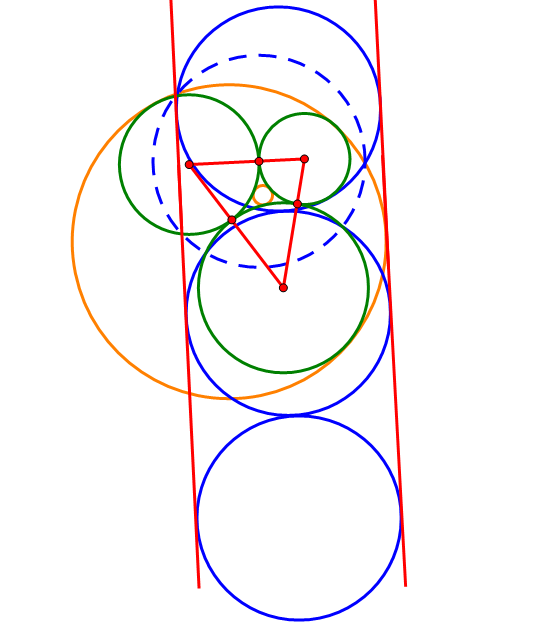
(3) The remaining steps are now easy: clearly we can construct two circles that are tangent to both the circle and the two lines in the inverted image. Having constructed these two circles, we again use the circle from (1) as the base circle and invert them back, giving us the circles we're after — corresponding respectively to the circumscribed circle and the inscribed circle of the three original circles.
 Circumscribed and inscribed circles of three circles (5)
 Circumscribed and inscribed circles of three circles (6)
Translated automatically with claude-sonnet-5; all equations are reproduced verbatim from the source. Copyright remains with the original author.