[Problem Solved] The Shortest Distance on a Hyperbola
Last night, a fellow blog reader and I discussed the following problem together:
The graph of the function $y=\sqrt{3} x-\frac{1}{x}$ is a hyperbola. Taking points P and Q on its two branches respectively, find the minimum possible distance PQ.
Clearly, if the hyperbola were in the standard form $\frac{x^2}{a^2}-\frac{y^2}{b^2}=1$, this problem would be quite simple — the minimum distance would just be the distance between the two vertices when y=0, namely 2a. But obviously this hyperbola has been rotated. So we need to figure out exactly how many degrees it has been rotated by $\theta$. Then we can write down $y=(\tan\theta) x$, combine it with the hyperbola's equation, and solve for the two points. More below the fold.
To find the rotation angle, we can make use of the hyperbola's two asymptotes. Lines are always easier to work with than hyperbolas. "Asymptotic" means the rough shape the function approaches in the limit. As $x\to \infty$, we have $\frac{1}{x} \to 0$, so one of the asymptotes is $y=\sqrt{3} x$; and as $x\to 0$, we have $y\to \infty$, which tells us the other asymptote is $x=0$ — the reasoning for this second asymptote can be understood by analogy with the asymptote of $y=\frac{1}{x}$.
Let's plot the hyperbola together with its asymptotes:
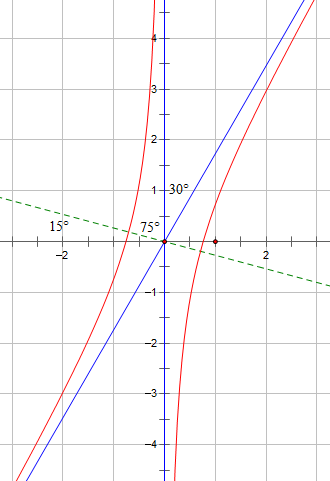 Hyperbola-asymptotes
Next we just need to find the equation of the angle bisector of the two asymptotes, shown as the green dashed line in the figure. A little geometric reasoning shows that the angle between the green dashed line and the negative x-axis is 15°, i.e. $\frac{\pi}{12}$, and from
$$\frac{2 \tan\frac{\pi}{12}}{1-\tan^2 \frac{\pi}{12}}=\tan\frac{\pi}{6}=\frac{\sqrt{3}}{3}$$
we can find $tan\frac{\pi}{12}=2-\sqrt{3}$, so the equation of the green dashed line is
$$y=(\sqrt{3}-2)x$$
Solving this together with $y=\sqrt{3} x-\frac{1}{x}$, we get
$$x=\pm \frac{\sqrt{2}}{2}$$
which corresponds to:
$y=\pm (\frac{\sqrt{6}}{2}-\sqrt{2})$
so the distance is
$$\begin{aligned}2\sqrt{(\frac{\sqrt{6}}{2}-\sqrt{2})^2+(\frac{\sqrt{2}}{2})} \\ =2\sqrt{4-2\sqrt{3}} \\ =2(\sqrt{3}-1)\end{aligned}$$
Translated automatically with claude-sonnet-5; all equations are reproduced verbatim from the source. Copyright remains with the original author.