A Brief Discussion on the Goldbach Conjecture, Part 1
Gauss once said, "Mathematics is the queen of the sciences, and arithmetic is the queen of mathematics." The "arithmetic" referred to here is essentially what we now call number theory. I've had a soft spot for number theory since I was very young. Although I've since encountered many more fascinating branches of mathematics, my enthusiasm for math has never waned. I suppose this stems from a childhood attachment. When I was in elementary school, having just learned the concepts of primes, composites, divisors, and divisibility, I was particularly drawn to numbers. I think, back then, number theory was really the only branch of mathematics whose famous open problems I could actually understand. Take Fermat's Last Theorem, for instance: $x^n+y^n=z^n$ has no positive integer solutions for n greater than 2 — it's easy to grasp what that's saying. Or take the Goldbach conjecture: every even number greater than 4 can be written as a sum of two odd primes — again, easy enough to understand. So once little me could make sense of these problems, I took great delight in playing around with numbers, and perhaps that's exactly why I developed such a deep love for numbers, and for mathematics as a whole.
The Goldbach conjecture is, without a doubt, a dazzling jewel in number theory, yet at present it remains tantalizingly out of reach. A conjecture that seems so simple has stumped mathematicians for centuries, and to this day no one has solved it. Even so, I'm happy to study it closely, to savor it slowly, and to appreciate the mysterious beauty of mathematics while "reasoning about" — or rather, computationally verifying — it. This post is mainly about studying the "Goldbach partition number" of a given even number, that is, through direct computation, finding the number of distinct ways an even number can be written as a sum of two primes. For example, 6 = 3 + 3 has only one way of being partitioned; 8 = 3 + 5 = 5 + 3 has two ways; 10 = 3 + 7 = 5 + 5 = 7 + 3 has three ways; and so on. The partition number of the even number 2n is denoted $G_2 (2n)$.
(The "partition number" defined here differs from the definition typically found online and in the general literature. Here, 3+5 and 5+3 are counted as two distinct partitions, whereas the usual online definition treats them as one. The advantage of my definition is that the partition number actually represents the total count of primes involved across all the partitions.)
It's true that the Goldbach conjecture is hard, but in fact it's actually a very weak statement. It says "every even number greater than 4 can be partitioned into a sum of two odd primes in at least one way" — in the terminology above, that every even number's "Goldbach partition number" is greater than or equal to 1. Yet actual computation shows that the larger the even number, the larger its Goldbach partition number tends to be — overall, the two are positively correlated. For instance, $G_2 (100)=12,G_2 (1000)=56,G_2 (10000)=254$... So in terms of strength, this is comparable to saying "there is at least one prime less than n" (though of course the difficulty is worlds apart). more
Why is such a weak statement so extraordinarily difficult to prove? Actually, there's a very basic approach to proving the Goldbach conjecture, namely the sieve method, somewhat similar to the Sieve of Eratosthenes. We can quite reasonably estimate the Goldbach partition number of each even number, but we simply cannot rigorously prove it down to the details — and that's exactly where the difficulty lies. As Hardy put it, "We have not failed in principle, but we have failed in detail."
Below is a table of Goldbach partition numbers that I computed using Python
(Due to space constraints, only even numbers up to 100 are listed; a table for numbers up to 10000 is included as an attachment.)
Even number Partition number
6 1
8 2
10 3
12 2
14 3
16 4
18 4
20 4
22 5
24 6
26 5
28 4
30 6
32 4
34 7
36 8
38 3
40 6
42 8
44 6
46 7
48 10
50 8
52 6
54 10
56 6
58 7
60 12
62 5
64 10
66 12
68 4
70 10
72 12
74 9
76 10
78 14
80 8
82 9
84 16
86 9
88 8
90 18
92 8
94 9
96 14
98 6
100 12
Overall, the larger n is, the larger $G_2 (2n)$ tends to be, but this isn't a universal rule. For example, the partition number of 96 is 14, but it drops to 6 for 98, then rises back to 12 for 100 — fluctuating unpredictably, hard to pin down, seemingly with no discernible pattern at all.
In fact, the partition number is related to the prime factors contained in the even number 2n. The fewer the prime factors, the larger the partition number tends to be, roughly speaking. So is there some "indicator," or approximate formula, that could give an upper or lower bound for $G_2 (2n)$? Through computational study, BoJone arrived at the following empirical formula:
$$G_2 (2n) > \frac{2n}{ln^2 (2n)} (n>3)$$
We might recall that the formula $\frac{2n}{ln (2n)}$ is actually just the one given by the prime number theorem. If the factor $\frac{1}{ln (2n)}$ is the result of applying a single sieve (sieving out primes less than 2n), then $\frac{1}{ln^2 (2n)}$ effectively corresponds to applying the sieve twice. So the Goldbach conjecture can be understood, roughly, as saying that after the natural numbers pass through two rounds of sieving, some "essence" still remains.
If there's no way to find a general pattern for the partition number, then perhaps we could first study the pattern for a specific class of even numbers. Since the partition number is related to prime factors, I naturally thought of numbers of the form $2^n$. Below is the partition table for this class of numbers:
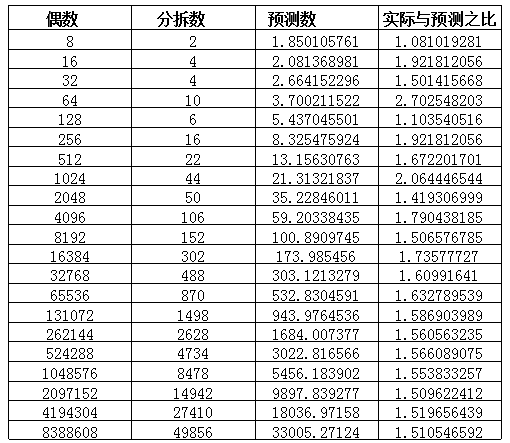 Goldbach study of 2^n-type even numbers
where the predicted value is $\frac{2^n}{ln^2(2^n)}$. When n is fairly large, the prediction quality of $\frac{2^n}{ln^2(2^n)}$ stabilizes, staying roughly around $\frac{2}{3}$ of the actual partition number. Of course, I haven't yet computed further values, since as n grows, it exceeds the computational range of the program I wrote — I'm still just starting out with programming, so the program's efficiency is still quite low.
Still, one can already spot some clues from this data. For a certain class of numbers, once their prime factors are fixed, the pattern of how the partition number changes becomes fairly clear — especially for numbers of the form $k^n$, where k is an even number. Perhaps that's a direction for further simple exploration down the road.
Attachment: Goldbach partition number table.zip
To be continued...
Translated automatically with claude-sonnet-5; all equations are reproduced verbatim from the source. Copyright remains with the original author.