A Chord of Fixed Length inside an Ellipse (the Circle-Transformation Method)
In the previous post A Chord of Fixed Length inside a Parabola, we solved the problem of the locus of midpoints of a fixed-length chord inside a parabola — that turned out to be a fairly easy problem. Even though a parabola and an ellipse are both conic sections, extending the same problem to the ellipse is not so simple at all. This is because the x and y coordinates in the ellipse's locus equation are "entangled" with each other through squares, unlike the parabola's equation, which can be easily separated (by "separated" I mean put into a form like $y=f(x)$). BoJone tried several approaches and still found it hard to work out the locus. In the end, the "circle-transformation method" finally gave the locus equation.
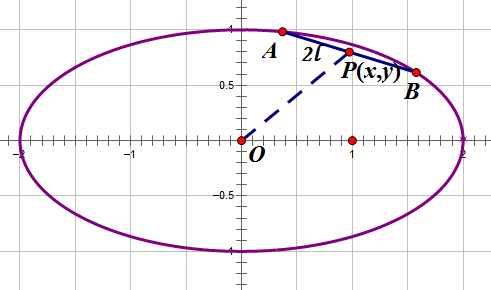 Fixed-length chord inside an ellipse 1
The so-called circle-transformation method consists of stretching an ellipse into a circle and using the properties of circles to solve problems. As everyone knows, compared with an ellipse, a circle has a lot more simplicity to it. This is a method I summarized while studying all sorts of conic-section problems from the college entrance exam (Gaokao) before my own exam. Sometimes, once you stretch an ellipse into a circle, the conclusion becomes practically obvious; and since a circle is a special case of an ellipse, any general result about ellipses naturally still holds for circles. So, to study a problem about ellipses, it can be worthwhile to first study its special case — the circle. On top of that, using the symmetry of the circle and so on can drastically reduce the amount of computation, which is why BoJone likes this method so much. What I really didn't expect was that it would actually come in handy for finding the locus in this post as well. more
How do we turn an ellipse into a circle? It's simple: let the equation of the ellipse be $\frac{x^2}{a^2}+\frac{y^2}{b^2}=1$. We just need to stretch the y-coordinate of the ellipse to $\frac{a}{b}$ times its original value, and the ellipse becomes $x^2+y^2=a^2$; or alternatively, we shrink the x-coordinate of the ellipse to $\frac{b}{a}$ of its original value, and the ellipse becomes $x^2+y^2=b^2$.
What properties does the stretched or shrunk figure have? The original relationships of intersecting, tangency, and separation are preserved; the area of the figure changes in proportion to the scaling factor of the length (since only one dimension is being scaled, there's no squaring involved); of course, angles and lengths will change too, and so on — readers will get a concrete feel for this in the calculations below.
As shown in the figure, the ellipse $\frac{x^2}{a^2}+\frac{y^2}{b^2}=1$ contains a fixed-length chord AB, $|AB|=2l$, where P(x, y) is the midpoint of AB, and let the slope of AB be k.
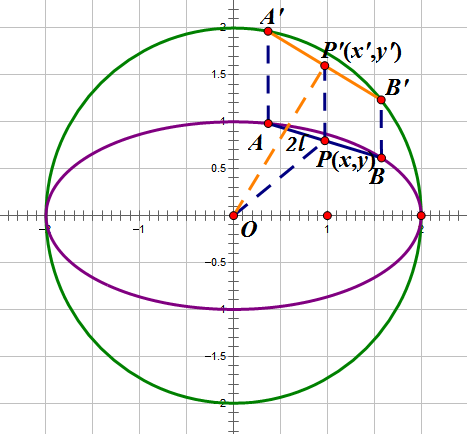 Fixed-length chord inside an ellipse 2
Using the stretching method, we stretch the y-coordinate of the ellipse to $\frac{a}{b}$ times its original value, and get the following results:
Point P becomes $P'(x',y')=P'(x,\frac{a}{b}y)$.
The slope k becomes $k'=\frac{a}{b}k$.
How does the length change then? We have the chord-length formula $|AB|=\sqrt{1+k^2}|x_A-x_B|$, from which we can see that the chord length is proportional to $\sqrt{1+k^2}$, so the stretched chord length is
$$|A'B'|=2l\cdot \sqrt{\frac{1+\frac{a^2}{b^2}k^2}{1+k^2}}$$
It is easy to find that the slope of OP' is: $\frac{y'}{x'}=\frac{ay}{bx}=-\frac{1}{k'}=-\frac{b}{ak}$
from which we can solve for $k=-\frac{b^2 x}{a^2 y}$.
We can also find the length of OP'.
$$|OP'|^2=x'^2+y'^2=x^2+\frac{a^2}{b^2}y^2$$
On the other hand, it also equals
$$a^2-(\frac{|A'B'|}{2})^2=a^2-l^2(\frac{1+\frac{a^2}{b^2}k^2}{1+k^2})$$
That is,
$$x^2+\frac{a^2}{b^2}y^2=a^2-(\frac{|A'B'|}{2})^2=a^2-l^2(\frac{1+\frac{a^2}{b^2}k^2}{1+k^2})$$
Using the $k=-\frac{b^2 x}{a^2 y}$ we obtained earlier, and substituting it into the equation above, after a series of simplifications we get
$$a^2 b^2[1-l^2(\frac{a^2 y^2+b^2 x^2}{a^4 y^2+b^4 x^2})]=a^2 y^2+b^2 x^2$$
This is the locus equation! Of course, it can also be simplified further into the following result. To me, the expression below looks nicer:
$$\sqrt{a^2 b^2-a^2 y^2-b^2 x^2}\cdot \sqrt{\frac{a^4 y^2+b^4 x^2}{a^2 y^2+b^2 x^2}}=lab$$
(This result was obtained on 2012.06.05)
Here is the result for a = 2, b = 1, l = 0.5:
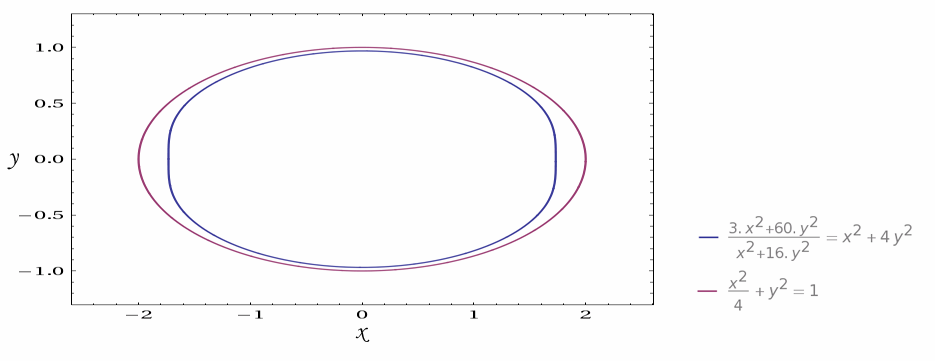 Fixed-length chord inside an ellipse 3
Summary
The "circle-transformation method" is a geometric-transformation technique, and an effective way of dealing with the heavy computation often involved in conic-section exercises. Of course, it has its limitations — in particular, it tends to fail when dealing with fixed-angle problems, and readers will need to explore and summarize the specific circumstances for themselves through practice. In high school, teachers almost never teach this trick, for the sake of consistency in the curriculum. But precisely because of its generality and elegance, I've always been fond of it. Although it has a bit of the flavor of a "folk remedy," it really does have many applications. Readers who are interested might want to think from this angle the next time they encounter a related problem — it may lead to unexpected discoveries. On another note, many geometric results that are quite simple within a circle (such as the power-of-a-point theorem) turn into rather good conic-section exercises once transformed via stretching into an ellipse. This might well be one of the ways conic-section problem-setters come up with their questions.
Translated automatically with claude-sonnet-5; all equations are reproduced verbatim from the source. Copyright remains with the original author.