A Fixed-Length Chord Inside a Parabola
The college entrance exam results are out, and they weren't quite what I'd hoped for — I won't be getting into a top-tier university. But no matter where I end up, I'll keep chasing my dream of science, and stay devoted to research in mathematics and physics. Yesterday I finished submitting my university application choices, so for now the whole college-entrance-exam saga is behind me, and all that's left is to wait for the results.
The next few posts will explore some interesting locus problems related to conic sections; nearly all of them were worked out in the two weeks before the exam. Let's start with the simplest one: inside the parabola $y=x^2$ there is a chord of fixed length a — find the locus of its midpoint, and investigate where the lowest point of that locus lies.
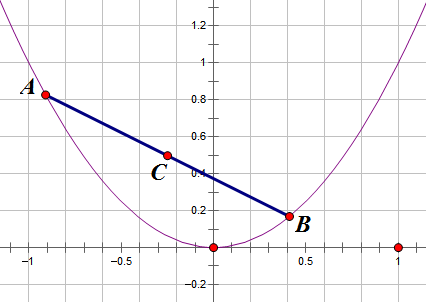 A fixed-length chord inside a parabola]
You can picture a corresponding physical model: a large bowl shaped like a parabola of revolution, with a chopstick sliding down inside it — we want the locus of its midpoint. And what would it mean for the midpoint to reach its lowest point? By the definition of gravitational potential energy, the midpoint being lowest means the potential energy is minimized, and the earlier "principle of minimum potential energy" tells us that minimizing the potential energy corresponds to equilibrium. So the lowest point of the midpoint locus actually corresponds to the stable position of this chopstick.
Let's first work out the locus. As in the figure, let $A=(x_1,y_1),B=(x_2,y_2)$, and combine this with $y=x^2$ to write down the relation
$$(x_1-x_2)^2+(x_1^2-x_2^2)^2=a^2$$
The coordinates of the midpoint are
$$x=\frac{x_1+x_2}{2},y=\frac{x_1^2+x_2^2}{2}$$
This form suggests that we should try to push the distance relation as close as possible to $x_1+x_2$ and $x_1^2+x_2^2$, and the derivation goes as follows
$$\begin{aligned}(x_1-x_2)^2[1+(x_1+x_2)^2]=a^2 \\ [2(x_1^2+x_2^2)-(x_1+x_2)^2][1+(x_1+x_2)^2]=a^2\end{aligned}$$
so the equation of the locus is
$$4(y-x^2)(1+4x^2)=a^2$$
or equivalently $4y=\frac{a^2}{1+4x^2}+4x^2$
Now let's investigate where the lowest point of the locus is, i.e., find the minimum value of y. By the basic inequality we get:
$$4y=\frac{a^2}{1+4x^2}+(1+4x^2)-1 \geq 2\sqrt{\frac{a^2}{1+4x^2}\cdot (1+4x^2)}-1=2a-1$$
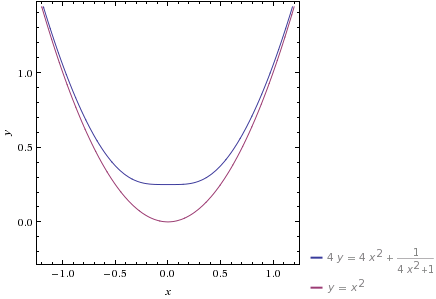
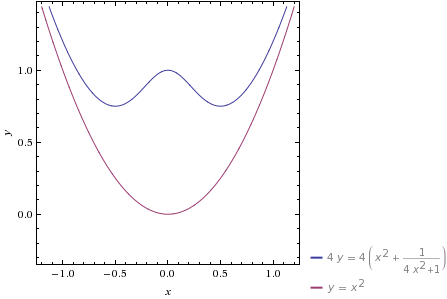
that is, $y_min=\frac{2a-1}{4}$, but there is a constraint — equality holds when $\frac{a^2}{1+4x^2}=1+4x^2$, which requires $a \geq 1$.
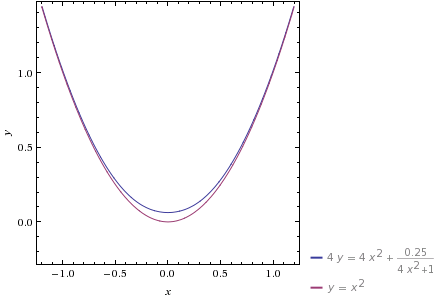
When $a \leq 1$, it's easy to see that the minimum $y_{min}=\frac{a^2}{4}$ is attained at x=0.
The graphs for different values of a are shown below:
Graph for a = 0.5
 Graph for a = 0.5]
Graph for a = 1
 Graph for a = 1]
Graph for a = 2
 Graph for a = 2]
As mentioned earlier, the lowest point is the equilibrium position of that "chopstick." But a force analysis tells us that when AB is parallel to the x-axis (the horizontal position), the chopstick is also in force equilibrium there — so shouldn't that also count as an equilibrium point? Why isn't that the point we found? The truth is, a system often has multiple equilibrium positions, but not every equilibrium position is stable. A stable equilibrium position, when slightly perturbed, will only oscillate gently around that point; an unstable equilibrium position, when slightly perturbed, will drift far away from its original state. For instance, if we gently shake this bowl, how will the chopstick move? If it wobbles only a little around its original position, that means it's stable; if it moves away to settle at another position altogether, that means it's unstable — even though both positions are points of force equilibrium.
For parabolas of the form $y=kx^2$, the locus can be reduced to the form treated in this post via a change of variables, so I won't go through it again. A natural question that comes to mind is: what if we change the curve in this post to an ellipse — what would the locus of the midpoint of a fixed-length chord look like then? That's what the next post will cover.
Translated automatically with claude-sonnet-5; all equations are reproduced verbatim from the source. Copyright remains with the original author.