2012 "Beiyou Alliance" Independent Admission Exam — Mathematics
The first six questions were multiple-choice, and I don't quite remember the details anymore — they were actually pretty simple. Readers who are interested can find the exam paper in the PDF attachment to this post (sourced from the math website "Kongnianyuanxi").
By the way, after checking the reference answers in this PDF, BoJone found that I got all the multiple-choice questions right. Of the last three long-answer problems, I only solved the last two, and my solutions differ somewhat from those in the PDF, so I'll write them out here for discussion.
1. Prove that a cyclic pentagon with equal interior angles is a regular pentagon.
I worked this one out in the last fifteen minutes of the exam. At first I thought of a lot of complicated theorems, but later I found it could be proved quite simply.
Below is a pentagon satisfying the conditions of the problem.
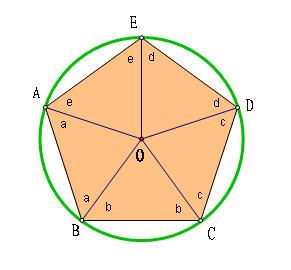 Pentagon more
Since each of the small triangles has one vertex at the center of the circle and two vertices on the circle, each of them is isosceles.
From the equality of interior angles we get:
a+b=b+c=c+d=d+e=e+a
and moreover
$$\begin{aligned}a+b=b+c \Rightarrow a=c;c+d=d+e \Rightarrow c=e \Rightarrow a=c=e \\ b+c=c+d \Rightarrow b=d;d+e=e+a \Rightarrow d=a \Rightarrow b=d=a\end{aligned}$$
Hence
a=b=c=d=e. From this it follows that ∠AOB=∠BOC=∠COD=∠DOE=∠EOA.
Therefore this pentagon is a regular pentagon. QED.
Note: it seems this can be generalized to "a cyclic polygon with an odd number of sides and equal interior angles is a regular odd-sided polygon."
2. Prove that any positive integer power of $\sqrt{2}+1$ can be expressed in the form $\sqrt{s}+\sqrt{s-1}$, where s is a positive integer.
This was the problem I thought about first (right after the papers were handed out, before the exam had officially started). At first I thought mathematical induction might work, but found it didn't quite go through, so I sought another approach. The idea behind my solution is similar to the one in the PDF, but the presentation differs somewhat.
Let $(\sqrt{2}+1)^n=a+b\sqrt{2}=\sqrt{a^2}+\sqrt{2b^2}$, where a and b are both positive integers.
It is not hard to prove:
(1) When n is odd, we have $(\sqrt{2}-1)^n=-a+b\sqrt{2}$;
(2) When n is even, we have $(\sqrt{2}-1)^n=a-b\sqrt{2}$.
Now let us prove:
(1) When n is odd, $s=a^2+1$, that is, $2b^2-a^2=1$
(2) When n is even, $s=a^2$, that is, $a^2-2b^2=1$
Solving case (1) gives:
$$\begin{aligned}a=\frac{(\sqrt{2}+1)^n-(\sqrt{2}-1)^n}{2} \\ \sqrt{2} b=\frac{(\sqrt{2}+1)^n+(\sqrt{2}-1)^n}{2}\end{aligned}$$
Substituting this in gives $2b^2-a^2=\frac{[(\sqrt{2}+1)^n+(\sqrt{2}-1)^n]^2-[(\sqrt{2}+1)^n-(\sqrt{2}-1)^n]^2}{4}$
$$=\frac{4(\sqrt{2}+1)^n(\sqrt{2}-1)^n}{4}=1$$
Solving case (2) gives:
$$\begin{aligned}a=\frac{(\sqrt{2}+1)^n+(\sqrt{2}-1)^n}{2} \\ \sqrt{2} b=\frac{(\sqrt{2}+1)^n-(\sqrt{2}-1)^n}{2}\end{aligned}$$
Similarly, substituting this in gives $a^2-2b^2=1$
QED.
Attachments:
2012 Beiyou Alliance Independent Admission Exam Mathematics — Kongnianyuanxi.pdf
2012 Beiyou Alliance Independent Admission Exam Mathematics Reference Answers — Kongnianyuanxi.pdf
Translated automatically with claude-sonnet-5; all equations are reproduced verbatim from the source. Copyright remains with the original author.