[Euler Mathematics] The Riemann Zeta Function
The charm of Euler's mathematics lies in its use of analogy: by connecting fields that appear entirely unrelated, it arrives at correct results in a vivid and ingenious way. His computation of $\frac{1}{1^2}+\frac{1}{2^2}+\frac{1}{3^2}+\frac{1}{4^2}+...=\frac{\pi^2}{6}$ is a classic example of this. Although the reasoning is not always rigorous, that "magical" derivation never fails to make us marvel, and it often gives us much to ponder. This is an effect that rigorous proof alone can rarely achieve — it not only gives us the answer but also gives us inspiration: new ideas, new directions. And sometimes it reveals deep and intrinsic connections between different branches of mathematics. Let's now take a look at the "Riemann zeta function" and the "golden key" in number theory!
The Riemann zeta function is defined as:
$$\xi (s)=\sum_{n=1}^{\infty} \frac{1}{n^s}=\frac{1}{1^s}+\frac{1}{2^s}+\frac{1}{3^s}+\frac{1}{4^s}+...$$
Originally s was meant to be a real number, but once complex analysis was introduced into number theory, extending s to the complex plane turned out to be of much greater research value. more
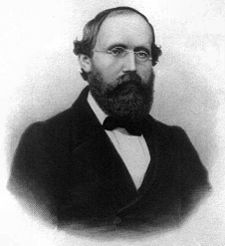 Bernhard Riemann
There is a famous open problem concerning the Riemann zeta function called the "Riemann Hypothesis": it conjectures that all nontrivial zeros of the Riemann zeta function have real part 1/2. This post will only mention it in passing without going into further detail; interested readers can refer to Wikipedia - Riemann zeta function and Wikipedia - Riemann Hypothesis. Although mathematicians generally regard the Riemann zeta function as belonging primarily to number theory, the "purest" of mathematical fields, it also turns up in applied statistics, in the mathematical theory of musical tuning, and even in the quantum chaos of theoretical physics!
Here we will focus only on the formal role of the zeta function. Do readers still remember the most primitive method for generating primes — the Sieve of Eratosthenes? Among the first n natural numbers, we cross out all multiples of every prime not exceeding $\sqrt{n}$ (except the prime itself), and what remains are exactly the primes. We will now treat the Riemann zeta function in a way analogous to the Sieve of Eratosthenes.
$$\xi (s)=1+\frac{1}{2^s}+\frac{1}{3^s}+\frac{1}{4^s}+\frac{1}{5^s}+\frac{1}{6^s}...$$
$$\frac{1}{2^s} \xi (s)=\frac{1}{2^s}+\frac{1}{4^s}+\frac{1}{6^s}+\frac{1}{8^s}+\frac{1}{10^s}+...$$
Subtracting the two:
$$(1-\frac{1}{2^s})\xi (s)=1+\frac{1}{3^s}+\frac{1}{5^s}+\frac{1}{7^s}+\frac{1}{9^s}...$$
In other words, all terms whose denominator is even have been removed. Doesn't this resemble the first step of the Sieve of Eratosthenes: removing all multiples of 2? Of course, the difference is that the Sieve of Eratosthenes does not remove 2 itself, whereas here 2 is removed as well. We then carry out the analogous procedure again:
$$\frac{1}{3^s}(1-\frac{1}{2^s})\xi (s)=\frac{1}{3^s}+\frac{1}{9^s}+\frac{1}{15^s}+\frac{1}{21^s}+\frac{1}{27^s}...$$
Subtracting gives:
$$(1-\frac{1}{3^s})(1-\frac{1}{2^s})\xi (s)=1+\frac{1}{5^s}+\frac{1}{7^s}+\frac{1}{11^s}+\frac{1}{13^s}...$$
Repeating this process up to some sufficiently large prime (say, 997), we obtain:
$$\begin{aligned}(1-\frac{1}{997^s})...(1-\frac{1}{5^s})(1-\frac{1}{3^s})(1-\frac{1}{2^s})\xi (s) \\ =1+\frac{1}{1009^s}+\frac{1}{1013^s}+\frac{1}{1019^s}+\frac{1}{1021^s}...\end{aligned}$$
If s is greater than 1, the right-hand side converges, and as the primes grow larger the right-hand side becomes smaller and smaller. This gives us good reason to believe in the existence of the following identity:
$$...(1-\frac{1}{p^s})...(1-\frac{1}{3^s})(1-\frac{1}{3^s})(1-\frac{1}{2^s})\xi (s)=1$$
where the left-hand side ranges over all primes. We can rewrite this as:
$$\xi (s)=(1-2^{-s})^{-1}(1-3^{-s})^{-1}(1-5^{-s})^{-1}(1-7^{-s})^{-1}(1-11^{-s})^{-1}...$$
or, in more formal notation:
$$\xi (s)=\prod_{p} (1-p^{-s})^{-1}$$
This reveals a relationship between the natural numbers and the primes, which in number theory is known as the "golden key" (it is in fact also called the Euler product formula, first obtained by Euler himself). Because of it, many doors in mathematics can be opened, especially connections between different branches of mathematics. In fact, we have already used part of it here. Using it, we can compute many otherwise-difficult results, such as the divergence of the sum of reciprocals of all primes, the probability that two arbitrary natural numbers are coprime, and so on...
References: A Love Affair with Primes
Translated automatically with claude-sonnet-5; all equations are reproduced verbatim from the source. Copyright remains with the original author.