[Euler Mathematics] The Face-Vertex-Edge Formula for Convex Polyhedra
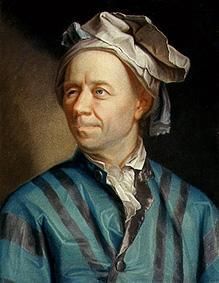 Leonhard Euler
As perhaps the most prolific mathematician in the history of mathematics (there is arguably no close second), Euler's research touched on nearly every field of mathematics, including number theory, graph theory, and calculus, while he was also a physicist: the calculus of variations that he and Lagrange pioneered lifted the study of classical mechanics to a new level. Euler possessed astonishing computational power and mathematical intuition, which proved enormously helpful to his mathematical research. Today, in many fields, we still see formulas and theorems named after Euler. Euler was extraordinarily prolific in mathematics, and arrived at a great many correct results, but quite a few of these conclusions stemmed purely from his mathematical intuition (creative thinking) and analogical reasoning. This was not because Euler didn't care about rigor, but because the mathematical knowledge of his time made rigorous treatment difficult. Moreover, the order of his research was: first find the answer, then prove it!
Furthermore, creative thinking is often a marvel to behold, and it can do much to sharpen our own thinking. Overemphasizing rigor and technical detail often gets in the way of arriving at the correct answer. As How to Solve It puts it: a rough but inspired idea can lead to a rigorous proof, while sometimes a rigorous proof completely dilutes the essence of the argument. So we need not worry about the lack of rigor in Euler's proofs — on the contrary, they offer a perfect feast for the eye and the mind. It is precisely for this reason that brilliant, non-rigorous mathematical arguments that are (to some extent) "incorrect" yet still arrive at correct results have come to be called "Euler mathematics." Indeed, anyone, and any line of research, must pass through this non-rigorous early stage of "Euler mathematics."
------------ Fancy divider ----------------
Below is a formula concerning the faces, vertices, and edges of a convex polyhedron. It belongs to the subject of topology, and we call it "Euler's formula." (Of course, the formula itself is Euler's; the derivation given here is merely a rough one I've put together.) more
Euler discovered that for any convex polyhedron, the number of vertices (v), edges (e), and faces (f) satisfy the following relation:
v − e + f = 2
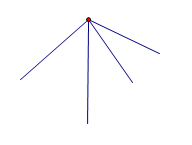 Euler's formula 1
Why should such a relation hold? (i) Let's first examine the simple case of a single point. As shown in the figure, from a point we can draw n rays, and these n rays partition the plane into n convex regions. Here v − e + f = 1 − n + n = 1 = constant, which hints that the v, e, f of an arbitrary polyhedron may satisfy a similarly invariant relation.
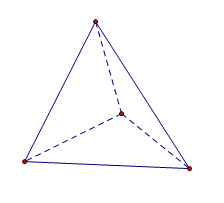 Euler's formula 2
Now let's examine an arbitrary tetrahedron. As shown in the figure, it's easy to check directly that for a tetrahedron, v − e + f = 2. In the plane, the triangle is the "building block" of all polygons (i.e., every polygon can be divided into a number of non-overlapping triangles — this is exactly the premise used to derive the formula for the sum of interior angles of a polygon); similarly, in space, the tetrahedron is the "building block" of all polyhedra (at least of convex polyhedra). Hence, for any n-hedron, we can decompose it into (n − 3) tetrahedra.
Now let's consider what happens when we reassemble these tetrahedral "fragments" back into the original n-hedron. Let's just consider the case of gluing two tetrahedra together: two separate tetrahedra necessarily have v − e + f = 4 each; and since the two tetrahedra must share one congruent face, when we "glue" these two faces together, we clearly lose 2 faces, 3 vertices, and 3 edges. Working this out, we get v − e + f = 4 − 2 + 3 − 3 = 2, so the relation is preserved. Of course, it may also happen that two lateral faces merge into a single face, in which case we additionally "lose" 1 face and 1 edge, and v − e + f = 2 still holds!
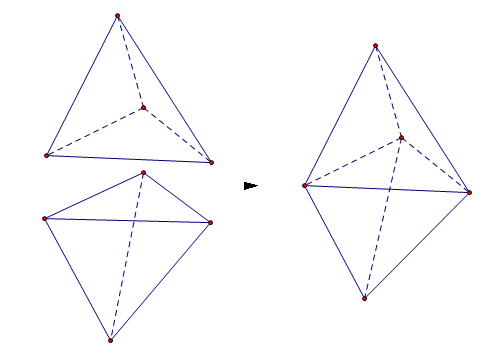 Euler's formula 3
So, continuing this gluing process step by step, the relation v − e + f = 2 remains invariant throughout, and therefore Euler's formula holds for any polyhedron!
------------ Fancy divider ----------------
**The above is a rough discussion of Euler's formula. Of course, it is merely a piece of mental gymnastics rather than a rigorous proof. But as noted at the beginning of this post, we should be more devoted to creative exploration than to dry, tedious detail. Because creativity is a kind of beauty, a stirring of the spirit, one that touches, from deep within, the heart that loves and explores mathematics. This is precisely the charm of "Euler mathematics"!
Translated automatically with claude-sonnet-5; all equations are reproduced verbatim from the source. Copyright remains with the original author.