Guangdong Preliminary Round of the Mathematics Competition: The Probability of Forming a Triangle
On September 3rd, BoJone and nine classmates went to Yunfu to take part in this year's Guangdong Province mathematics competition preliminary round. The scenes of us setting off together, joking around, fighting the exam side by side, and eating meals together are still vivid in my mind, and I find it hard to forget them even now. Indeed, the feeling of fighting shoulder to shoulder with others is truly wonderful! The results came out on the 9th, and unfortunately the policy changed this year — I was told that only three spots in the whole city could advance to the second round, and in the end I was the only one from Xinxing to make it through (the other two, I heard, were from Luoding; the three of us tied for first place). I found this a bit hard to accept — I suppose it's meant to weed out those who compete purely for personal gain...
This year's Guangdong preliminary questions were unprecedentedly easy, noticeably simpler both compared to other regions across the country and compared to last year's problems. Still, I didn't do as well as I'd hoped — by my own estimate, out of a 120-point paper I could get at most 68 points, so BoJone's basic skills are clearly nothing to boast about. After coming back from the exam in Yunfu, I discussed the problems with classmates who had taken the test with me, and we arrived at some very interesting results — the process was a lot of fun! Below are several brilliant solutions to the second-to-last problem on the preliminary exam, for everyone to enjoy. These solutions were worked out by myself and Wu Zeqi (nicknamed "Rabbit" or "Divine Rabbit" — a fitting name, as he's both gifted and endearing).
Problem:
Two points are chosen at random on a line segment, dividing it into three parts. Find the probability that these three parts can form a triangle.
The problem is easy to understand, and the answer is also simple: 1/4. The conventional approach to such problems is linear programming, but linear programming is fundamentally an algebraic idea, belonging to the realm of analytic geometry. The answer 1/4 is so clean that it even makes the linear-programming approach feel rather "ugly" by comparison — we felt we should look for a more concise and direct approach, one that leans closer to pure geometry. It was precisely this line of thinking that gave rise to the three solutions below.
I. The Circle and Symmetry Approach
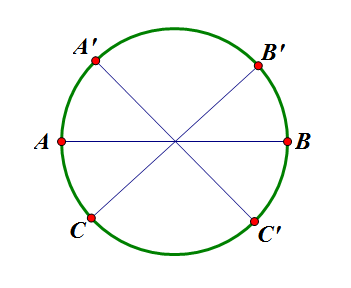 Circle-symmetry approach
Take the segment to be cut and join its two ends to form a circle. Let A be the joining point, and let the other two cut points be C and D. As long as A, C, and D do not all lie within the same semicircle, the circle can be "straightened out" into triangle ACD. In the figure, let AB be a diameter; then C and D must be separated by AB — the probability of this is 1/2 (the probability that C and D both lie below AB is 1/4, and likewise for above AB).
Choose any point C on the circle; then the region in which D may lie is the minor arc BB′, and correspondingly we can find another point C′ such that the region in which D may not lie is the minor arc AA′, where AC = BC′ and BB′ = AA′. Thus, within that 1/2 probability, the cases where a triangle can be formed and the cases where it cannot are in one-to-one correspondence, which shows that the two probabilities are equal — each accounting for half. Hence, the probability of forming a triangle is $P(\Delta)=1/2 \cdot 1/2 = 1/4$.
II. The Ellipse and Circle Approach
 Ellipse-circle approach
For a triangle with fixed perimeter, if two of its vertices are fixed, the locus traced out by the third vertex as it moves is an ellipse. Based on this principle, we draw two concentric circles, one with radius equal to the segment's length and the other with radius equal to half that length. Suppose segment AD is cut into three parts, AB, BC, and CD. Let segment AB coincide with the diameter MN, with its midpoint coinciding with O. Then only when point C lies inside the small circle can we find a corresponding segment AB that forms a triangle with a given perimeter (simply locate the appropriate ellipse); when C lies outside the small circle but inside the large circle, no such AB segment can be found to form a triangle of fixed perimeter. Hence the probability of forming a triangle equals S(small circle)/S(large circle) = 1/4.
III. The Triangular Coordinate System Approach
This idea of a triangular coordinate system is quite distinctive — and interestingly, its origin isn't mathematics at all, but geography. Indeed, the first time I encountered it was on a geography exam, in one of those diagrams depicting the proportions of children, working-age adults, and elderly people in a country or region's population. Those three proportions share one feature: they always sum to 1. And the triangle we're studying here has a similar property: the sum of its three sides is a fixed value. This gave me a bit of inspiration.
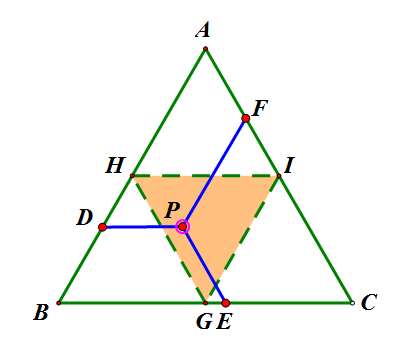 Triangular coordinate system approach
As shown in the figure, construct an equilateral triangle ABC with side length equal to the length of the segment, and mark points D, E, F as shown. Observe that PD + PE + PF = AB, and PD = AF, PF = CE, PE = BD. For these three lengths to form a triangle, it suffices that any two of them sum to more than the third — equivalently, each of them must be less than $1/2 AB$. From the figure, we can see that as soon as any one of AF, CE, or BD exceeds $AB/2$, point P must fall outside triangle GHI. Therefore, for a triangle to be formed, point P must lie inside triangle GHI, and so the probability of forming a triangle is:
$$P(\Delta)=\frac{S_{\Delta GHI}}{S_{\Delta ABC}}=1/4$$
That concludes the presentation of the solutions.
**The above are three solutions worked out by classmates in my class while discussing this problem. Each solution strives to stay as close as possible to pure geometry and to make the reasoning as transparent as possible — while appreciating the elegance and simplicity of mathematics, we also hoped to convey a sense of inevitability in the logic. Of course, this is merely the tip of the iceberg, and we hope that by offering these modest attempts, we might draw out better ideas from others. If any readers have better solutions, we'd love to hear them. With that, Scientific Spaces wishes everyone a happy Mid-Autumn Festival!
Translated automatically with claude-sonnet-5; all equations are reproduced verbatim from the source. Copyright remains with the original author.