Halving a Square with Triangles
I recall that back in my first year of middle school, I learned a method for drawing an ellipse from an art-student friend of mine: take a rectangle, mark the midpoints of a pair of adjacent sides, connect them, and cut off the resulting triangle; in the remaining pentagon, again take the midpoints of adjacent sides, connect them, and cut, obtaining a shape like the one shown below; then draw an arc that is as tangent as possible to AG, GH, HI, IJ in the figure below, and this arc is roughly a quarter of an ellipse.
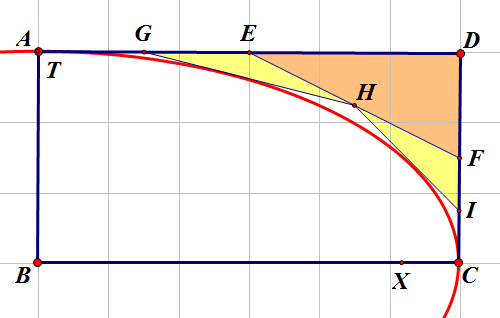 Artistic method for drawing an ellipse
more
I assumed that if you kept halving indefinitely, you would eventually get an exact ellipse. But I quickly overturned this conclusion — the reason is simple. Consider the figure below (a square with side length 1). If my conclusion were correct, this figure should converge to a quarter circle, whose arc length should converge to $\frac{\pi}{2}$. But if you compute using the Pythagorean theorem, you'll find that the sum of the side lengths of the cut-out polygon (excluding the two longest right-angle sides) quickly drops below $\frac{\pi}{2}$.
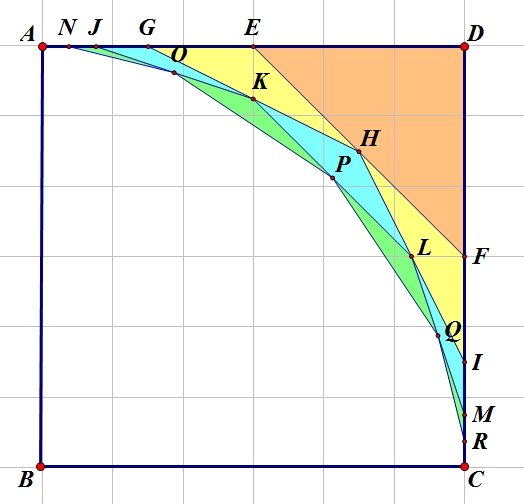 Halving a square with triangles
So what shape does this halving process converge to in the limit? I originally thought it would produce some interesting curve, but a few days ago, after doing the calculation, I found that it's not an exciting curve at all — the final result is — triangle ABC! Yes, this cutting method actually ends up removing half the square. (Fortunately my friend only carried out finitely many cutting steps.) Let's now try to prove this result.
Let's first look at how these points are distributed. Taking D as the origin, with A at (1,0) and C at (0,1), we can tabulate the following:
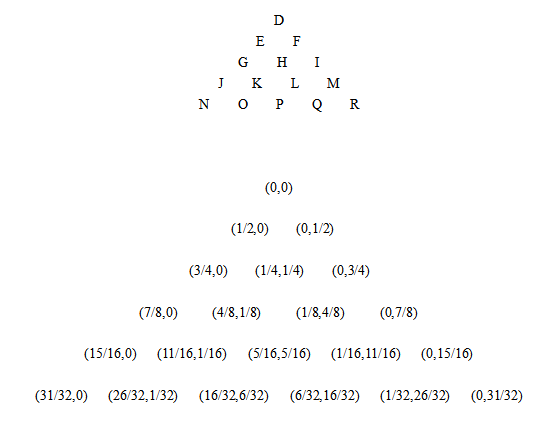 Pascal's-triangle-like array
This is an array resembling Pascal's triangle, where each coordinate is the average of the two adjacent coordinates above it, and the two ends take the form $(\frac{2^n-1}{2^n},0)$. To see the pattern more clearly, let's just look at the x-coordinates:
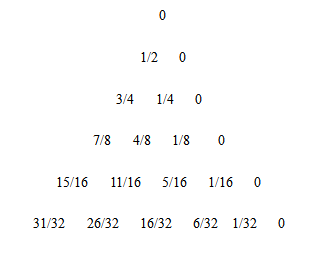 Pascal's-triangle-like array 2
It's not hard to see that the denominators of the numbers in row (n+1) are all $2^n$, and if you take the difference between the numerators of adjacent entries, you get exactly row n of Pascal's triangle. That is, the i-th number in row (n+1) is:
$$\frac{2^n-C_n^0-C_n^1-...C_n^{i-1}}{2^n}$$
To prove that the final curve tends to a straight line, we only need to show that the midpoint coordinates tend to $(1/2,1/2)$. To this end, consider row (2n+1), whose midpoint coordinate is (k,k), where
$$k=\frac{2^{2n}-C_{2n}^0-C_{2n}^1-...C_{2n}^n}{2^{2n}}$$
Using $C_{2n}^0+C_{2n}^1+C_{2n}^2+...+C_{2n}^{2n}=2^{2n}$, k can be rewritten as
$$k=\frac{2^{2n}-\frac{2^{2n}+C_{2n}^n}{2}}{2^{2n}}=1/2-\frac{C_{2n}^n}{2^{2n+1}}$$
The question now is whether $\frac{C_{2n}^n}{2^{2n+1}}$ tends to 0 as n tends to infinity. BoJone plugged n=50 into a scientific calculator at hand and got a result of 0.036..., which shows no sign of convergence — but the calculator's precision only goes up to n=50, so there was no choice but to find another approach. Since $C_{2n}^n=\frac{(2n)!}{(n!)^2}$, by Stirling's formula:
$$lim_{n\to \infty} \sqrt{2\pi n} (\frac{n}{e})^n //n! =1$$
Hence $(n!)^2=2\pi n (\frac{n}{e})^{2n},(2n)! =2\sqrt{\pi n} (\frac{2n}{e})^{2n}$, that is,
$$C_{2n}^n=2^{2n}\cdot \frac{1}{sqrt{\pi n}}$$
and finally we get: $lim_{n\to \infty} \frac{C_{2n}^n}{2^{2n+1}}=lim_{n\to \infty} \frac{1}{2 sqrt{\pi n}}=0$
Strictly speaking, using equal signs throughout the above derivation isn't quite rigorous. But since we're only interested in the limit, and limits are transitive, this presents no real problem. We have thus shown that the midpoints of the cut figure tend to $(1/2,1/2)$, meaning the end result is indeed a straight line!
Translated automatically with claude-sonnet-5; all equations are reproduced verbatim from the source. Copyright remains with the original author.