IMO 42-1 — I Can Do Geometry Too!
July has brought another round of "farming season" — back in the countryside it's rice-transplanting time, sowing the seedlings and waiting for the next harvest ^_^
I've always felt that my mathematical strengths lie more in analysis and computation than in geometry. Even when I run into a geometry problem, my head fills up with analytic-geometry approaches, lacking the elegance of pure synthetic geometry. These past few days, in an effort to sharpen my skills for math competition problems, I've been working through IMO problems, trying to solve some of them independently, but without much success. I'm particularly drawn to inequalities — I feel that if there's any type of problem that can be stated clearly with just a short expression and few words, it has to be an inequality. But IMO inequality problems are truly formidable, and I still haven't managed to solve one on my own (I can follow the reference solutions, I just can't come up with the ideas myself) — perhaps because I keep chasing a unified method instead of studying the specific tricks involved. Unexpectedly, today I took a look at a geometry problem from the 2001 IMO and realized I might actually be able to solve it. So I worked on it for a while, and in the end, luckily, I did. It's not the simplest method, but let me share it anyway.
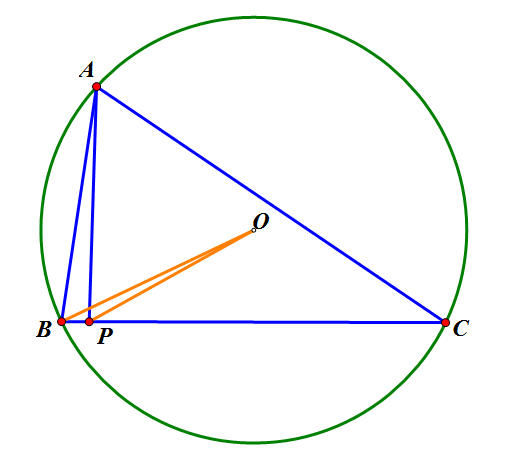 IMO-42-1
As shown in the figure, O is the circumcenter of acute triangle ABC, AP is the altitude of the triangle, and ∠B − ∠C is at least 30°. Prove that ∠BAC + ∠BOP < 90°.
The reason BoJone managed to solve this problem is really just that it isn't all that hard. My geometry skills are still stuck at the middle-school level, and my proof still leans heavily on analysis and computation. First, from "∠B − ∠C is at least 30°" we can deduce that ∠B > 60° and ∠A + ∠C < 120°; otherwise ∠C would end up being right or obtuse, which would contradict the problem statement.
Draw the auxiliary lines as in the figure below: OD perpendicular to BC, and connect O and C. Denote the three angles of the triangle directly as A, B, C.
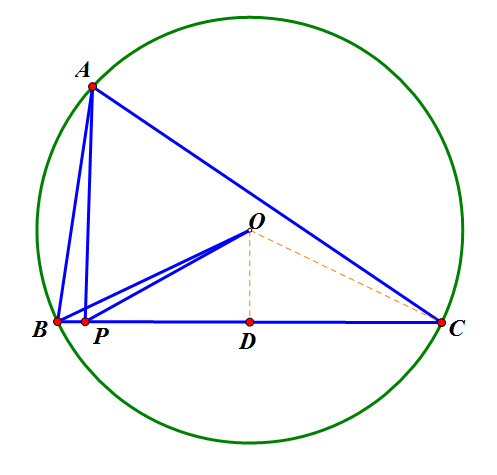 IMO-42-1-solution
Since a central angle is twice its corresponding inscribed angle, we get ∠BOC = 2∠A, and hence ∠A = ∠BOD. The problem asks us to prove ∠A + ∠BOP < 90°, i.e., ∠BOD + ∠BOP < 90°. Since ∠BOD + ∠OBD = 90°, this is equivalent to proving ∠BOP < ∠OBD, which in turn is equivalent to proving BP < OP, i.e., BP² < OP².
Let the sides opposite angles A, B, C be a, b, c respectively, and let R be the circumradius. It is easy to see that:
$$BP=c\cdot \cos B$$
By the law of cosines:
$$\begin{aligned}OP^2=BP^2+R^2-2R\cdot BP\cdot \cos \angle OBD \\ =BP^2+R^2-2R\cdot BP\cdot \sin \angle BOD=BP^2+R^2-2R\cdot c\cdot \cos B\cdot \sin A\end{aligned}$$
So the conclusion to be proved becomes: $R^2-2R*c*cosB*sin A > 0$, and by the law of sines we know: $2R*sin C=c$, so what ultimately needs to be proved is:
$$4\sin A\cdot \sin C\cdot \cos B < 1$$
By the product-to-sum formula: $sin C cos B=1/2 [sin(B+C)-sin(B-C)]$, and since B − C ≥ 30°, we have sin(B−C) ≥ 1/2.
Therefore:
$$\begin{aligned}4\sin A\cdot \sin C\cdot \cos B =2 \sin A [\sin(B+C)-\sin(B-C)] \\ < 2 \sin A (\sin A-1/2) \leq 2\cdot 1\cdot (1-1/2)=1\end{aligned}$$
This completes the proof.
The method of proof used in this post is like using a sledgehammer to crack a nut... it's just that BoJone's geometric intuition is really too weak to come up with a better proof.
Translated automatically with claude-sonnet-5; all equations are reproduced verbatim from the source. Copyright remains with the original author.