[Correction] An Elegant Proof of a Classic Inequality
In math competitions, many problems are specifically designed to test a particular trick — one that, to a large extent, isn't really "obvious," in the sense that it's hard to arrive at it through natural, step-by-step reasoning, or the method simply isn't systematic. This is actually one of the reasons I'm not especially fond of competition problems. On the other hand, I personally think that math competitions train one's thinking ability — especially abstract reasoning and geometric intuition — more effectively than physics competitions, so working through problems like this does have its benefits.
Below is a very classic competition problem, from the 42nd IMO held in Korea:
Let a, b, c be positive real numbers. Prove that:
$\frac{a}{\sqrt{a^2+8bc}}+ \frac{b}{\sqrt{b^2+8ac}} + \frac{c}{\sqrt{c^2+8ab}} \geq 1$
I've seen several different proofs of this problem. On page 376 of International Mathematical Olympiad, two different proofs are given, one of which goes as follows:
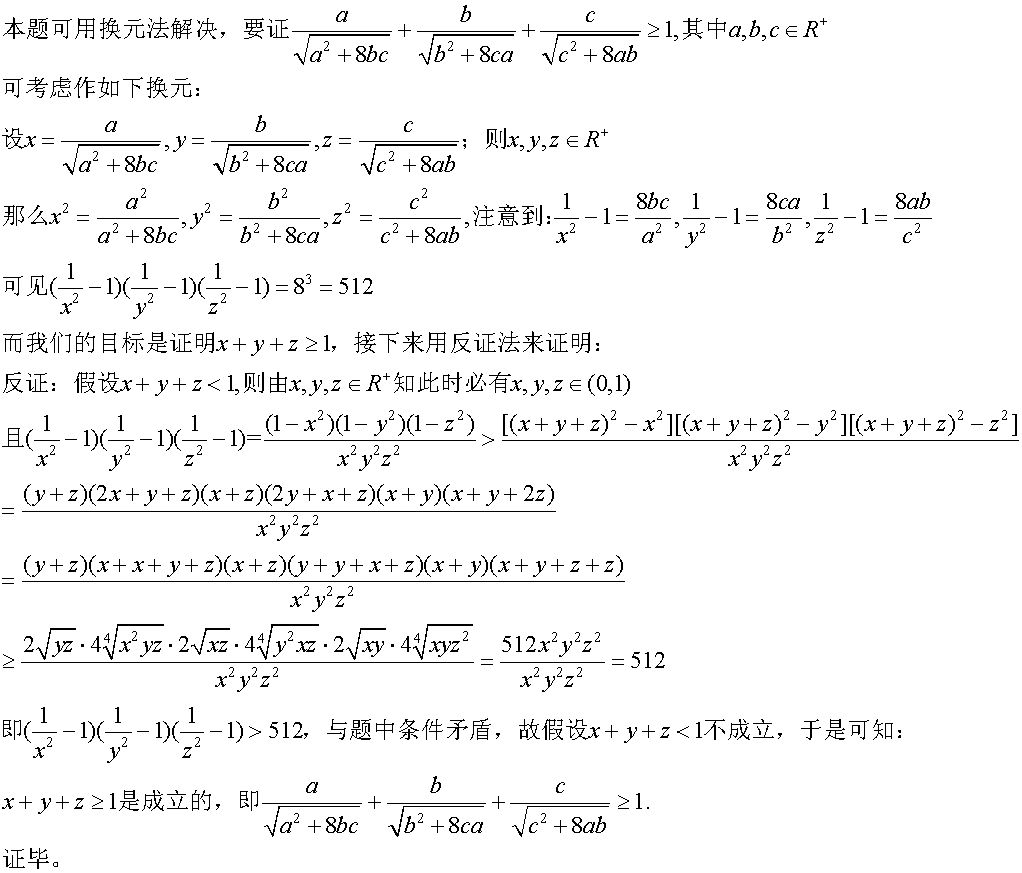 Classic Inequality — Proof
The other proof takes a different approach, but I still find it hard to see how one would think of it in the first place. Yesterday, while browsing 数联天地 (Mathematical Web), I came across a wonderful proof that follows a much more natural line of thought. The main tool it uses is Jensen's inequality:
If a function f(x) satisfies $f(a_1 x_1+a_2 x_2) \geq a_1 f(x_1)+a_2 f(x_2)$ over some interval, it is called a concave (upward-convex) function, or simply a convex function for short, where $a_1,a_2$ are nonnegative and $a_1+a_2=1$. Convexity can also be determined via the second derivative: if $f''(x) < 0$ holds on the interval, then the function is concave there. (If the inequality direction is reversed, the function is called convex downward, or simply concave.)
Jensen's inequality generalizes this relationship: if a function satisfies $f(a_1 x_1+a_2 x_2) \geq a_1 f(x_1)+a_2 f(x_2)$ for any nonnegative $a_1+a_2=1$, then for any nonnegative numbers $a_1,a_2,...,a_n$ satisfying $a_1+a_2+...+a_n=1$, we have
$f(a_1 x_1+a_2 x_2+...+a_n x_n) \geq a_1 f(x_1)+a_2 f(x_2)+...+a_n f(x_n)$
This is a powerful inequality — one can use it to derive almost all other inequalities, such as the AM–GM inequality, the Cauchy–Schwarz inequality, and so on. We'll skip its proof here; the most direct way is via Taylor series expansion, which can be found in online references. Let's return now to the problem at hand. Its proof involves several techniques commonly used in proving inequalities.
First, transforming the form, then uncovering the hidden condition.
Transforming the form:
$$\frac{1}{\sqrt{1+\frac{8bc}{a^2}}}+ \frac{1}{\sqrt{1+\frac{8ac}{b^2}}} + \frac{1}{\sqrt{1+\frac{8ab}{c^2}}} \geq 1$$
Uncovering the hidden condition:
Let $\frac{bc}{a^2}=x,\frac{ac}{b^2}=y,\frac{ab}{c^2}=z$, and the expression becomes
$$\frac{1}{\sqrt{1+8x}}+ \frac{1}{\sqrt{1+8y}} + \frac{1}{\sqrt{1+8z}} \geq 1$$
where the hidden condition is $xyz=1$.
The next step is truly ingenious! Since applying Jensen's inequality involves a sum, while the given condition is in the form of a product, we need to convert it into a sum — and the natural way to do that is via exponentiation: let $x=e^u,y=e^v,z=e^w$, so that the given condition becomes $u+v+w$. The problem now becomes
$$\frac{1}{\sqrt{1+8e^u}}+ \frac{1}{\sqrt{1+8e^v}} + \frac{1}{\sqrt{1+8e^w}} \geq 1$$
The most brilliant part of this substitution is that it not only performs a valid transformation, but also automatically incorporates the constraint already built into the problem: that x, y, z must all be positive!
From here, applying Jensen's inequality is straightforward:
$$\frac{1}{\sqrt{1+8e^u}}+ \frac{1}{\sqrt{1+8e^v}} + \frac{1}{\sqrt{1+8e^w}} \geq \frac{3}{\sqrt{1+8e^(\frac{u+v+w}{3})}} =1$$
(This is a concave function.)
The proof originally given in this post had a flaw: we cannot actually show that $\frac{1}{\sqrt{1+8e^x}}$ is concave over the whole of R. So the proof needs to be corrected as follows:
We still use Jensen's inequality, but apply it to the function $f(x)=\frac{1}{\sqrt{x}}$ instead. One can show that $f''(x) >0$ holds for all positive x, so Jensen's inequality can indeed be applied (this being the necessary premise).
It is not hard to derive:
$$\begin{aligned}(\frac{a}{a+b+c})\frac{1}{\sqrt{a^2+8bc}}+ (\frac{b}{a+b+c})\frac{1}{\sqrt{b^2+8ac}} + (\frac{c}{a+b+c})\frac{1}{\sqrt{c^2+8ab}} \\ \geq \frac{1}{\sqrt{(\frac{a}{a+b+c})(a^2+8bc)+(\frac{b}{a+b+c})(b^2+8ac)+(\frac{c}{a+b+c})(c^2+8ab)}} \\ =\sqrt{\frac{a+b+c}{a^3+b^3+c^3+24abc}}\end{aligned}$$
and hence:
$$\frac{a}{\sqrt{a^2+8bc}}+ \frac{b}{\sqrt{b^2+8ac}} + \frac{c}{\sqrt{c^2+8ab}} \geq \sqrt{\frac{(a+b+c)^3}{a^3+b^3+c^3+24abc}}$$
It remains only to prove $(a+b+c)^3 \geq a^3+b^3+c^3+24abc$, which follows readily from the AM–GM inequality; we omit the details here.
The above proof is adapted from American Mathematical Olympiad Students.
Translated automatically with claude-sonnet-5; all equations are reproduced verbatim from the source. Copyright remains with the original author.