The Optimal Shape Model for Mushrooms
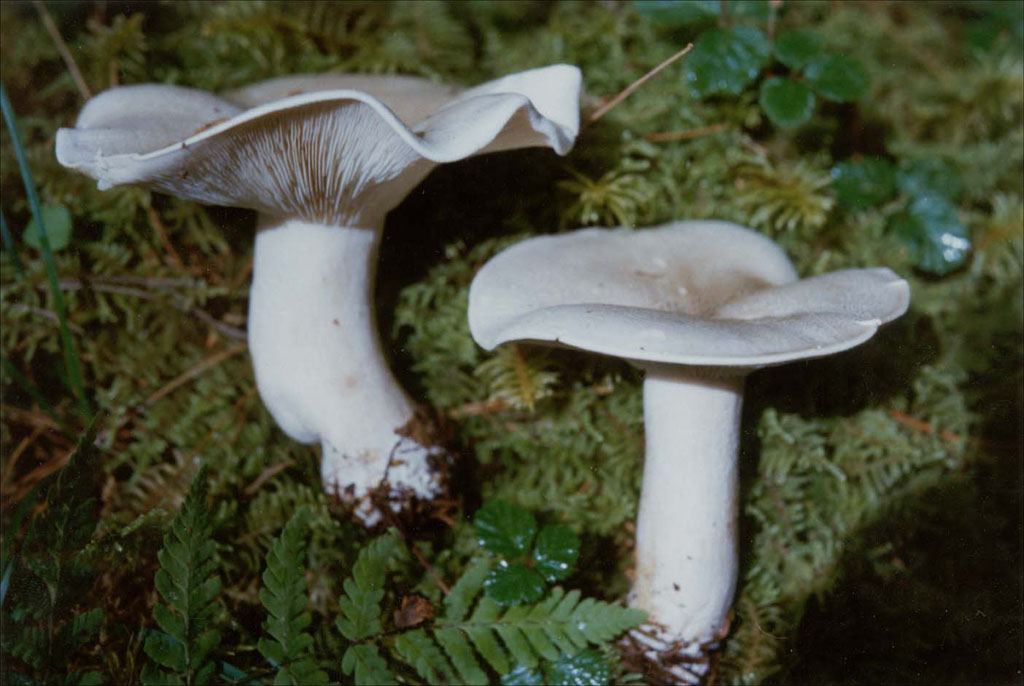 Pale Tricholoma
Darwin's theory of evolution tells us that nature is always selecting, from among a great many organisms, those species best able to adapt to their environment, giving them a higher chance of survival. Over long stretches of time, through this process of "survival of the fittest" spanning hundreds of millions of years, these species have evolved into today's astonishing variety of living things. Undoubtedly, through this prolonged process of selection, favorable shapes get accumulated—in other words, these species have, in certain respects related to environmental adaptability, already reached an optimal or near-optimal state (another extremal problem!). Now, let's turn to mushrooms.
Mushrooms are a type of fungus that generally grows in dark, damp environments. Naturally, a mushroom that loves moisture doesn't want to lose too much water, so it works hard to adjust its own shape so as to minimize its "water loss." Suppose the rate of water loss per unit area of the mushroom's surface is uniform; then the problem becomes one of minimizing the surface area of a solid with a given volume. And considering that growth is isotropic in the horizontal direction, the ideal mushroom shape ought to be a solid of revolution generated by some planar curve. So what is this solid of revolution? Clever readers might guess it's a sphere (or part of one)? more
Unfortunately, the answer is not a sphere. Let's analyze this problem—namely, which curve, when revolved, produces the solid of revolution with minimum surface area, given that the curve passes through $(x_1,y_1)$ and $(x_2,y_2)$.
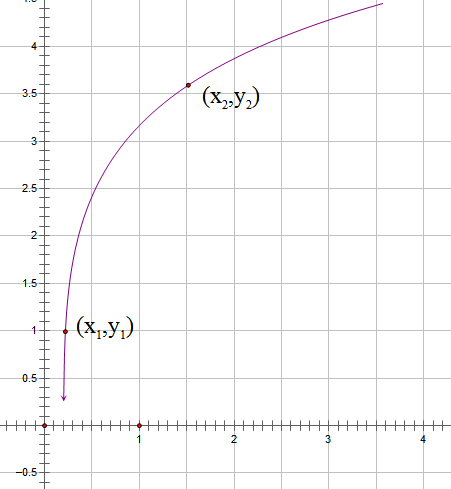 Curve of the solid of revolution
Suppose the curve $y=f(x)$ is known to satisfy the condition. Since the two end faces are both disks of known area, we only need to consider the lateral surface area. The formula for computing the lateral surface area of the solid of revolution is:
$$\begin{aligned}S=\int_{x_1}^{x_2} 2\pi x\sqrt{dx^2+dy^2} \\ =2\pi\int_{x_1}^{x_2} x\sqrt{1+\dot{y}^2}dx\end{aligned}$$
Here $\dot{y}=\frac{dy}{dx}$. The meaning of the expression above is that we divide the solid into infinitely many slices, treat each slice as a frustum of a cone, approximate it using the frustum's lateral surface area, and then sum them all up.
At this point, the problem becomes one of finding a function $y=f(x)$ that makes the integral $S=2\pi\int_{x_1}^{x_2} x\sqrt{1+\dot{y}^2}dx$ attain an extremum. By the Euler–Lagrange equation, we should have
$$\frac{d}{dx}\left(\frac{\partial \left(x\sqrt{1+\dot{y}^2}\right)}{\partial \dot{y}}\right)=\frac{\partial \left(x\sqrt{1+\dot{y}^2}\right)}{\partial y}=0$$
so we get $\frac{\partial (x\sqrt{1+\dot{y}^2})}{\partial \dot{y}}=\frac{x\dot{y}}{\sqrt{1+\dot{y}^2}}=C_1$, where C1 is a constant of integration. From this we can further derive
$$\dot{y}=C_1\sqrt{\frac{1}{x^2-C_1^2}}$$
At this point, integrating both sides gives: $y=C_1 ln\left|x+\sqrt{x^2-C_1^2}\right|+C_2$. Or, rewriting it using hyperbolic functions:
$$x=C_1 \cosh\left(\frac{y-C_2}{C_1}\right)$$
As we can see, this is not a circle. What shape is it, then? If we set $C_1=2,C_2=0$, we can use Geometer's Sketchpad to plot it:
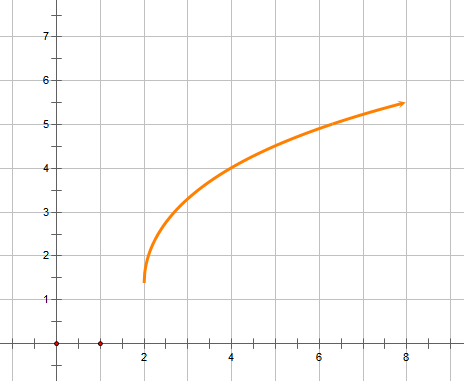 The mushroom's optimal curve
**Clearly, this shape is already fairly close to a real mushroom. What's more, the hyperbolic function involves that magical constant e, the base of the natural logarithm—which means that e, itself originating from nature, is also thoroughly embodied in nature! What a harmonious world this is!
Translated automatically with claude-sonnet-5; all equations are reproduced verbatim from the source. Copyright remains with the original author.