Calculus Study (Part 2): Derivatives
It's been quite a while since I last wrote about limits in calculus (roughly 20-odd days, I reckon). By way of background: I myself only started studying calculus systematically from late September this year, so it's been about a month so far. What I've covered includes: sets, functions, limits, derivatives, differentials, integrals — but all single-variable calculus for now. Multivariable calculus is currently being tackled with great intensity...
Let's now take a look at one of the most fundamental topics in calculus — the study of "derivatives."
Put in the simplest terms, if there exists a function $f(x)$, then its derivative (first-order derivative) is
$$\lim_{\Delta x->0} f'(x)=\frac{f(x+\Delta x)-f(x)}{\Delta x}$$
where
$$\lim_{\Delta x->-0} f'(x_0)=\frac{f(x_0+\Delta x)-f(x_0)}{\Delta x}$$
is called the "left derivative" of the function $f(x)$ at $x_0$, and
$$\lim_{\Delta x->+0} f'(x_0)=\frac{f(x_0+\Delta x)-f(x_0)}{\Delta x}$$
is called the "right derivative" of the function $f(x)$ at $x_0$.
Only when "left derivative = right derivative" can we say that the function $f(x)$ is "differentiable" at $x_0$.
Practical significance of the derivative (first-order derivative):
(1) Instantaneous velocity, instantaneous rate of change
If in a linear motion, the relationship between distance s and time t is given by $s=f(t)$, then the distance traveled between time t and time $(t+\Delta t)$ is $f(t+\Delta t)-f(t)$, and the average velocity over this time interval is $\frac{f(t+\Delta t)-f(t)}{\Delta t}$. Letting $\Delta t$ become as small as possible (i.e., $\Delta t->0$), the result obtained (i.e., $f'(x)$) is precisely the instantaneous velocity at time t.
(2) The slope of a tangent to a curve
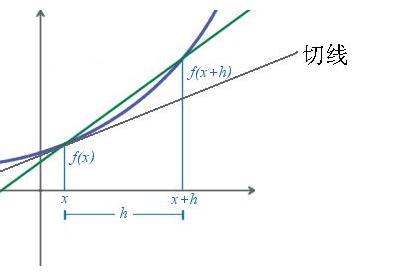
As shown in the figure, on the curve $f(x)$, the slope (i.e., the tangent value) of the line determined by point $(x,f(x))$ and point $(x+h,f(x+h))$ is
$$\frac{f(x+h)-f(x)}{h}$$
The smaller h is, the closer this line gets to the tangent line of the curve at x, and correspondingly, $\frac{f(x+h)-f(x)}{h}$ also gets closer to the slope of the tangent line. So, as $h->0$, this line approaches the tangent line indefinitely, and $\frac{f(x+h)-f(x)}{h}=f'(x)$ is precisely the slope of the tangent line to the curve $f(x)$ at x.
Methods for finding derivatives:
1. Basic differentiation formulas
http://web.nuist.edu.cn/courses/gdsx/calculus1/chap2/section2/2.2.4.1.HTM
Among these, I'd like to discuss the derivation process for a couple of the basic differentiation formulas.
1.1 $(a^x)'=a^x ln a(a>0,a!=1)$
$$(a^x)'=\lim_{\Delta x->0} \frac{a^{x+\Delta x}-a^x}{\Delta x}=a^x \lim_{\Delta x->0} \frac{a^{\Delta x}-1}{\Delta x}$$
Let $a^{\Delta x}-1=\beta<\Rightarrow a^{\Delta x}=\beta+1$; taking the logarithm of both sides gives $\Delta x=\frac{ln(\beta+1)}{ln a}$, so the original expression becomes
$$\begin{aligned}(a^x)'=a^x lim_{\beta->0} \frac{\beta ln a}{ln(1+\beta)} \\ =a^x ln a lim_{\beta->0} \frac{1}{\frac{1}{\beta}ln(1+\beta)} \\ =a^x ln a lim_{\beta->0} \frac{1}{ln(1+\beta)^{\frac{1}{\beta}}}\end{aligned}$$
Since $lim_{\beta->0} (1+\beta)^{\frac{1}{\beta}}=e$, we have $lim_{\beta->0} \frac{1}{ln(1+\beta)^{\frac{1}{\beta}}}=1$
That is, $(a^x)'=a^x ln a$.
1.2 $(log_a x)'=\frac{1}{x ln a}$
$$\begin{aligned}(log_a x)'=\lim_{\Delta x->0} \frac{log_a (x+\Delta x)-log_a x}{\Delta x} \\ =\lim_{\Delta x->0} \frac{log_a (1+\frac{\Delta x}{x})}{\Delta x} \\ =\lim_{\Delta x->0} log_a (1+\frac{1}{x}\cdot \Delta x)^{\frac{1}{\Delta x}} \\ =log_a e^{(1/x)}=\frac{log_a e}{x}\end{aligned}$$
Changing the base, we obtain $(log_a x)'=\frac{1}{x ln a}$
From the above, we can see that "differentiation" is in fact essentially a form of finding limits. If we derive the derivative starting from its most basic definition, we need to introduce a variable $\Delta x$ and let it tend to zero, while also working to transform the expression into a limit form we're familiar with (such as e). This requires us to be acquainted with some basic limit formulas.
Of course, this is far from sufficient. Since finding derivatives directly from the definition is extremely tedious, we must find some rules that make differentiation more convenient
I'll skip over the specific details here, since readers should already have a certain foundation in calculus — and I'd advise beginners not to dive straight into Wikipedia's calculus articles.
Also, everything we've discussed above concerns only "first-order derivatives." In fact, there are also "second-order derivatives," "n-th order derivatives," and so on. The definition is actually quite simple: the "derivative of the (n-1)-th order derivative" of a function is called its "n-th order derivative." The n-th order derivative of $f(x)$ is denoted $f^{(n)} (x)$.
Translated automatically with claude-sonnet-5; all equations are reproduced verbatim from the source. Copyright remains with the original author.