Curve Equation of a Three-Link Linkage Device
This clever device comes from zhangyf1997, a fellow enthusiast at the Mubufu Astronomy Forum.
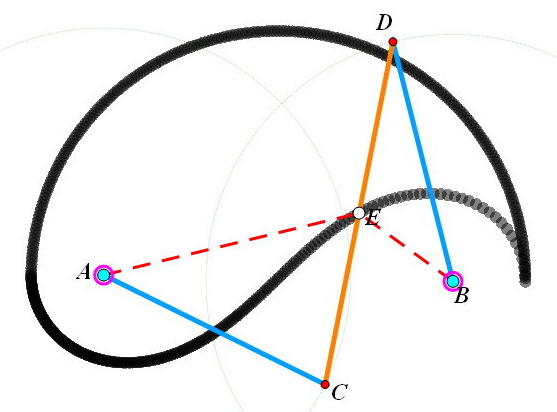 Three-link linkage device — "Fish"
Structure:
- A and B are two fixed points, which can be thought of as connected by a rigid rod;
- AC is the driving rod, rotating about point A;
- BD is the driven rod, and CD is the connecting rod.
Length data:
- CD = AB = $\sqrt{2}$;
- AC = BD = 1.
- E is the midpoint of CD.
Find: the trajectory equation of point E (i.e. the black curve in the figure — pretty interesting, right?) more
To find the curve equation for this problem, BoJone again turns to the vector method, but this time with a bit of a twist — using the "point-mass notation." In The Winding Vector Method, BoJone learned about something called "point-mass notation," which is really nothing mysterious or new. In my view, it's simply a convenient shorthand within the vector method: we write a vector $\vec{AB}$ as $B-A$ (the difference of two points), and we define $AB$ as the dot product of two vectors, $\vec{OA}\cdot \vec{OB}$. Everything else stays essentially the same. Just keep two things in mind during the calculation: 1) use clear notation to distinguish "points" from "numbers" so they don't get mixed up; 2) there is no division for vectors, so you can't casually cancel vectors from both sides of an equation.
Back to the problem at hand. Setting up a coordinate system with A as the origin and AB as the x-axis, we can write:
$$\begin{aligned}B=(\sqrt{2},0) \\ 2E=C+D\end{aligned}\tag{1}$$$$1=C^2=(D-B)^2=D^2+B^2-2DB\tag{2}$$$$2=B^2=(D-C)^2=D^2+C^2-2DC\tag{3}$$
From (1) we get $C=2E-D$, and squaring both sides gives
$$1=4E^2+D^2-4DE\tag{4}$$
Substituting $C=2E-D$ into (3) gives $$1=D^2-2D(2E-D)=3D^2-4ED\tag{5}$$.
Combining (4) and (5) gives $2E^2=D^2$; substituting this back into (5) gives $1=6E^2-4ED$, and substituting into (2) gives $2DB=1+2E^2$. At this point, the vector approach has done its job, and we can return to the coordinate system (the vectors have already helped us reduce the problem to a system of linear equations). Let $E=(x,y),D=(D_1,D_2)$, so that
$$\begin{aligned}6(x^2+y^2)-1=4D_1 x+4D_2 y \\ 1+2(x^2+y^2)=2\sqrt{2} D_1\end{aligned}$$
Solving this gives $D_1=\frac{1+2(x^2+y^2)}{2\sqrt{2}},D_2=\frac{6(x^2+y^2)-1-4D_1 x}{4y}$.
From $2E^2=D^2$ we get $2(x^2+y^2)=D_1^2+D_2^2$; substituting the $D_1,D_2$ solved above and simplifying yields the trajectory equation — an extremely tedious process...
$$2(x^2+y^2)=(\frac{1+2(x^2+y^2)}{2\sqrt{2}})^2+(\frac{6(x^2+y^2)-1-4(\frac{1+2(x^2+y^2)}{2\sqrt{2}}) x}{4y})^2$$
A relatively "simple" expanded form is:
$$\begin{aligned}8 x^6-24 \sqrt{2} x^5+24 x^4 y^2+44 x^4-48 \sqrt{2} x^3 y^2-8 \sqrt{2} x^3+24 x^2 y^4+56 x^2 y^2-10 x^2-24 \sqrt{2} x y^4-8 \sqrt{2} x y^2 \\ +2 \sqrt{2} x+8 y^6+12 y^4-10 y^2+1=0\end{aligned}$$
Who would have guessed it turns out to be a sextic curve! Still, it can be simplified a bit further — this curve is made up of two parts:
$$\begin{aligned}2y^2 +2 x^2= 2 \sqrt(2) x+1 \\ 4(y^2+x^2+1-\sqrt{2} x)^2=8 x^2-8 \sqrt{2} x+5\end{aligned}$$
Since the computation is so overwhelmingly complex, even someone like me who genuinely enjoys doing calculations by hand didn't have the heart to push through it manually — so all of these results were obtained using WolframAlpha.
If any readers know of a simpler method, please do let BoJone know.
Translated automatically with claude-sonnet-5; all equations are reproduced verbatim from the source. Copyright remains with the original author.