The "Extremes in Nature" Series — 4. The Fermat Point Problem
After all the discussion above, you may still not fully appreciate what's elegant about these two principles, or perhaps you're eager to apply them but don't yet know how. To avoid causing "aesthetic fatigue," let's try using these two principles to explore the Fermat point problem, and see exactly how the principles come into play. The key to applying them lies in finding the right transformation to connect the problem with optics or potential energy.
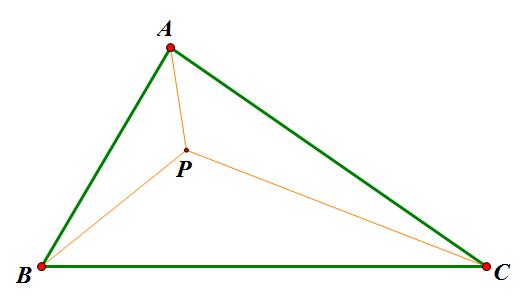 Fermat point problem
The classical Fermat point problem asks: in ΔABC, find the point P that minimizes $AP+BP+CP$; the generalized Fermat point problem instead asks for the point that minimizes $k_1 AP+k_2 BP+k_3 CP$. This has real practical significance—it's the kind of optimization problem behind questions like "how should a transfer station be built among three villages so that transportation costs are minimized?" We'll explore this problem from two angles: optics and potential energy. (Some readers may already have seen a solution using gravity, but I think the optical approach will still give you a fresh perspective.) more
I. Solving the Fermat Point via "Optics"
We notice that the quantity $kAP+mBP+nCP$ we're minimizing in the generalized Fermat point problem closely resembles $\frac{PO}{v_1}+\frac{QO}{v_2}$ from the law of refraction in form, which suggests we might apply the law of refraction. First, let's rewrite it as
$$\frac{AP}{(1/{k_1})}+\frac{BP}{(1/{k_2})}+\frac{CP}{(1/{k_3})},v_1=1/{k_1},v_2=1/{k_2},v_3=1/{k_3}$$
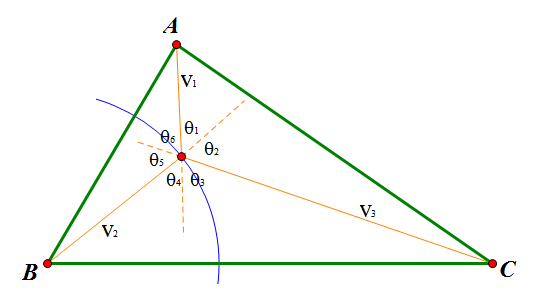
Fermat's principle concerns the extremum of a sum of two terms, whereas the Fermat point problem involves a sum of three. In order to apply Fermat's principle, we need to first "fix" one of the lengths. As shown in the figure below:
 Solving the Fermat point via "optics"
Suppose the length BP is given. Then we draw a circular arc with BP as its radius, and treat this arc as a special kind of mirror (one whose reflection changes the speed of light). Our problem then becomes: find the point P on the arc that minimizes $k_1 AP+k_3 CP$.
By Fermat's principle, we should choose the actual light path. This path is exactly the corollary of the "law of reflection-refraction" we derived earlier in the section on "Fermat's principle," namely by setting
$$\frac{\sin \theta_1}{v_1}=\frac{\sin\theta_2}{v_3}\Rightarrow k_1 \sin\theta_1=k_3 \sin\theta_2$$
We can set up the same construction using AP and CP in place of BP, giving
$$\begin{aligned}k_3 \sin\theta_3=k_2 \sin\theta_4 \\ k_2 \sin\theta_5=k_1 \sin\theta_6\end{aligned}$$
Using the facts that "vertical angles are equal" and "the sum of three adjacent angles is π," we obtain
$$\begin{aligned}\frac{\sin\theta_1}{k_3}=\frac{\sin\theta_5}{k_1};\frac{\sin\theta_3}{k_2}=\frac{\sin\theta_1}{k_3};\frac{\sin\theta_5}{k_1}=\frac{\sin\theta_3}{k_2} \\ \theta_1+\theta_3+\theta_5=\pi\end{aligned}$$
We can see that $\theta_1,\theta_3,\theta_5$ are precisely the three interior angles of the triangle whose opposite sides are $k_3,k_2,k_1$. At this point, BoJone considers the problem solved. The remaining details are left for readers to work out themselves (it wouldn't do to reveal all the mystery—that would make things far too dull).
II. Solving the Fermat Point via "Potential Energy"
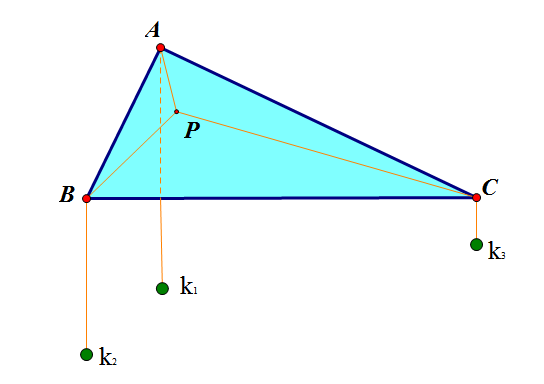
Imagine placing ΔABC horizontally at height h. Tie three ropes of length l together at one end, and attach a weight of mass $k_1,k_2,k_3$ to the other end of each. As shown in the figure, arrange things so that the ropes must pass through points A, B, and C respectively.
 Solving the Fermat point via "potential energy"
Under gravity, the system will tend toward an equilibrium state, i.e., a state of minimum potential energy, which requires minimizing $k_1 [h-(l-AP)]+k_2 [h-(l-BP)]+k_3 [h-(l-CP)]$ (the gravitational potential energy is $E_p=Gh$, where the terms in brackets are precisely the heights of each weight), which is equivalent to minimizing $k_1 AP+k_2 BP+k_3 CP$.
By the axiom of equilibrium states, once the system stabilizes, the forces on the knot where the three ropes meet must balance, i.e., the net external force there must be zero. This gives us the solution: it can be written either in the same form as in the "optical" solution, or, for computational convenience, as:
$k_1^2+k_2^2+2k_1 k_2 cos\angle APB=k_3^2$ (the parallelogram rule for forces)
The other two are analogous and won't be repeated here. So there we have it: two perspectives, two solutions, one problem. OK!
A bit more discussion:
Whether it's Fermat's principle or the axiom of equilibrium, both are physical extremum principles, and readers need to exercise their imagination to connect them with mathematical extremum problems. Of course, this method isn't a cure-all, since these principles were never designed for mathematical research in the first place. We study them in order to appreciate the beauty of science, to make our calculations and solutions easier, and in hopes of making some new discoveries along the way. Systematizing and refining this approach in full generality isn't our task here (though interested readers are welcome to take that on).
Here's an interesting problem for readers to ponder using these two principles:
Among all triangles inscribed in an acute triangle, find the one with the shortest perimeter.
Readers are welcome to think it over!
Translated automatically with claude-sonnet-5; all equations are reproduced verbatim from the source. Copyright remains with the original author.