"Extrema in Nature" Series — 2. Fermat's Principle
The beauty of physics isn't just found in elegant formulas. We also find, to our surprise, that many physical phenomena occur in a way that drives some quantity to an extremum. A classic example is Fermat's principle, which states an important rule governing the paths that light travels: light always travels along the path that takes the least time. Here we'll give a brief introduction to Fermat's principle.
Fermat's principle is popularly known as the "principle of fastest arrival" or the "principle of least time." In 1657, Fermat proposed:
Among all possible paths from point P to point Q, light chooses the one that requires the least time.
Among all possible paths from point P to point Q, light chooses the one for which the required time is an extremum.
This is an extraordinarily curious principle, and one of the most wondrous extrema found in nature. That light, a non-living thing, should autonomously "choose" the optimal path, becoming the most "efficient" thing in the world, cannot help but make one marvel at the grandeur of the universe. Was this the careful design of a creator, or simply happenstance? more
Fermat's principle manifests itself mainly in the following:
1. The speed of light is the fastest speed in the universe
2. Light travels in a straight line (in a homogeneous medium)
3. The law of reflection
4. The law of refraction (Snell's law)
Of these, (1) belongs to physics proper and we won't discuss it here; (2) and (3) are relatively familiar—nowadays even junior high school students have encountered them—so we won't go into detail on those either. We'll just say a little about (4), from which we can see that both (2) and (3) are actually consequences of (4).
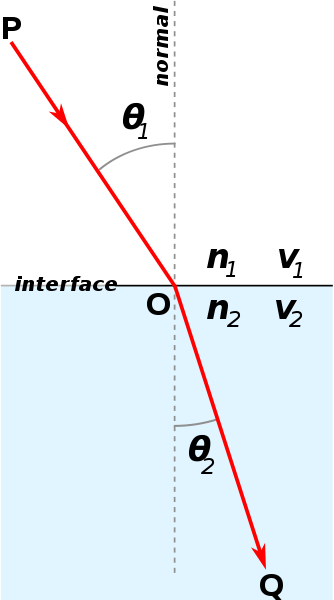 Snell's law
As shown in the figure, given a moving point O on a straight line interface, and two fixed points P and Q, the necessary and sufficient condition for minimizing $\frac{PO}{v_1}+\frac{QO}{v_2}$ is $\frac{v_1}{\sin\theta_1}=\frac{v_2}{\sin\theta_2}$.
Let us set $P=(x_1,y_1),Q=(x_2,y_2),O=(x,0)$, then
$$t=\frac{\sqrt{(x_1-x)^2+y_1^2}}{v_1}+\frac{\sqrt{(x_2-x)^2+y_2^2}}{v_2}$$
Differentiating this and setting it to zero gives
$$0=\frac{x-x_1}{v_1 \sqrt{(x_1-x)^2+y_1^2}}+\frac{x-x_2}{v_2 \sqrt{(x_2-x)^2+y_2^2}}$$
that is,
$$\frac{v_1}{\sin\theta_1}=\frac{v_2}{\sin\theta_2}$$
This completes the proof.
Note that in the above proof, we never required that P and Q lie on opposite sides of the interface, so the conclusion also holds when P and Q are on the same side. Perhaps the figure below can help you understand this better (by using mirror symmetry, the problem is turned into one of light refraction — doesn't this method feel a bit familiar?)
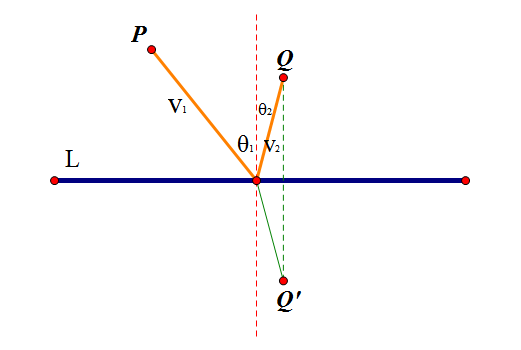 Corollary of the law of refraction
For convenience of reference, let's call the version of Snell's law where P and Q lie on the same side the "law of catadioptric reflection" for light. It's not hard to see that the rectilinear propagation of light and the law of reflection are simply special cases of $v_1=v_2$. It's worth noting that although we used the term "necessary and sufficient condition" above, that only applies to this particular special case; in more general situations, Fermat's principle is merely a "necessary condition." In this article, we've given a brief argument concerning the propagation of light and the fastest optical path, laying the groundwork for the applications to come. However, we won't jump straight into applications of optical principles next—instead, we'll shift our attention and focus on another kind of "extremum in nature," one that is related to many phenomena we encounter in everyday life...
Translated automatically with claude-sonnet-5; all equations are reproduced verbatim from the source. Copyright remains with the original author.