Police Chasing a Thief, Chasing a Cow, Missile Tracking
Wang Erxiao's cow ran off. When he noticed, the cow was 300 meters due south of him, running due west at a constant speed. Wang Erxiao immediately gave chase — not by heading in some fixed direction, but by running toward the cow's current position at every instant, at a speed 4/3 times that of the cow. How far did Wang Erxiao run in total by the time he caught up with the cow?
Problem Analysis
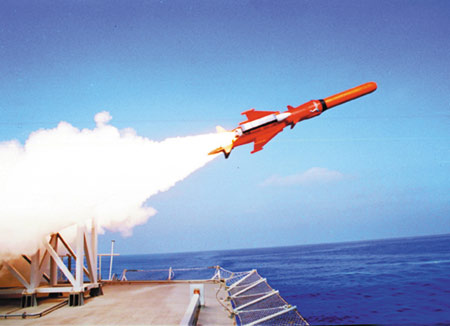 Malafon anti-submarine missile
At first glance, chasing a cow and tracking a missile seem to have nothing to do with each other: one is an everyday trifle, the other a physics problem — how could they possibly be connected?
Think back to how police normally catch a thief. Police aren't physicists; they neither will nor can first work out the function describing the thief's escape route and then design a path that minimizes the chase time. So, without being able to predict the thief's escape route in advance, how does the police catch the thief? Very simple: lock onto him! Indeed, as long as you run faster than him and always head straight toward him, you'll eventually catch up. Extending this line of thought: isn't tracking and destroying an enemy warship with a missile essentially the same idea? And looking back at the "cow-chasing problem" from the start of this article — isn't it fundamentally the same thing too? Below is a missile-tracking problem proposed by Shanghai Jiao Tong University: more
A missile base of a certain military discovers an enemy vessel 120 km due north, on the sea surface, traveling due east at 90 km/h. The base immediately launches a missile to track and pursue the enemy vessel. The missile travels at 450 km/h, and its automatic guidance system keeps it aimed at the enemy vessel at every instant. When and where does the missile hit the enemy vessel?
Set up a coordinate system:
 Missile tracking
Let the missile's speed be $u$ and the enemy vessel's speed be $v$. We can then write down
$$dx^2+dy^2=u^2 dt^2\tag{1}$$
$$\frac{dy}{dx}=\frac{H-y}{vt-x}\tag{2}$$
Feigning Retreat to Advance
The general strategy for solving a system of differential equations is: eliminate variables, then reduce the order. If you're not very familiar with differential equations, or you're just starting out, the step that probably comes to mind first is reducing the order, while skipping the elimination step first — leaving you stuck with nowhere to start. This is because our subconscious mind tells us that higher-order equations are always more troublesome than lower-order ones, so turning a low-order equation into a high-order one seems like asking for trouble. But that's not actually the case. In order to eliminate a variable, we need to "feign retreat in order to advance" — that is, raise the order!
We try to eliminate $t$, transforming $(2)$ into $\frac{dx}{dy}(H-y)=vt-x$. Differentiating both sides gives
$$d\left(\frac{dx}{dy}\right)(H-y)-\frac{dx}{dy}\cdot dy=v dt-dx\tag{3}$$
This is equivalent to $\frac{d\left(\frac{dx}{dy}\right)}{dy} \frac{dy}{dt}(H-y)=v$. From equation $(1)$ we can obtain
$$\frac{dy}{dt}=\frac{u}{\sqrt{\left(\frac{dx}{dy}\right)^2+1}}$$
Substituting this into the equation above gives
$$\frac{d\left(\frac{dx}{dy}\right)}{dy} \frac{u}{\sqrt{\left(\frac{dx}{dy}\right)^2+1}}(H-y)=v$$
Straight to the Heart of the Matter
Once the elimination is complete, what remains is to reduce the order, separate variables, and so on, in order to arrive at the final result. During elimination, it's also worth comparing which unknown, once eliminated, leaves the differential equation in a relatively simpler form. For instance, in the problem above, we arrived at an equation whose variables can be separated, which saved us a good deal of effort. Had we chosen to eliminate y instead, we would not have obtained a separable equation, and the computation would have been much more complicated.
Let $\frac{v}{u}=k$, and we obtain
$$\frac{d\left(\frac{dx}{dy}\right)}{\sqrt{\left(\frac{dx}{dy}\right)^2+1}}=\frac{k dy}{H-y}$$
Integrating both sides gives
$$\ln\left(\frac{dx}{dy}+\sqrt{\left(\frac{dx}{dy}\right)^2+1}\right)=-k \ln(H-y)+C$$
Substituting the initial condition $\frac{dx}{dy}=0,y=0$ gives $C=k \ln H$. Exponentiating each term, we get
$$\begin{aligned}&\frac{dx}{dy}+\sqrt{\left(\frac{dx}{dy}\right)^2+1}=(\frac{H}{H-y})^k \\ &\frac{dx}{dy}=\frac{1}{2}\left[\left(\frac{H}{H-y}\right)^k-\left(\frac{H}{H-y}\right)^{-k}\right] \\ &2dx=[(1-y/H)^{-k}-(1-y/H)^k]dy\end{aligned}$$
Integrating both sides, and substituting the initial value $x=0,y=0$, we obtain
$$x=\frac{1}{2} \left[-\frac{1}{-k+1}(1-y/H)^{-k+1}+\frac{1}{k+1}(1-y/H)^{k+1}\right]+\frac{kH}{1-k^2}$$
At this point, the problem is solved. The time required to destroy it is $T=\frac{Hu}{u^2-v^2}$.
But some friends may ask: what if the enemy vessel's speed and the missile's speed are not constants, but functions of $t$ — how should we solve this type of equation then? In this case, we can choose to eliminate $x$. First, let's agree that $\dot{x}$ denotes the derivative with respect to the independent variable $t$, namely $\frac{dx}{dt}$. Starting again from equation $(3)$, we change $\frac{dx}{dy}$ to $\frac{\dot{x}}{\dot{y}}$, solve for $\dot{x}=\sqrt{u^2-\dot{y}^2}$ from equation $(1)$, substitute it in, and eliminate variables. Anyone interested is welcome to work through the derivation themselves; here I'll just post BoJone's result:
$$\frac{u\dot{u}\dot{y}-u^2 \ddot{y}}{\dot{y}^2 \sqrt{u^2-\dot{y}^2}}=\frac{\dot{s}}{H-y}$$
Here, $s\equiv s(t)$ is the distance function of the pursuer, and the equation above is a second-order differential equation in terms of $y$ and $t$.
(Thanks to the Department of Mathematics, Shanghai Jiao Tong University; here's a download link for Shanghai Jiao Tong University's course materials: Missile Tracking (07.3).rar)
Translated automatically with claude-sonnet-5; all equations are reproduced verbatim from the source. Copyright remains with the original author.