The Ruler-and-Compass Construction of the Regular 17-gon
Why can the regular 17-gon be constructed with ruler and compass? And how is it done? Don't rush ahead — first take a look at the explanation below:
A regular polygon with a prime number of sides can be constructed with ruler and compass if and only if that number of sides is a Fermat prime. In other words, only the equilateral triangle, the regular pentagon, the regular 17-gon, the regular 257-gon, and the regular 65537-gon can be constructed with ruler and compass; no other regular prime polygon can be. (Unless we happen to discover another Fermat prime.)
The ruler-and-compass construction of the regular 17-gon was worked out by Gauss in 1796, and it was this discovery that made him resolve to become a mathematician. As for Fermat primes, these are primes of the form $2^{2^n}+1$. Fermat originally believed that numbers of this form were prime for every n. But, as if fate were playing a joke, so far it has only been confirmed that $2^{2^n}+1$ is prime for n = 0, 1, 2, 3, 4; all the others found so far are composite. more
Richelot gave a ruler-and-compass construction for the regular 257-gon, filling a full 80 pages. Hermes gave a construction for the regular 65537-gon, and the manuscript filled an entire suitcase — it is now kept at the University of Göttingen in Germany. This is, by all accounts, the most painstaking ruler-and-compass construction ever carried out.
Proving that the regular 17-gon can be constructed with ruler and compass is actually quite simple, because we have
$$\cos\frac{2\pi}{17}= \frac{-1+\sqrt{17}+\sqrt{34-2\sqrt{17}}+2\sqrt{17+3\sqrt{17}-\sqrt{34-2\sqrt{17}}-2\sqrt{34+2\sqrt{17}}}}{16}$$
The necessary and sufficient condition for a ruler-and-compass construction is: a length can be constructed with ruler and compass if and only if it can be obtained starting from 1 through a finite sequence of additions, subtractions, multiplications, divisions, and square-root extractions. And $\cos\frac{2\pi}{17}$ satisfies this condition, which is why the regular 17-gon can be constructed with ruler and compass. (As for $cos\frac{2\pi}{17}$, it can be derived through a series of trigonometric computations — readers are welcome to try it themselves; I haven't yet found a detailed derivation.)
Having said all that, let's get to the main point — here comes the method for the ruler-and-compass construction:
1. GIF version (this one seems a bit too complicated)
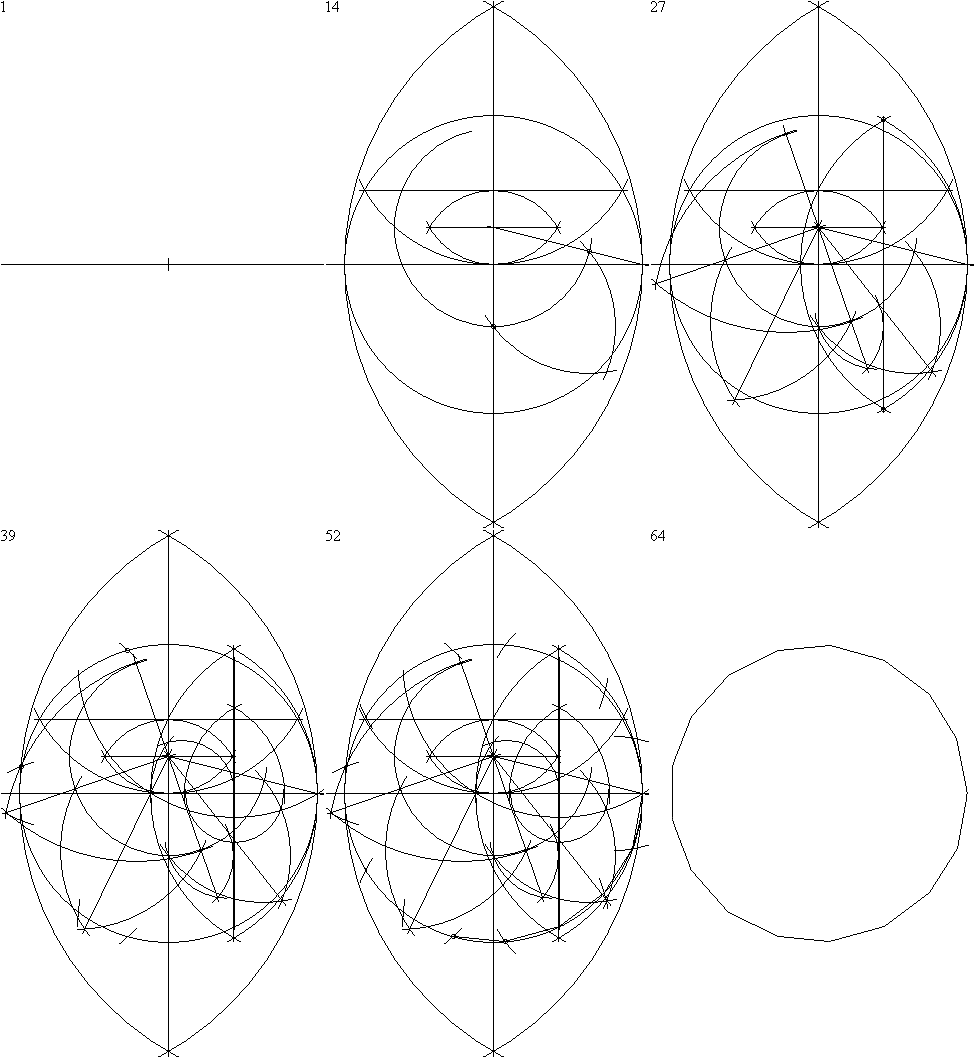
2. Flash (1)
**3. Flash (2)
Translated automatically with claude-sonnet-5; all equations are reproduced verbatim from the source. Copyright remains with the original author.