Some New Attempts at "Cool Papers + On-site Search"
In Cool Papers Update: A Simple On-site Retrieval System, we introduced Cool Papers's newly added on-site search system. The purpose of a search system, naturally, is to help users quickly find the papers they need. However, efficiently retrieving results of value to oneself is not a trivial matter—it often requires some tricks, such as precisely extracting keywords.
This is where algorithms show their worth: some steps are tedious to do by hand but quite simple to do with an algorithm. So next, we'll introduce a few new attempts at using algorithms to improve the efficiency of searching and filtering papers on Cool Papers.
Related Papers
The technology behind on-site search is a full-text search engine—in simple terms, a search algorithm based on keyword matching, whose similarity metric is BM25. more
Since keywords are the core of this, we can put some effort into that dimension. So, we extracted 10 keywords for each paper based on its title and abstract, serving as a compressed representation of that paper. The first use of these keywords is to feed them into the on-site search system in order to search for papers related to that one—this is the principle behind the new "[REL]" button that has been added to each paper.
![Newly added [REL] button](https://kexue.fm/usr/uploads/2024/08/4271789345.jpeg) Newly added [REL] button
Newly added [REL] button
Simple tests show that this approach does succeed in surfacing some genuinely related papers, though since the keyword extraction algorithm currently used is just TF-IDF, the results aren't perfect. For now we'll make do with this, leaving room for optimization down the line.
Historical Word Cloud
The second use of paper keywords is to aggregate all the keywords from papers a user has clicked on, forming a word cloud that serves as a description of the user's paper preferences. If you've been using Cool Papers to browse papers recently, this word cloud should already have taken some shape, since the word-cloud statistics were quietly rolled out a while back. You can now see it by clicking "More" at the bottom of the homepage (under the Track tab):
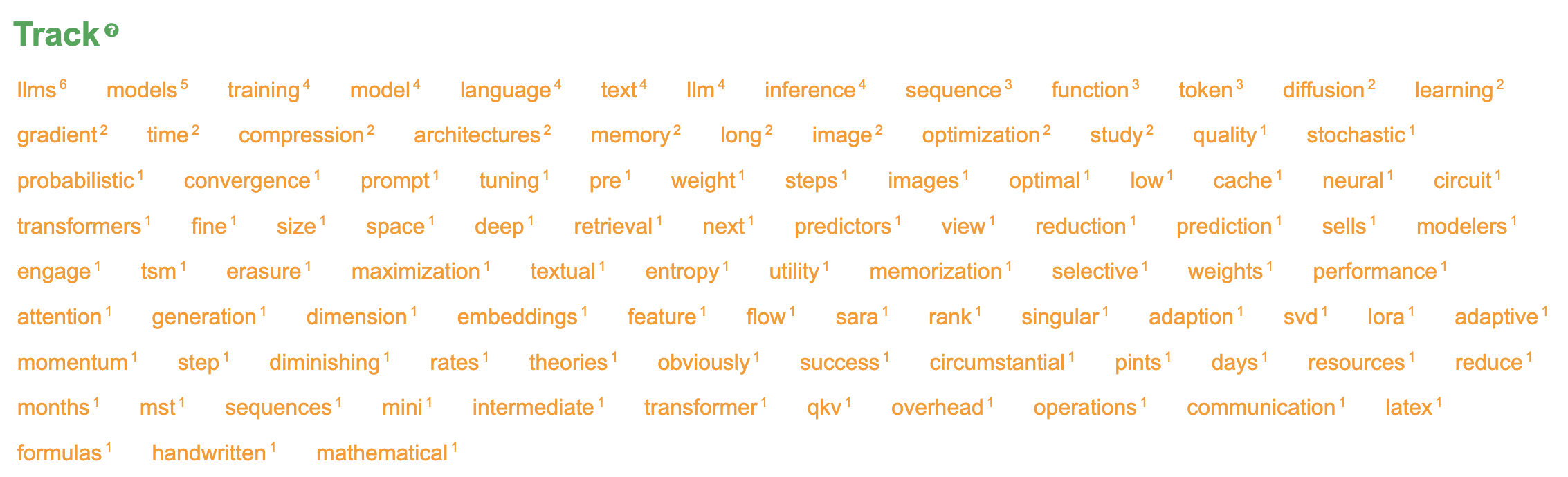 The author's reading word cloud
Beyond describing user preferences, word-cloud statistics may in the future also be used for things like customized paper recommendations—this will depend on further development, so stay tuned, and feel free to share suggestions.
Preference-based Sorting
As we've emphasized several times before, Cool Papers is mainly focused on "browsing papers," but the number of new papers added each day is still a bit much for some readers, who don't have the time or energy to go through the entire list. So previously we offered the option to sort by star count, letting readers choose to read only the relatively popular papers—those with more stars.
However, star count can only represent the collective preference of all readers; it doesn't necessarily match an individual reader's personal preferences. So this time, we've added personal preference-based sorting. Again, by clicking the "More" button on the homepage, you'll see a "Prefer" section, where you can set the keywords you want to follow. Leaving it blank is also fine—if left blank, the site will default to using the top 20 keywords from your historical word cloud as your preferences.
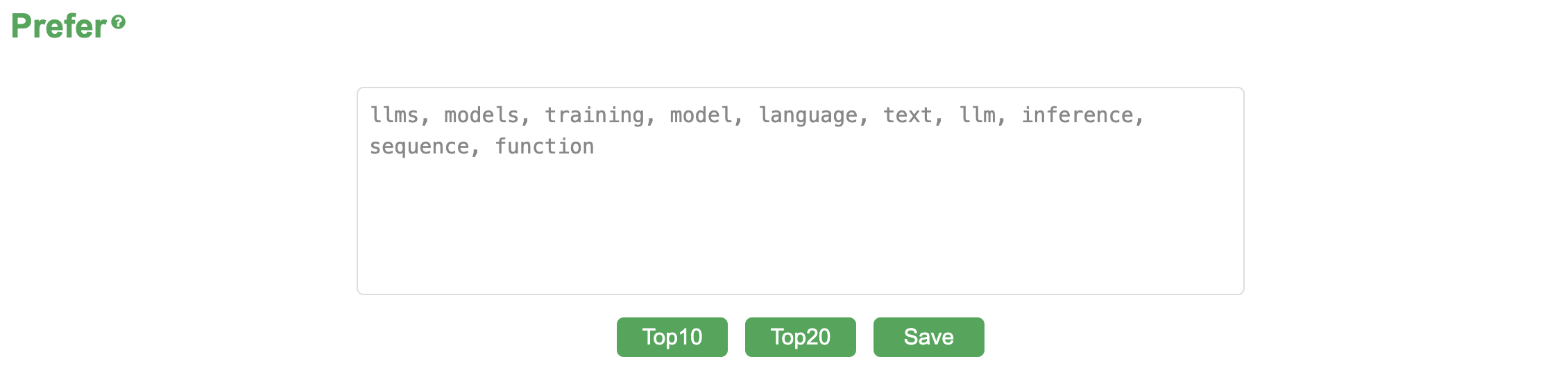 You can set preference keywords
After setting preference keywords, at the top of the list page you'll now see two symbols, "★" and "❤", which represent "sort by star count" and "sort by user preference" respectively—click either to trigger the sorting:
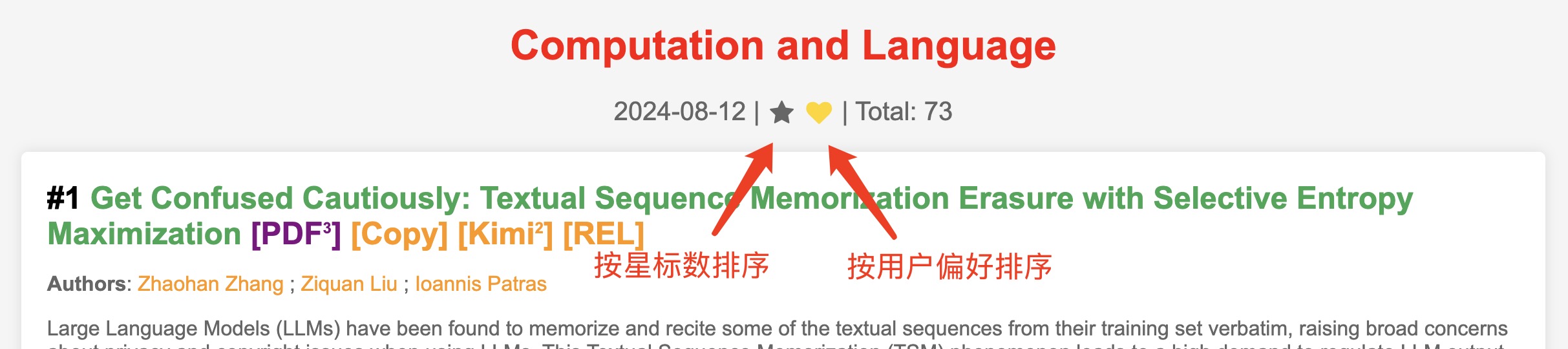 Two sorting methods
The principle behind this sorting is still based on the on-site search system: the user's preference keywords are used as the query, the search scope is restricted accordingly, and the search-ranked results are returned.
Summary
This article introduced several newly added features on Cool Papers, including related-paper search, word-cloud statistics, and user preference-based sorting, in the hope of improving everyone's paper-browsing efficiency. We should specifically note that the above user preference data and the like are all stored locally in the user's browser—Cool Papers does not collect this data.
Translated automatically with claude-sonnet-5; all equations are reproduced verbatim from the source. Copyright remains with the original author.